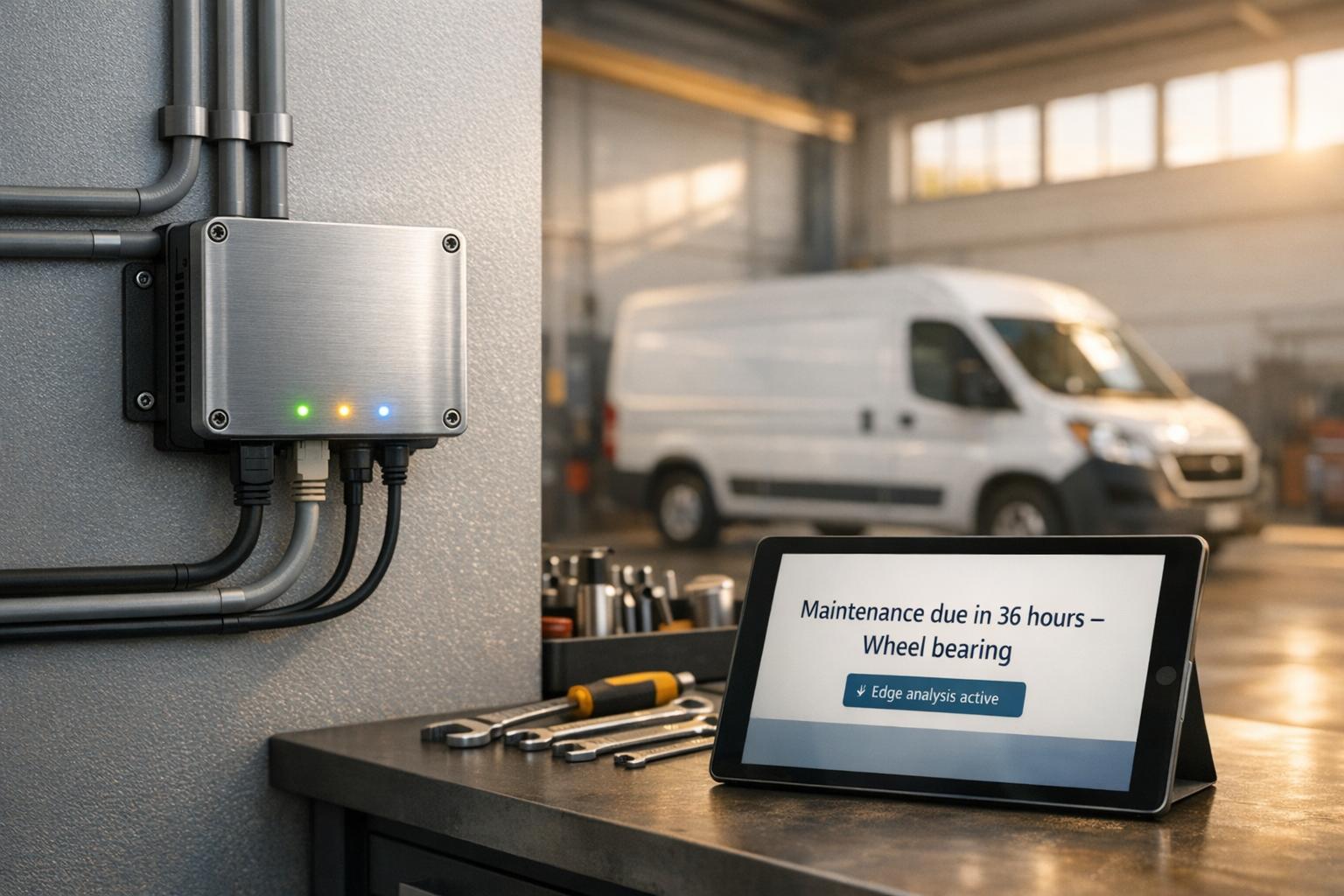
Best Practices for IoT Predictive Maintenance
UK fleet guide to using IoT sensors and machine learning to predict failures, reduce downtime and cut maintenance costs.
 By Michael Bar12 min read
IoT predictive maintenance helps UK fleet operators prevent costly breakdowns by using real-time sensor data and machine learning to predict issues before they happen. This approach reduces downtime, lowers maintenance costs, improves safety, and ensures compliance with regulations like the Road Traffic Act. Here's what you need to know:
- Cost Savings: Predictive maintenance can cut maintenance expenses by up to 35% and reduce breakdowns by 70%, saving fleets between £20,000 and £50,000 annually for 50 vehicles.
- Efficiency Gains: Fleets see 10–20% higher uptime and up to 25% better fuel efficiency.
- Key Metrics: Operators track engine temperature, tyre pressure, vibration patterns, and more to plan repairs and extend component life by 20–30%.
- Tools: IoT sensors, such as vibration, temperature, and pressure sensors, combined with telematics platforms like GRS Fleet Telematics, provide real-time data for actionable insights.
- Machine Learning Models: Techniques like regression, classification, and anomaly detection improve failure predictions, with examples showing up to 94% accuracy in forecasting component life.
Predictive maintenance requires upfront investment in IoT sensors and analytics, but the long-term savings and operational improvements make it a cost-effective choice for UK fleets. By focusing on high-quality data, reliable sensors, and robust analytics, businesses can cut downtime, improve compliance, and save money.
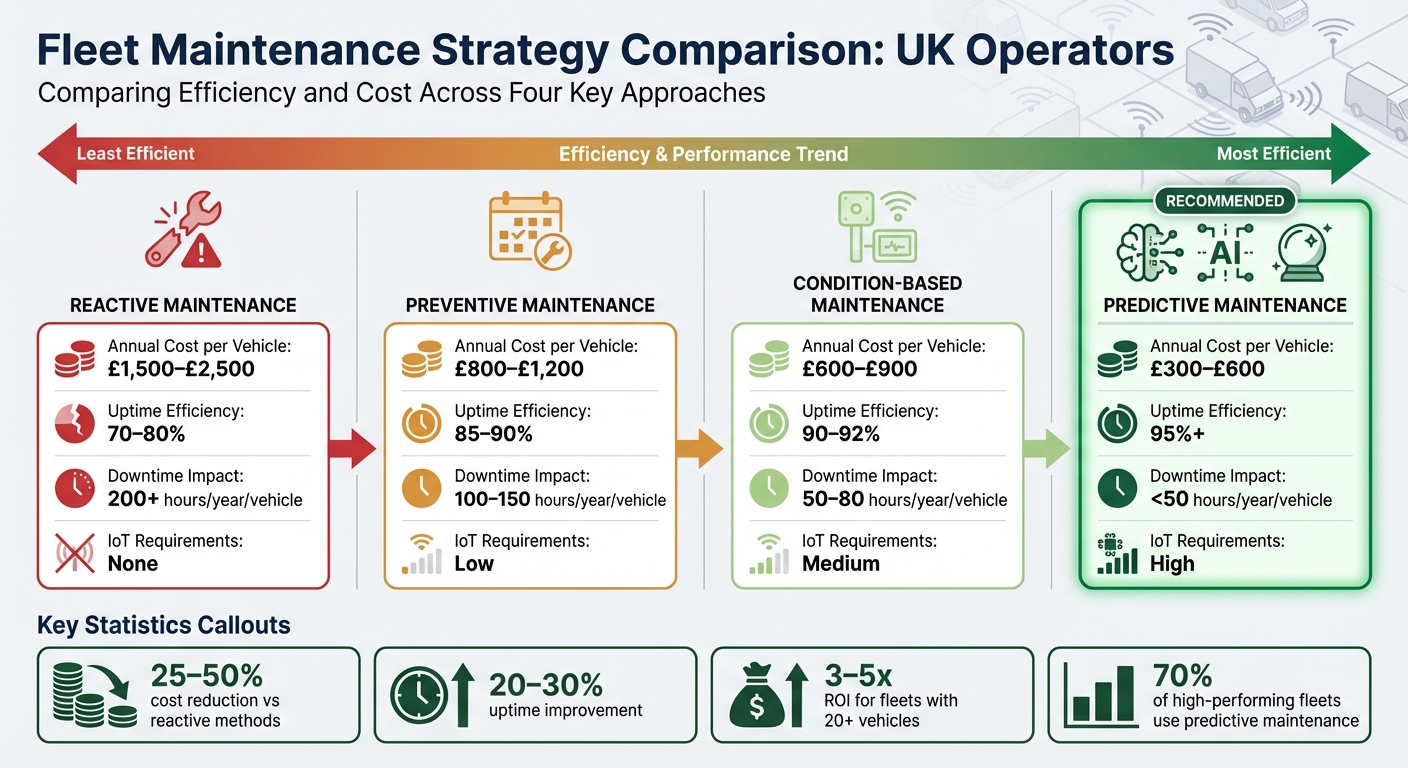
Fleet Maintenance Strategy Comparison: Costs, Uptime and ROI
Getting Ready for IoT Predictive Maintenance
Preparing your fleet data is essential for effective predictive maintenance. This process helps minimise unexpected breakdowns and ensures smoother operations.
Review Fleet and Equipment Performance Data
Start by compiling historical maintenance records, fuel receipts, and service invoices. Look for key metrics like mileage, engine hours, fuel consumption, and downtime events to uncover trends. For instance, a UK logistics company analysed two years of data and found that vans experienced 25% higher failure rates due to brake wear after 15,000 km. This insight allowed them to prioritise which vehicles needed IoT sensors first.
Focus on vehicles with a lower Mean Time Between Failures (MTBF) and those requiring frequent repairs. For example, if brakes on certain vans fail every 20,000 km or engines consistently overheat above 90°C, these vehicles should take priority. Organise this information in a structured table, including details like vehicle registration, last service date (DD/MM/YYYY), recurring issues, and repair costs (£). This clear format helps your team assign tasks efficiently and monitor progress.
Once you've reviewed your fleet data, the next step is ensuring its accuracy and readiness for integration.
Check Data Quality and Integration Options
After analysing performance data, it's crucial to confirm its accuracy and ensure it integrates seamlessly with your systems. Faulty or incomplete data can lead to costly errors. For example, gaps in records or confusion between imperial and metric units can trigger unnecessary repairs. Aim for a 95% data fill rate and remove anomalies, such as speeds recorded above 200 km/h. Cross-check sensor data against invoices to confirm accuracy, and make sure your records are no older than 12 months.
Plan the flow of data from IoT sensors to your van tracking solutions and analytics platforms. Use open standards like OBD-II for diagnostics and test APIs like MQTT to ensure real-time compatibility. Verify that your platform complies with UK data protection regulations (GDPR), supports metric units, and accommodates £ cost analyses. Document each step of the integration process to maintain consistency as your fleet expands.
Installing IoT Sensors and Fleet Telematics Systems
Once your fleet data is validated and integration options are sorted, it's time to install the right IoT sensors and telematics systems. The success of your predictive maintenance programme hinges on selecting and setting up these tools correctly.
Selecting IoT Sensors for Fleet Monitoring
The key to effective fleet monitoring lies in choosing sensors tailored to the failure modes identified during your data review. Here’s a breakdown of the most commonly used sensors:
- Vibration sensors: These detect issues like imbalances or bearing wear in engines and axles by capturing unusual movement patterns.
- Temperature sensors: Ideal for monitoring overheating in brakes, motors, and coolant lines.
- Pressure sensors: These help track hydraulic systems, tyres, and fuel lines, identifying potential leaks before they become a problem.
These sensors provide crucial data trends that flag anomalies early, cutting fleet downtime by as much as 50%.
To ensure durability and performance, opt for sensors with an IP67+ rating to handle the UK’s weather conditions, and prioritise wireless models with a battery life of over five years. Compatibility with low-power networks like LoRaWAN or NB-IoT is essential, along with seamless integration into your telematics platform via APIs. For accuracy and compliance, use devices certified for metric measurements (°C, kPa) and GDPR standards.
Placement matters too. Install vibration sensors on engine mounts, temperature sensors on brakes, and pressure sensors on fuel systems. Use non-invasive installation methods to avoid voiding warranties. Professional installation, including calibration and signal testing, typically takes 1–2 hours per vehicle. To maximise sensor uptime (99%), secure them in weatherproof enclosures (rated for -20°C to 60°C), use anti-vibration mounts, and position them away from exhaust heat.
Using GRS Fleet Telematics for Real-Time Data
After selecting robust sensors, GRS Fleet Telematics plays a critical role in capturing and analysing real-time data. This system collects sensor data through plug-and-play OBD-II or CAN bus interfaces, streaming it to a central dashboard for live monitoring. Metrics like location, speed, and sensor alerts are displayed, enabling geofenced maintenance triggers across UK routes.
Dual-tracker technology ensures consistent data flow by backing up GPS signals, which is crucial for accurate failure predictions. With pricing starting at £7.99 per month, GRS integrates sensor data to predict issues like tyre wear up to 500 km in advance.
For example, a Midlands-based logistics company outfitted 50 vans with GRS trackers and vibration and temperature sensors. Over 12 months, they cut unplanned breakdowns by 40% and slashed maintenance costs by 25%. Real-time alerts helped them avoid £15,000 in engine repairs during peak M6 traffic, delivering a return on investment within six months.
To monitor performance, track key metrics like sensor data accuracy (99%+), alert response times (under five minutes), and downtime reduction (aiming for 30–50%). The dashboard also provides insights into remaining useful life and failure probabilities, helping you stay ahead of maintenance needs.
Creating and Improving Predictive Maintenance Models
Once your IoT sensors and telematics systems start providing real-time data, the next step is to create analytics models that can reliably predict maintenance needs. These models take raw data from sensors and turn it into actionable insights, allowing you to schedule repairs before breakdowns occur.
Using Machine Learning for Predictive Analytics
Machine learning techniques used for predictive analytics generally fall into three categories:
- Regression models: These predict continuous values, like the remaining lifespan of a component or time-to-failure, by analysing historical sensor data trends.
- Classification models: These group vehicles into risk categories - such as high, medium, or low failure probability - based on patterns from past maintenance events. This helps prioritise which vehicles need immediate attention.
- Anomaly detection: This identifies unusual sensor readings that deviate from normal operating ranges, catching unexpected failures that don’t follow typical wear patterns.
A great example comes from DHL Supply Chain, which in 2022 used regression models powered by XGBoost algorithms across a fleet of 5,000 vans in the UK. By analysing vibration and temperature data from IoT sensors, Data Scientist Dr Elena Vasquez managed to cut breakdowns from 12% to 6.6% within a year, saving £4.2 million annually. The success came from combining regression for planned maintenance, classification to prioritise schedules, and anomaly detection for sudden issues.
However, the accuracy of these models depends heavily on data quality. Start by auditing your telematics data for missing values, inconsistent timestamps, and sensor calibration errors. Standardising formats across devices and normalising numerical values - like converting engine temperature to Celsius or oil pressure to bar - prevents bias in predictions. For UK-based operations, ensure your historical data covers 12–24 months to account for seasonal variations and multiple maintenance cycles. A common approach is to split data 70/30 for training and validation, then use metrics like Mean Absolute Error (MAE) for regression or the F1-score for classification to evaluate model performance. Regularly retraining models, ideally every month, helps to address concept drift as conditions in the field change.
With these models in place, you can move on to precisely estimating the remaining useful life of components.
Calculating Remaining Useful Life and Forecasting Failures
Estimating remaining useful life (RUL) involves combining historical wear data with current operating conditions to predict how long a component will last. For straightforward wear items, a linear degradation method works well. For example, if brake pads fail at 2 mm thickness, currently measure 8 mm, and wear down by 0.5 mm per 1,000 km, the RUL would be 12,000 km.
More complex wear patterns require advanced models. Exponential degradation models handle components that deteriorate faster over time, while proportional hazards models adjust RUL predictions based on operating conditions. For instance, a van used in stop-and-go urban traffic will have a different RUL compared to one primarily used on motorways. Thames Water demonstrated this in 2023 by using LSTM neural networks for predictive maintenance across 2,500 vehicles. They achieved 94% accuracy in forecasting pump failures, extending average asset life from 18 to 23 months. Engineer Mark Thompson credited this approach with preventing 1,200 breakdowns by integrating telematics data with time-series analysis.
For practical use, aim for high precision (over 85%) and recall (above 90%), while keeping MAE under seven days for predictions. Cost-effectiveness can be measured by comparing maintenance expenses against downtime avoided. For instance, in early 2024, National Grid implemented anomaly detection using isolation forest algorithms on 1,200 IoT-enabled service vans. This reduced unplanned downtime from 8.2 to 5.1 hours per vehicle annually. AI Lead Priya Singh’s system, which processed GPS and engine data in real time, saved £1.8 million. Additionally, continuous RUL updates from systems like GRS Fleet Telematics can predict failures 2–4 weeks in advance, ensuring parts are available and disruptions are minimised.
Monitoring and Improving Predictive Maintenance Systems
Once your predictive models are in place, it’s essential to keep a close eye on their performance and make regular updates to ensure they remain effective.
Monitoring Key Performance Indicators
Key performance indicators (KPIs) like Mean Time Between Failures (MTBF), Overall Equipment Effectiveness (OEE), and unplanned downtime are crucial for gauging system health. For example, aim for an MTBF of over 1,000 hours and an OEE of at least 85%. Automated dashboards, such as those available through GRS Fleet Telematics, can help by sending alerts when these metrics fall below acceptable thresholds. If your baseline MTBF is set at 1,200 hours, you can configure alerts to trigger if it drops below 960 hours.
Between 2021 and 2023, Rolls-Royce used Azure IoT to monitor the remaining useful life of its aircraft engine fleets, achieving a 38% increase in MTBF (from 4,200 to 5,800 hours) and 92% prediction accuracy for failures through continuous updates. Chief Engineer Dr David Smith led this initiative.
Reviewing KPIs weekly is a smart way to catch early warning signs. A sudden drop in OEE or a rise in unplanned downtime could mean your predictive models need retraining, or that sensors require recalibration. Additionally, performing quarterly audits of data quality and model performance helps ensure consistent accuracy in predictions.
By staying on top of KPI monitoring, you can maintain your system’s reliability and address potential issues before they escalate.
Applying Updates and Security Patches
After your KPI reviews, it’s important to apply software updates and security patches promptly. Regular updates can improve prediction accuracy by 15–25%, fix bugs in sensor data processing, and incorporate new data sources, such as weather APIs. These updates also help to prevent model drift and reduce false positives. Scheduling updates quarterly ensures your system stays aligned with current conditions.
Security patches are equally critical. With 70% of IoT predictive maintenance failures linked to unpatched vulnerabilities, staying on top of these updates is non-negotiable. The risks are real: in 2023, ransomware attacks on telematics systems caused significant financial losses for UK fleets. To avoid disruptions, schedule over-the-air (OTA) updates during off-peak hours, such as 02:00 GMT. Testing patches on a small segment of your fleet - around 10% - before wider deployment is a good practice. Automated systems with rollback options provide an extra layer of safety if any issues arise.
For even better accuracy, consider integrating new data sources regularly. Adding inputs like traffic camera feeds, EV battery monitoring, or road condition sensors can improve prediction accuracy by up to 30%. This is especially useful in the UK, where factors like frequent rainfall can accelerate tyre wear. Tools like GRS Fleet Telematics make API integration straightforward, ensuring your system continues to deliver strong returns on your investment.
Summary of Best Practices for Fleet Optimisation
Let’s recap the key practices for optimising fleet operations, focusing on how IoT predictive maintenance can transform performance and cut costs.
By adopting IoT predictive maintenance, fleets can significantly reduce downtime and maintenance expenses. For example, UK fleets have reported up to 50% less unplanned downtime and 10–40% lower maintenance costs compared to traditional methods. Early fault detection in engines and tyres alone can save logistics firms operating 50-vehicle fleets between £20,000 and £50,000 annually.
The foundation of success lies in data. Using high-quality data and strategically placed sensors, combined with machine learning models, allows fleets to calculate metrics like remaining useful life (RUL) and monitor key indicators such as mean time between failures (MTBF) and overall equipment effectiveness (OEE). These metrics improve with consistent monitoring and proactive measures. Don’t overlook the importance of regular security updates to protect your systems.
In Q1 2024, DHL UK introduced IoT predictive maintenance across 5,000 vans. Over six months, breakdown rates fell from 12% to 6.9%, saving £1.2 million annually and reducing downtime by 28%, according to Fleet Director Mark Evans.
For businesses in the UK, solutions like GRS Fleet Telematics offer affordable entry points at £7.99 per month, providing real-time data. Predictive maintenance can deliver a 3–5x return on investment (ROI) for fleets with over 20 vehicles. Deloitte reports that 70% of high-performing fleets have already adopted this approach, citing benefits like enhanced sustainability.
Maintenance Strategy Comparison: Reactive, Preventive, Condition-Based, and Predictive
Choosing the right maintenance strategy is crucial. Here’s a breakdown of how the most common approaches compare in terms of cost, efficiency, downtime, and IoT requirements:
| Maintenance Strategy | Cost (£/vehicle/year) | Efficiency (Uptime %) | Downtime Impact (hours/year/vehicle) | IoT Requirements |
|---|---|---|---|---|
| Reactive | £1,500–£2,500 | 70–80% | 200+ | None |
| Preventive | £800–£1,200 | 85–90% | 100–150 | Low |
| Condition-Based | £600–£900 | 90–92% | 50–80 | Medium |
| Predictive | £300–£600 | 95%+ | <50 | High |
Predictive maintenance stands out by cutting costs by 25–50% and improving uptime by 20–30% compared to reactive methods. While it requires an upfront investment in IoT sensors and analytics platforms, the long-term savings make it a smart choice. Many UK fleets using predictive strategies report 20–30% better fuel efficiency and 15–25% lower vehicle lifecycle costs, making it a practical solution for businesses navigating rising fuel prices and stricter regulations.
These comparisons highlight the value of IoT predictive maintenance for modern fleets, offering both cost efficiency and operational reliability in today’s challenging landscape.
FAQs
Which vehicles should be prioritised for predictive maintenance?
Prioritise vehicles that play a crucial role in your operations or are at a higher risk of breaking down. By doing this, you can reduce the chances of unexpected failures and keep your fleet running smoothly. Concentrating on these essential assets helps maintain reliability and efficiency throughout your operations.
How do I know my sensor and telematics data is accurate enough?
To make sure your sensor and telematics data delivers reliable results for predictive maintenance, prioritise data quality and ensure systems are properly calibrated. Gather enough data - typically over a period of 6 to 12 months - to train algorithms effectively. Tackle any data quality problems by following best practices for validation and management. Additionally, keep sensors calibrated regularly and check data consistency to uphold accuracy and dependability.
How quickly will IoT predictive maintenance pay for itself?
IoT predictive maintenance offers impressive financial benefits, often covering its initial costs in less than a year. By cutting expenses, minimising downtime, and boosting operational efficiency, businesses typically achieve an average return on investment (ROI) of 520%. It's a powerful approach for streamlining processes and improving overall performance.