
Driver Hours Rules: UK vs EU vs FMCSA
Straight comparison of UK, EU and US driver hours — limits, breaks, tachographs/ELDs and cross-border compliance.

Driver hours rules ensure road safety by limiting driving times and enforcing rest periods. These regulations differ significantly across the UK, EU, and the US (FMCSA). Here's a quick breakdown:
- UK Rules: Drivers can drive up to 9 hours daily (10 hours twice a week) and 56 hours weekly, with a 90-hour limit over two weeks. Breaks are required after 4.5 hours of driving. Tachographs are mandatory for recording hours.
- EU Rules: Similar to UK rules, with additional provisions like 45-hour weekly rest (reducible to 24 hours every other week) and specific multi-manning allowances.
- FMCSA Rules (US): Allows 11 hours of driving within a 14-hour work window, with a 60-hour (7 days) or 70-hour (8 days) weekly limit. A 34-hour reset restarts weekly limits, and breaks are required after 8 hours of driving.
Quick Comparison
| Feature | UK & EU Rules | Great Britain Domestic Rules | FMCSA (United States) |
|---|---|---|---|
| Daily Driving Limit | 9 hours (10h twice/week) | 10 hours | 11 hours |
| Weekly Driving Limit | 56 hours | N/A | 60h (7 days) / 70h (8 days) |
| Fortnightly Limit | 90 hours | N/A | N/A (Rolling window) |
| Break After Driving | 45 mins after 4.5h | 30 mins after 5.5h | 30 mins after 8h |
| Daily Rest | 11 hours (or 9h up to 3x/week) | 10 hours (or 8.5h up to 3x/week) | 10 hours |
| Weekly Rest / Reset | 45 hours (or 24h alternate weeks) | 24 hours per fortnight | 34-hour restart |
For fleet managers, cross-border operations demand strict compliance with local rules, accurate records, and proper van tracking solutions like tachographs or ELDs to avoid penalties. Smart tachographs, mandatory by 2026, and telematics systems can simplify compliance and improve efficiency. These systems are tailored to meet the specific needs of various industries.
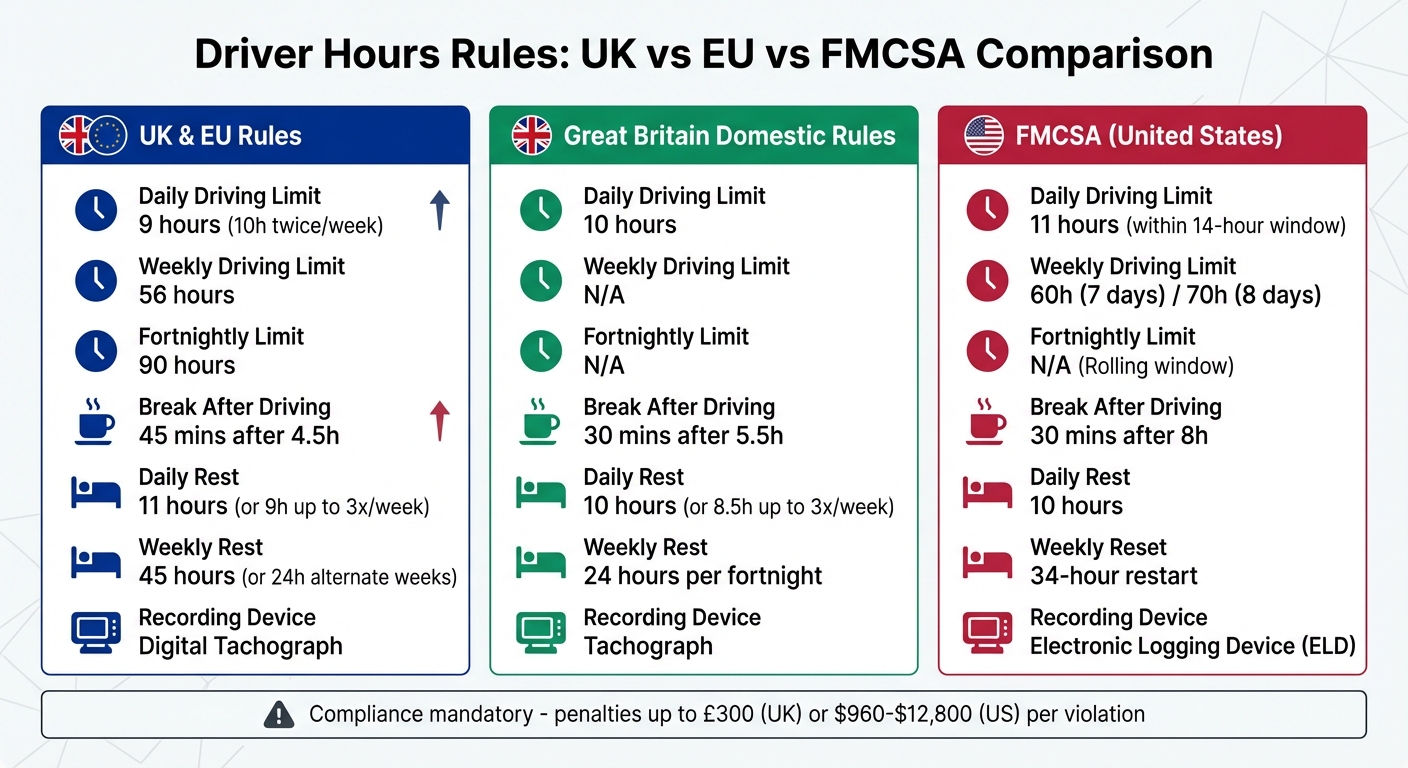
UK vs EU vs FMCSA Driver Hours Rules Comparison Chart
Hours of Service (HOS) Rules Explained for Commercial Drivers | DOT & ELD Training
sbb-itb-499a7f0
UK Driver Hours Rules
Since Brexit, the UK has adopted rules that closely mirror EU Regulation 561/2006. These rules apply to vehicles over 3.5 tonnes operating within the UK or travelling to, from, or through EU nations.
For drivers working exclusively within Great Britain, the GB Domestic Rules are in place. Under these, goods vehicle drivers may drive up to 10 hours a day within an 11-hour duty period, without specific weekly or fortnightly driving restrictions.
Daily Driving and Rest Requirements
Drivers are limited to a maximum of 9 hours of driving per day. This can be extended to 10 hours on two days within a fixed week (Monday 00:01 to Sunday 23:59). After a driving shift, a minimum daily rest of 11 hours is required, though this can be reduced to 9 hours up to three times between weekly rest periods. Alternatively, the daily rest can be split into two periods - one lasting at least 3 hours and the other at least 9 hours - totalling 12 hours.
Weekly and Fortnightly Limits
The weekly driving limit is capped at 56 hours, which can be achieved through a mix of four 9-hour and two 10-hour driving days. Over any two consecutive fixed weeks, drivers must not exceed 90 hours of driving. This means that if a driver reaches the 56-hour limit in one week, they are restricted to 34 hours the following week to reduce the risk of fatigue.
To ensure compliance, DVSA traffic examiners and police review driving records for the current day and the previous 28 days during roadside checks. Penalties for violations can reach up to £300 per offence, and repeated or serious breaches may result in the suspension of both the driver’s vocational licence and the operator’s licence.
In addition to these limits, there are strict rules around breaks and tachograph use.
Break Rules and Tachograph Requirements
Drivers must take a 45-minute break after a maximum of 4.5 hours of driving. This break can be split into two parts: the first lasting at least 15 minutes, and the second at least 30 minutes. However, splits like 20 and 25 minutes are not compliant.
All driving under these rules must be recorded using a digital tachograph. For international transport, vehicles must be equipped with 'Smart 2' tachographs. Drivers on international trips are required to maintain full daily records for the past 28 days, even for days without regulated driving. Any non-driving activities, such as loading or unloading, must be recorded as 'other work' using the tachograph's manual input function. Additionally, when vehicles are transported by ferry or train, the tachograph’s 'ferry/train' mode must be activated to correctly log rest periods.
In emergency situations, such as severe weather or accidents, drivers are allowed to deviate from these rules to reach a safe stopping point. However, they must immediately record the reason for the deviation on a tachograph printout.
EU Driver Hours Rules
EU Regulation 561/2006 sets out the rules for commercial driver hours across the EU. These rules apply to all drivers operating vehicles over 3.5 tonnes.
Driving Time Limits
Drivers are allowed to drive for up to 9 hours per day. This can be increased to 10 hours, but only twice a week. Weekly driving is capped at 56 hours, and over a two-week period, the total driving time must not exceed 90 hours. If a driver hits the 56-hour weekly limit, the following week is restricted to 34 hours of driving.
There are some exceptions to these limits. Drivers can exceed the daily and weekly limits by up to one hour when travelling to start a weekly rest period, or by two hours when heading towards a regular weekly rest period. Additionally, coach drivers on a single international trip can delay their weekly rest period for up to 12 days.
Rest and Break Requirements
After driving for 4.5 hours, drivers must take a 45-minute break. This break can be split into two parts: one lasting at least 15 minutes and the other 30 minutes. Daily rest periods are set at 11 hours, though this can be reduced to 9 hours up to three times between two weekly rest periods. Alternatively, the daily rest can be split into a 3-hour period followed by a 9-hour period, totalling 12 hours.
Weekly rest is generally 45 continuous hours. However, every second week, this can be reduced to 24 hours, provided the reduced rest is compensated with an equivalent rest period taken in one block before the end of the third week. Any weekly rest period longer than 45 hours cannot be taken in the vehicle cabin. Employers must provide and cover the cost of proper accommodation with suitable sleeping and sanitary facilities.
Tachograph records play a key role in compliance. Driver cards must be downloaded at least every 28 days, and vehicle unit data must be downloaded every 90 days. These records must be kept for at least one year and made available to authorities upon request.
Multi-Manning and Night Work Provisions
In multi-manning operations - where two drivers share responsibility for a vehicle - the standard 24-hour period is extended to 30 hours. This allows a combined driving time of 18 to 20 hours within a single cycle. To qualify as multi-manning, the second driver must join within the first hour of the initial driving period.
"In multi-manning, the 24-hour period is extended to 30 hours." – TachoTools
During this 30-hour period, each driver must take at least 9 consecutive hours of daily rest. A key benefit of multi-manning is that the 45-minute break can be taken while the vehicle is moving. Time spent in the passenger seat counts as "Availability" and fulfils the break requirement, provided the second driver is not assisting.
Smart Tachograph V2 technology, which will be mandatory by 2026, ensures accuracy in multi-manning scenarios. It cross-references data from both drivers' cards and flags errors, such as one driver recording "Availability" while the other's card is not inserted.
Fleet managers must carefully plan schedules and use van tracker systems to ensure compliance with these rules. Employers are also prohibited from paying drivers based on distance or goods carried if such payment methods encourage rule violations. Penalties for breaking these regulations include fines, licence suspensions, operating licence revocations, and, in severe cases, imprisonment - particularly if accidents occur.
These rules highlight how EU regulations adapt to modern driving practices, helping fleet managers navigate compliance across borders while aligning with UK and FMCSA standards.
FMCSA Driver Hours Rules
The Federal Motor Carrier Safety Administration (FMCSA) oversees driving hours for commercial drivers in the US. Many fleets manage these requirements using white-label van tracking solutions to ensure real-time compliance and security. These rules differ significantly from those in the UK and EU, particularly in how they structure daily work periods and rest requirements.
Daily Driving and Duty Limits
For property-carrying drivers, the FMCSA allows up to 11 hours of driving within a 14-hour work window, provided the driver has had at least 10 hours off duty beforehand. Passenger-carrying drivers, on the other hand, are limited to 10 hours of driving within a 15-hour work window, following a minimum of 8 hours off duty.
Additionally, property drivers must take a 30-minute break after accumulating 8 hours of driving. This break can be fulfilled by any non-driving activity, such as resting or performing other duties.
Weekly Limits and Reset Provisions
Drivers are restricted from driving after reaching 60 hours on duty over 7 consecutive days or 70 hours over 8 consecutive days. These limits include all on-duty activities, not just driving. Most long-haul operations typically follow the 70-hour/8-day cycle.
To reset these limits, drivers can take 34 consecutive hours off duty, which effectively restarts the weekly clock. Without this reset, the hours worked on the oldest day in the cycle drop off as each new day begins, creating a rolling limit. Violations of these rules can result in fines ranging from £960 to £12,800 per offence. Drivers in violation may also be taken out of service during roadside inspections until they accrue enough off-duty time.
In addition to these limits, FMCSA provides flexibility for rest periods through sleeper berth rules.
Rest and Sleeper Berth Rules
Property drivers are required to take 10 hours off duty before they can resume driving. However, the FMCSA allows drivers to split this mandatory rest period using sleeper berth provisions. A driver can divide the 10-hour rest into two segments: one lasting at least 7 consecutive hours in the sleeper berth and another lasting at least 2 consecutive hours, either off duty or in the sleeper berth.
When using these splits - commonly referred to as the 8/2 or 7/3 split - neither rest period is counted against the 14-hour driving window.
"The Agency will modify the sleeper-berth exception to allow drivers to split their required 10 hours off duty into two periods: an 8/2 split, and a 7/3 split - with neither period counting against the driver's 14-hour driving window".
Since December 2017, the majority of carriers are required to use Electronic Logging Devices (ELDs) instead of traditional paper logs to monitor compliance. Despite these measures, surveys suggest that between 25% and 75% of drivers still breach Hours of Service (HOS) regulations.
These FMCSA rules stand in stark contrast to the regulations in the UK and EU, which will be explored in the next section.
Comparing UK, EU, and FMCSA Rules
Side-by-Side Comparison of Core Limits
The UK/EU and FMCSA regulations take distinctly different approaches to managing driver hours. Under UK and EU rules, drivers can drive up to 9 hours daily, with the flexibility to extend to 10 hours twice a week. In contrast, FMCSA regulations allow 11 hours of driving within a 14-hour window. Meanwhile, Great Britain Domestic rules set a flat 10-hour daily driving limit.
When comparing weekly limits, the differences become even more pronounced. UK and EU rules cap driving at 56 hours per week and impose a 90-hour limit over two weeks. FMCSA, however, uses a rolling system, restricting drivers to 60 hours over 7 days or 70 hours over 8 days, with a 34-hour reset to restart the weekly total. Additionally, UK and EU regulations require fixed weekly rest periods of 45 hours, which can be reduced to 24 hours every other week.
Here’s a breakdown of the core differences between the regions:
| Feature | UK & EU Rules | Great Britain Domestic Rules | FMCSA (United States) |
|---|---|---|---|
| Daily Driving Limit | 9 hours (10h twice/week) | 10 hours | 11 hours |
| Weekly Driving Limit | 56 hours | N/A | 60h (7 days) / 70h (8 days) |
| Fortnightly Limit | 90 hours | N/A | N/A (Rolling window) |
| Break After Driving | 45 mins after 4.5h | 30 mins after 5.5h | 30 mins after 8h |
| Daily Rest | 11 hours (or 9 hours up to 3x/week) | 10 hours (or 8.5 hours up to 3x/week) | 10 hours |
| Weekly Rest / Reset | 45 hours (or 24 hours alternate weeks) | 24 hours per fortnight | 34‑hour restart |
UK and EU rules also require a 45-minute break after 4.5 hours of driving, which can be split into a 15-minute and a 30-minute break. Great Britain Domestic rules, however, mandate a 30-minute break after 5.5 hours, while FMCSA rules require a 30-minute break after 8 hours.
Impact on Cross-Border Operations
Cross-border operations add a layer of complexity to these differences. Drivers must comply with the local regulations of the jurisdiction they are operating in, which means switching between rule sets as they cross borders. This demands meticulous record-keeping to avoid penalties. For instance, drivers under UK and EU rules must maintain 28 days of tachograph data, while U.S. drivers are required to keep records for the current day and the previous 7 days.
Operating under both EU and Great Britain Domestic rules simultaneously introduces further complications. In such cases, EU rules govern driving hours and rest periods, while Great Britain Domestic rules apply to duty limits. As of 2025, the DVSA has tightened inspections of fortnightly driving totals, making accurate record-keeping even more critical.
Fleet managers must ensure drivers are well-trained on these jurisdiction-specific requirements to maintain compliance and safety. Failing to do so can result in fines of up to £300 per infringement in the UK. This makes proper training and record management not just important but essential for seamless cross-border operations.
Compliance Tools for Fleet Managers
Tachographs vs ELDs
In the UK and EU, tachographs are the standard tools for recording driver hours, while in the US, the Federal Motor Carrier Safety Administration (FMCSA) mandates the use of Electronic Logging Devices (ELDs). Tachographs are required for vehicles or combinations exceeding 3.5 tonnes under UK and EU rules. These devices track driving time, rest periods, breaks, and other work-related activities, storing the data on a driver card.
From 2026, all new vehicles will need to be equipped with smart tachographs. These advanced devices include GPS tracking and remote detection capabilities, allowing enforcement officers to identify potential violations without stopping vehicles. Fleet operators must download vehicle unit data every 90 days. Beyond compliance, smart tachographs also provide valuable data that can be integrated into telematics systems for real-time fleet management.
How Telematics Supports HOS Compliance
Telematics systems enhance compliance by integrating tachograph data into fleet management processes. Digital tachographs paired with telematics software give managers real-time insights into driving hours, rest periods, and breaks across their fleets. This visibility allows for immediate action to prevent breaches, rather than discovering issues during roadside checks or audits.
Telematics systems simplify the management of Hours of Service (HOS) compliance, especially when navigating cross-border regulations. By consolidating tachograph data and domestic logbooks into a single platform, these systems enable real-time monitoring, automated alerts for approaching limits, and proactive scheduling adjustments. Regular weekly reviews of telematics data - rather than relying on the usual 28-day cycle - help identify and address potential problems early.
For UK fleets, GRS Fleet Telematics offers real-time tracking and driver safety features like speed alerts, geofencing, and eco-driving analytics. Its route optimisation tools help managers plan journeys that comply with HOS limits while improving efficiency. Starting at just £7.99 per vehicle per month, the platform provides an affordable way to manage compliance alongside broader operational needs.
Telematics also supports the documentation of Periods of Availability (POA) - time when drivers are available but not actively driving or resting. This feature helps optimise driver schedules without violating mandatory rest requirements. As David Patterson, Fleet Operations Specialist at Compliance Cover, highlights:
"Operators who track compliance proactively - monitoring driving hours, scheduling downloads, and analysing infringement patterns - avoid the costly consequences of enforcement action".
With minor HOS violations carrying fixed penalties of up to £300 per offence, and serious tachograph tampering resulting in fines as high as £5,000, proactive monitoring not only ensures compliance but also protects businesses from hefty financial penalties.
Conclusion
Driver hours rules in the UK, EU, and FMCSA differ significantly, particularly in daily driving limits and break requirements. These differences create unique compliance challenges, such as varying fine structures and risk levels. In the UK, fines for violations can reach up to £1,500 per offence, and driver fatigue is a factor in around 10% of road accidents.
Staying compliant isn’t just about avoiding fines - it’s also essential for safeguarding drivers and maintaining efficient operations. For fleets operating across borders, the mix of regulations demands accurate tracking and careful management to avoid unintentional breaches.
The introduction of mandatory smart tachographs by 2026 adds another layer of complexity. Telematics systems provide fleet managers with tools like real-time monitoring, automated alerts for approaching limits, and detailed tachograph data analysis. This level of visibility is especially critical for fleets navigating both EU and UK domestic rules.
Upgrading to the Smart Tachograph 2 by 1st July 2026 ensures compliance with upcoming regulations while supporting safer and more efficient cross-border operations. Advanced telematics solutions, such as those offered by GRS Fleet Telematics, make it easier to manage these challenges, streamlining compliance and improving overall fleet performance.
FAQs
Which driver hours rules apply if I operate in both the UK and EU on the same trip?
If your journey involves driving in both the UK and the EU, you need to adhere to the driver hours rules specific to the region you're in at any given time. This means following UK regulations while in the UK and switching to EU rules when driving in the EU. Make sure you're fully compliant with the requirements of each area, including proper use of tachographs, observing driving time limits, and taking the required rest periods based on your location during the trip.
What counts as “other work” and “availability” on a tachograph or ELD?
On a tachograph or ELD, "other work" refers to tasks that aren't driving but still count as part of a driver's working hours. This includes activities like loading, unloading, or even waiting while performing job-related duties. On the other hand, "availability" indicates a period when the driver is on standby - ready to drive but not actively driving or carrying out other tasks. These categories are crucial for adhering to driver hours regulations and ensuring safety by keeping a clear record of all activities.
How do I plan routes to avoid breaching daily and weekly limits across different rule sets?
To stay within daily and weekly driver hour limits, it's crucial to keep a close eye on driving times. Use tachograph data and compliance tools to monitor these hours effectively. Plan routes that include enough rest breaks, ensuring drivers stick to the daily driving cap of 9 hours (which can be extended to 10 hours twice a week) and avoid surpassing weekly limits. Telematics systems, such as those offered by GRS Fleet Telematics, are useful for tracking driving hours and staying compliant with different regulations.