ULEZ vs. CAZ: Key Differences for Fleet Compliance
Compare ULEZ and CAZ rules, charges and penalties for UK fleets, and learn upgrades, telematics and payment tips for compliance.
 By Michael Bar11 min read
Fleet operators in the UK must navigate two major air quality schemes: Ultra Low Emission Zone (ULEZ) in London and Clean Air Zones (CAZ) in cities like Birmingham, Bristol, and Sheffield. Both aim to reduce pollution by charging high-emission vehicles, but they differ in scope, charges, and rules.
Key Points:
- ULEZ applies across Greater London 24/7 (except Christmas Day) with uniform charges (£12.50 for cars/vans, £100 for HGVs).
- CAZ operates in various cities with different classes (A–D) targeting specific vehicles. Charges range from £8–£12.50 for cars/vans and £50–£100 for HGVs.
- Non-compliance penalties: ULEZ fines start at £180; CAZ fines range £60–£120.
Quick Comparison Table:
| Feature | ULEZ | CAZ |
|---|---|---|
| Location | Greater London | Various UK cities |
| Vehicle Scope | Uniform (all vehicles) | Varies by CAZ class (A–D) |
| Daily Charges | £12.50 (cars/vans) | £8–£12.50 (cars/vans) |
| HGV Charges | £100+ | £50–£100 |
| Operating Hours | 24/7 (except Christmas) | 24/7, year-round |
| Penalty Charges | £180 (£90 if paid early) | £60–£120 |
Fleet compliance requires understanding these differences, upgrading vehicles to meet Euro standards, and leveraging van tracking solutions for route planning and charge management.
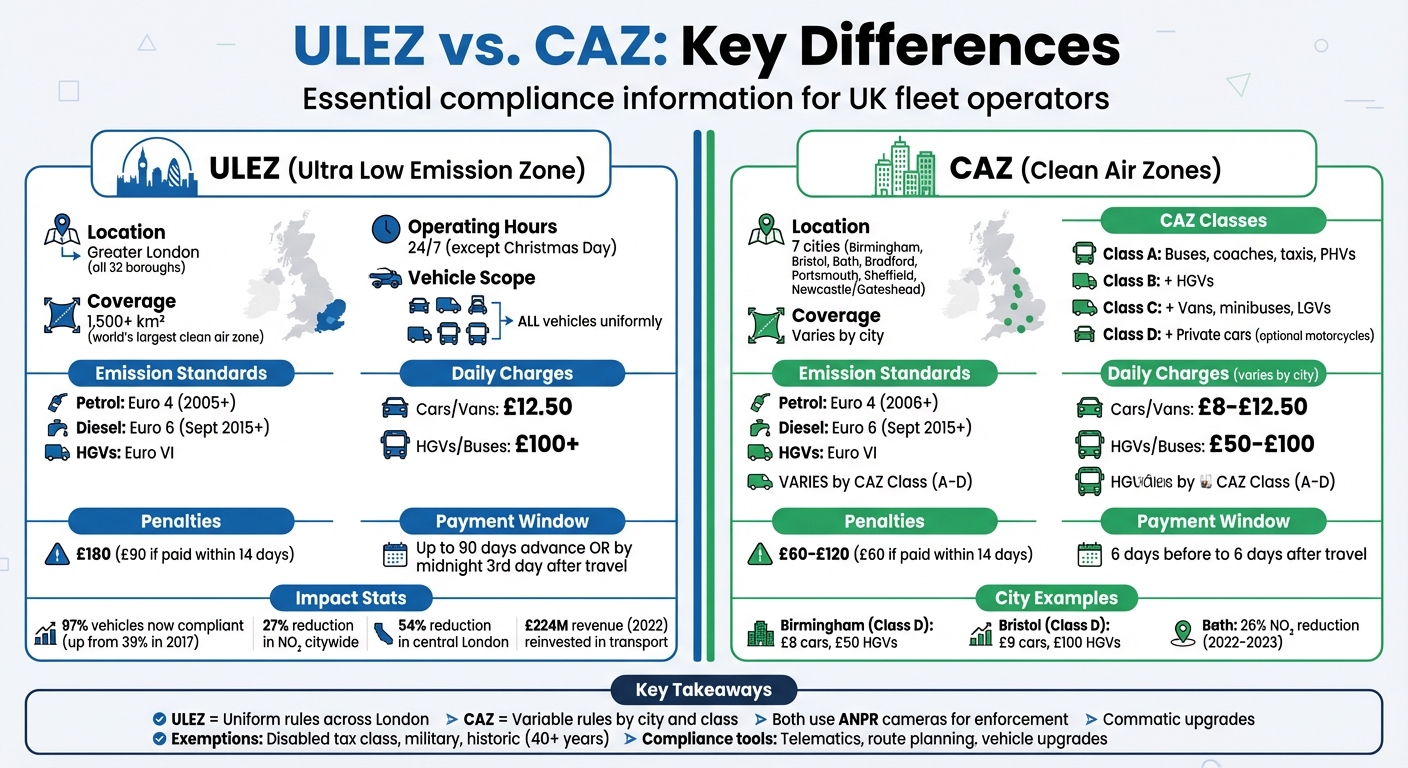
ULEZ vs CAZ Comparison Chart for UK Fleet Operators
What is ULEZ?
The Ultra Low Emission Zone (ULEZ) is a designated area in London where vehicles that fail to meet specific emission standards incur a daily charge to operate. Introduced by Transport for London, ULEZ aims to tackle air pollution, improve public health, and address climate concerns. Toxic air is linked to about 4,000 premature deaths each year in the city.
As of 29 August 2023, ULEZ expanded to cover all 32 London boroughs, making it the largest clean air zone globally, spanning over 1,500 km² [5,6]. The zone operates around the clock, from midnight to midnight, every day except Christmas Day (25 December) [5,7]. This expansion means that fleet operators can no longer bypass ULEZ charges by rerouting vehicles through outer boroughs - any journey within Greater London must now comply with ULEZ regulations.
The impact of ULEZ is already visible: nearly 97% of vehicles in London now meet ULEZ standards, a significant jump from just 39% in 2017. Additionally, nitrogen dioxide levels have dropped 27% across the city and 54% in central London [5,6]. Revenue from ULEZ, which totalled £224 million in 2022, is legally reinvested into improving London's public transport system [5,6].
ULEZ Emission Standards
To comply with ULEZ:
- Petrol vehicles must meet Euro 4 standards, which generally applies to cars and vans registered after 2005, though some models from 2001 are compliant.
- Diesel vehicles face stricter rules, requiring Euro 6 standards - typically for those registered after September 2015.
- Motorcycles and mopeds need to meet Euro 3 standards.
- Heavier vehicles like lorries and coaches over 3.5 tonnes must comply with Euro VI standards.
Fleet managers can confirm vehicle compliance using the TfL vehicle checker, which relies on registration numbers for accuracy [5,4]. The Euro standard is also listed on the V5C registration document. Retrofitting vehicles under the Clean Vehicle Retrofit Accreditation Scheme (CVRAS) is another option, although it might not be cost-effective for older models.
ULEZ Charges and Penalties
Non-compliant vehicles face daily charges:
- £12.50 for cars, motorcycles, and vans up to 3.5 tonnes [7,1].
- £100 per day for buses, coaches, and lorries over 3.5 tonnes, under related LEZ standards [6,1].
These charges apply whenever a non-compliant vehicle enters, moves within, or parks inside the zone during operating hours. Payments can be made up to 90 days in advance or by midnight on the third day after the journey. Businesses can simplify payments by registering for "Auto Pay" through the TfL website, which automates charges without any registration or renewal fees.
Failure to pay results in a Penalty Charge Notice (PCN) of £180, reduced to £90 if settled within 14 days. For fleet operators managing multiple vehicles, these penalties can add up quickly.
To ease the financial burden, small businesses and charities may qualify for scrappage grants ranging from £5,000 to £9,500 to help with scrapping or retrofitting non-compliant vans and minibuses.
Next, we’ll explore Clean Air Zones (CAZ), including their classifications, charges, and penalties, to help fleets stay compliant.
What is CAZ?
A Clean Air Zone (CAZ) is an area in a city where certain vehicles that don’t meet emission standards are charged a daily fee to enter. While similar to London’s Ultra Low Emission Zone (ULEZ), CAZs are rolled out in cities across the UK, with each local authority setting rules to address its specific air quality issues.
The aim of CAZs is to lower nitrogen dioxide (NO₂) levels, improving public health. Currently, seven cities in England have active charging CAZs: Bath, Birmingham, Bradford, Bristol, Portsmouth, Sheffield, and Tyneside (Newcastle and Gateshead). For instance, Bath’s CAZ led to a 26% drop in nitrogen dioxide levels between 2022 and 2023, helping the city meet legal air quality targets.
CAZs operate non-stop - 24/7, every day of the year - using ANPR cameras to monitor vehicles. Many operators use van tracker systems to monitor fleet movements and ensure compliance. The emission standards typically align with ULEZ requirements: petrol vehicles must meet Euro 4 standards (generally registered after 2006), and diesel vehicles must comply with Euro 6 standards (registered after September 2015). Larger vehicles like buses, coaches, and HGVs need to meet Euro VI standards. For fleet operators, it’s crucial to understand both these technical requirements and the charges specific to each zone.
CAZ Classes Explained
Local authorities choose one of four CAZ classes (A–D), which determine which vehicles are charged:
- Class A: Targets buses, coaches, taxis, and private hire vehicles (PHVs).
- Class B: Includes all Class A vehicles plus heavy goods vehicles (HGVs).
- Class C: Adds vans, minibuses, and light goods vehicles (LGVs).
- Class D: Covers all vehicles in Class C and also private cars, with an option to include motorcycles.
Different cities operate under different classifications. For example, Portsmouth’s Class B CAZ excludes private cars and vans, while Bath, Bradford, Sheffield, and Newcastle (Tyneside) operate Class C zones that also exempt private cars. On the other hand, Birmingham and Bristol’s Class D zones charge even private cars.
Some councils choose non-charging CAZs, focusing on measures like traffic management, retrofitting vehicles, or improving public transport, as seen in Southampton and York. Alternatively, cities like Canterbury and Basildon use other approaches, such as enforcing anti-idling rules or reducing speed limits, instead of implementing a formal CAZ.
CAZ Charges and Penalties
The daily charges for non-compliant vehicles differ by city and vehicle type. Here’s a breakdown:
- Birmingham (Class D): £8 for cars and vans, £50 for HGVs and coaches.
- Bristol (Class D): £9 for cars and vans, £100 for larger vehicles.
- Bradford (Class C): £7 for taxis, £9 for vans, and £50 for HGVs.
- Sheffield (Class C): £10 for vans, £50 for HGVs.
- Newcastle and Gateshead (Class C): £12.50 for vans, £50 for HGVs.
Fleet operators have a 13-day payment window - charges can be settled up to six days before, on the day of travel, or up to six days after. Businesses managing multiple vehicles are encouraged to create a business account on GOV.UK to streamline compliance and track payments across various zones.
Failing to pay the fee results in a Penalty Charge Notice (PCN) of £120, which is reduced to £60 if paid within 14 days. Unlike London’s ULEZ, most local authorities don’t send reminders before issuing penalties, so vehicle owners must stay on top of their payments.
Some vehicles are automatically exempt, such as those in the disabled tax class, military vehicles, and historic vehicles over 40 years old. However, local exemptions - like those for residents, blue badge holders, or small businesses - often require an application to the relevant council. In Scotland, Low Emission Zones (LEZs) operate differently. Non-compliant vehicles cannot pay to enter; instead, they automatically incur a £60 fine.
For fleet operators, understanding these charges and deadlines is essential for route planning and cost control. CAZ standards, much like ULEZ, play a key role in managing fleet expenses effectively.
ULEZ vs. CAZ: Main Differences
Emission Standards Compared
ULEZ and CAZ both enforce Euro 4 standards for petrol vehicles and Euro 6 for diesel vehicles, but they differ in how these rules are applied. ULEZ imposes these requirements uniformly across Greater London, targeting nearly all non-compliant vehicles, including private cars and motorcycles. On the other hand, CAZ uses a tiered system with four classes (A to D) that focus on specific vehicle types, varying by city.
For instance, a van exempt from charges in a Class B CAZ might face fees in a Class C or D zone. Portsmouth's Class B CAZ charges buses and heavy goods vehicles but exempts vans, while Sheffield's Class C zone charges non-compliant vans £10 per day. Only Class D zones, such as those in Birmingham and Bristol, include private cars in their charging schemes. Even here, there are exceptions - Birmingham’s Class D zone, for example, does not charge motorcycles with two wheels.
Here’s a side-by-side comparison to clarify these differences.
ULEZ vs. CAZ Comparison Table
| Feature | Ultra Low Emission Zone (ULEZ) | Clean Air Zones (CAZ) |
|---|---|---|
| Location | Greater London (within the M25) | Various UK cities (e.g., Birmingham, Bristol, Sheffield) |
| Vehicle Scope | Uniform – includes cars, vans, motorcycles | Variable – based on CAZ Class (A–D) |
| Emission Standards | Petrol: Euro 4; Diesel: Euro 6 | Petrol: Euro 4; Diesel: Euro 6 (varies by class) |
| Daily Charge (Cars/Vans) | £12.50 | £8–£9 in Class D zones |
| Daily Charge (HGVs) | £100+ (via the LEZ framework) | Typically £50–£100, depending on the city |
| Penalty for Non-Payment | £180 (or £90 if paid within 14 days) | Generally between £60 and £120 |
| Operating Hours | 24/7 (except Christmas Day) | 24/7, every day of the year |
| Payment Window | By midnight on the third day after travel | Up to 6 days before or after travel |
Fleet operators need to be especially mindful of these differences. While a vehicle may meet ULEZ standards, it could still face charges in certain CAZ zones, depending on the class and location. This means operators must adapt their compliance strategies to accommodate ULEZ’s consistent rules and CAZ’s variable frameworks.
How to Achieve Fleet Compliance
Vehicle Upgrades and Route Planning
Fleet compliance often involves upgrading vehicles or refining route strategies. For older vehicles, retrofitting with technology approved by the Clean Vehicle Retrofit Accreditation Scheme (CVRAS) can ensure they meet Euro standards, granting exemptions from daily charges.
Switching to fully electric or ultra-low emission vehicles is another effective way to stay compliant. However, operators should keep in mind that the London Congestion Charge exemption for electric vehicles is set to end in December 2025. After that, even electric vehicles might face daily congestion charges. The ULEZ scrappage scheme, discussed earlier, can help reduce the financial burden of upgrading.
Smart routing tools and navigation systems can also play a key role by helping drivers avoid regulated zones and unnecessary charges. Businesses managing two or more UK-registered vehicles can benefit from creating a business account, simplifying the process of checking and paying charges.
Combining these upgrades and routing strategies with telematics can further enhance compliance efforts.
Using Telematics for Compliance
Telematics systems provide real-time tools to help fleets maintain compliance with ULEZ and CAZ regulations. For example, geofencing alerts notify drivers when they are nearing or entering regulated zones, allowing them to reroute or ensure charges are paid within the required timeframe - up to six days before or after travel. These alerts help avoid Penalty Charge Notices, which start at £160.
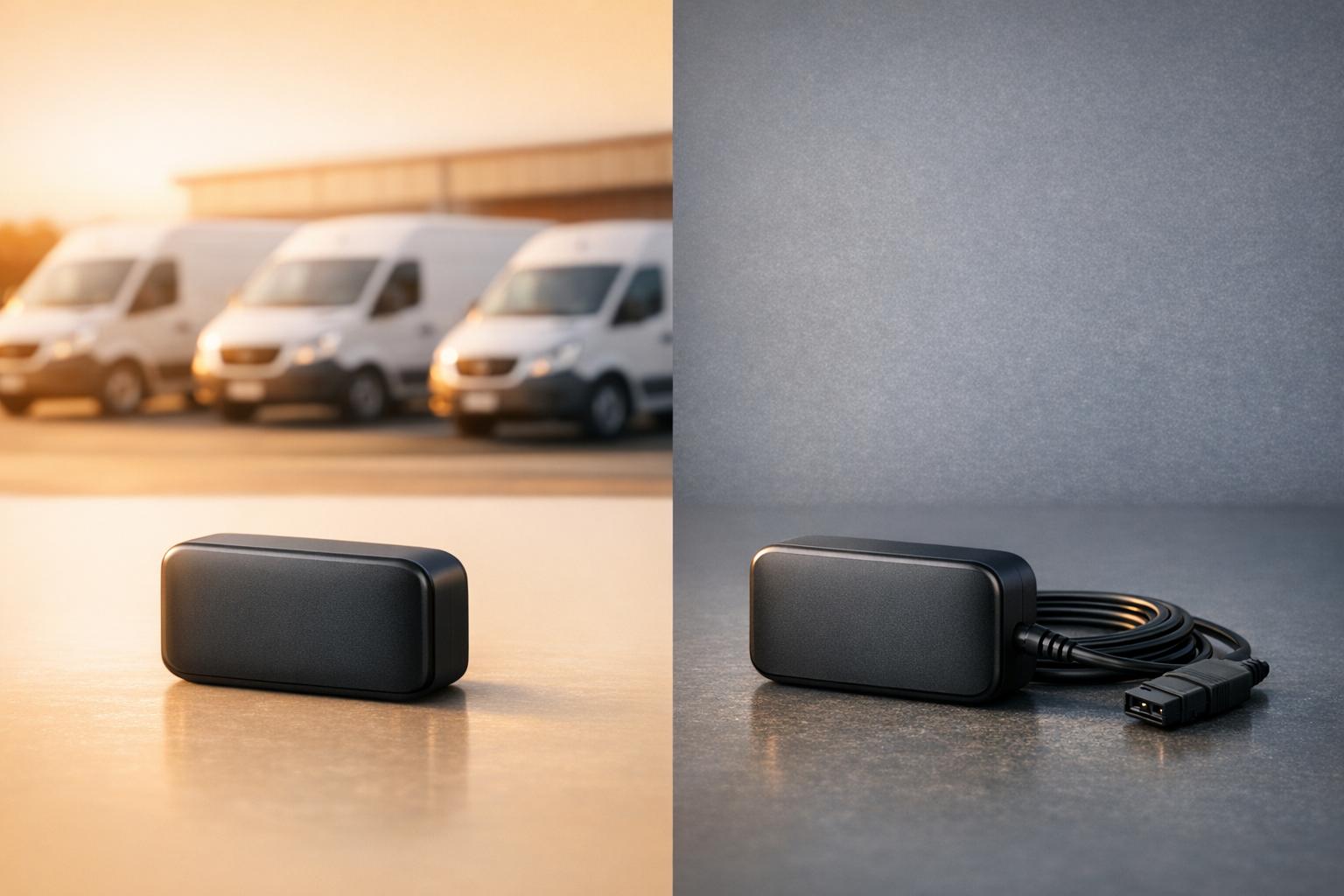
GRS Fleet Telematics offers solutions to track fleet movements across all UK emission zones. Their route planning tools identify compliant routes, while eco-driving analytics monitor fuel efficiency. The dual-tracker technology, available from a £79 hardware cost and a £7.99 monthly subscription, provides extensive coverage. Additionally, the platform’s reporting features help fleet managers verify compliance with Euro 4, Euro 6, and Euro VI standards. Operators can also integrate TfL's AutoPay system with telematics data to automate charge payments, reducing the need for manual processing.
Conclusion
Grasping the differences between ULEZ and CAZ is crucial for fleet operators aiming to stay compliant. ULEZ applies solely to Greater London and enforces the same standards across all vehicle types. In contrast, CAZ schemes differ significantly between cities such as Birmingham, Bristol, and Bath, with four distinct classes determining which vehicles are subject to charges. Enforcement also varies; most English zones allow non-compliant vehicles to pay a daily charge, while Scottish LEZs impose outright bans with no pay-to-enter option.
Failing to comply comes with steep penalties. Daily charges, coupled with escalating fines, can quickly eat into profits. For zones that impose outright restrictions rather than offering payment options, non-compliance can even halt service operations. These financial and operational risks make proactive fleet management a necessity.
To navigate these challenges, fleet operators need effective tools. Telematics systems provide real-time geofencing alerts, optimise routes to avoid non-compliant areas, and centralise records for easier audits.
One such solution is GRS Fleet Telematics, offering a comprehensive platform for navigating ULEZ and CAZ requirements. Their dual-tracker technology monitors fleet movements across all UK emission zones, while route planning tools identify compliant paths. Additionally, eco-driving analytics help track fuel efficiency. Priced from £7.99 per month, with hardware starting from £35, the system supports compliance with Euro 4, Euro 6, and Euro VI standards while automating reporting to reduce administrative workload.
Looking ahead, regulatory changes like the Oxford Traffic Filters (set for August 2026) and the shift towards fully electric fleets by 2035 will demand even greater adaptability. Investing in telematics not only ensures immediate compliance but also prepares fleets for the evolving demands of the future.
FAQs
How can I quickly check if my fleet vehicles are ULEZ/CAZ compliant?
To find out if your fleet vehicles comply with ULEZ or CAZ regulations, you can use online tools provided by local authorities. Simply input your vehicle registration numbers to check whether they meet the necessary emission standards. Make sure your registration details are current, and compare your vehicle's emissions data with the specific requirements of the zones. Additionally, telematics systems, such as those offered by GRS Fleet Telematics, can assist in tracking vehicle data to maintain compliance over time.
What’s the cheapest way to avoid ULEZ and CAZ charges for older vehicles?
To avoid paying ULEZ and CAZ charges without breaking the bank, the best approach is to ensure your vehicle meets the required emissions standards. For ULEZ, this means driving a Euro 6 diesel or Euro 4 petrol vehicle. CAZ compliance depends on the specific requirements of each zone.
Options like upgrading to a compliant vehicle, switching to electric or hybrid models, or carefully planning routes to avoid these zones can help you significantly reduce or even eliminate these charges.
How can telematics help prevent missed payments and PCNs in multiple zones?
Telematics plays a crucial role in reducing missed payments and Penalty Charge Notices (PCNs) by offering real-time tracking, route monitoring, and compliance management. These advanced systems help ensure vehicles remain within ULEZ (Ultra Low Emission Zone) and CAZ (Clean Air Zone) boundaries, keeping emissions standards in check. Automated alerts notify drivers upon entering restricted zones, lowering the chances of unauthorised access or unpaid charges. Additionally, detailed reports simplify billing processes, helping fleets operate smoothly across multiple zones while reducing administrative mistakes.