5 AI Algorithms Improving Route Optimisation
Five AI methods—genetic algorithms, simulated annealing, ML dynamic routing, GNN traffic prediction and XGBoost—improve fleet routes and cut fuel use.
 By Michael Bar12 min read
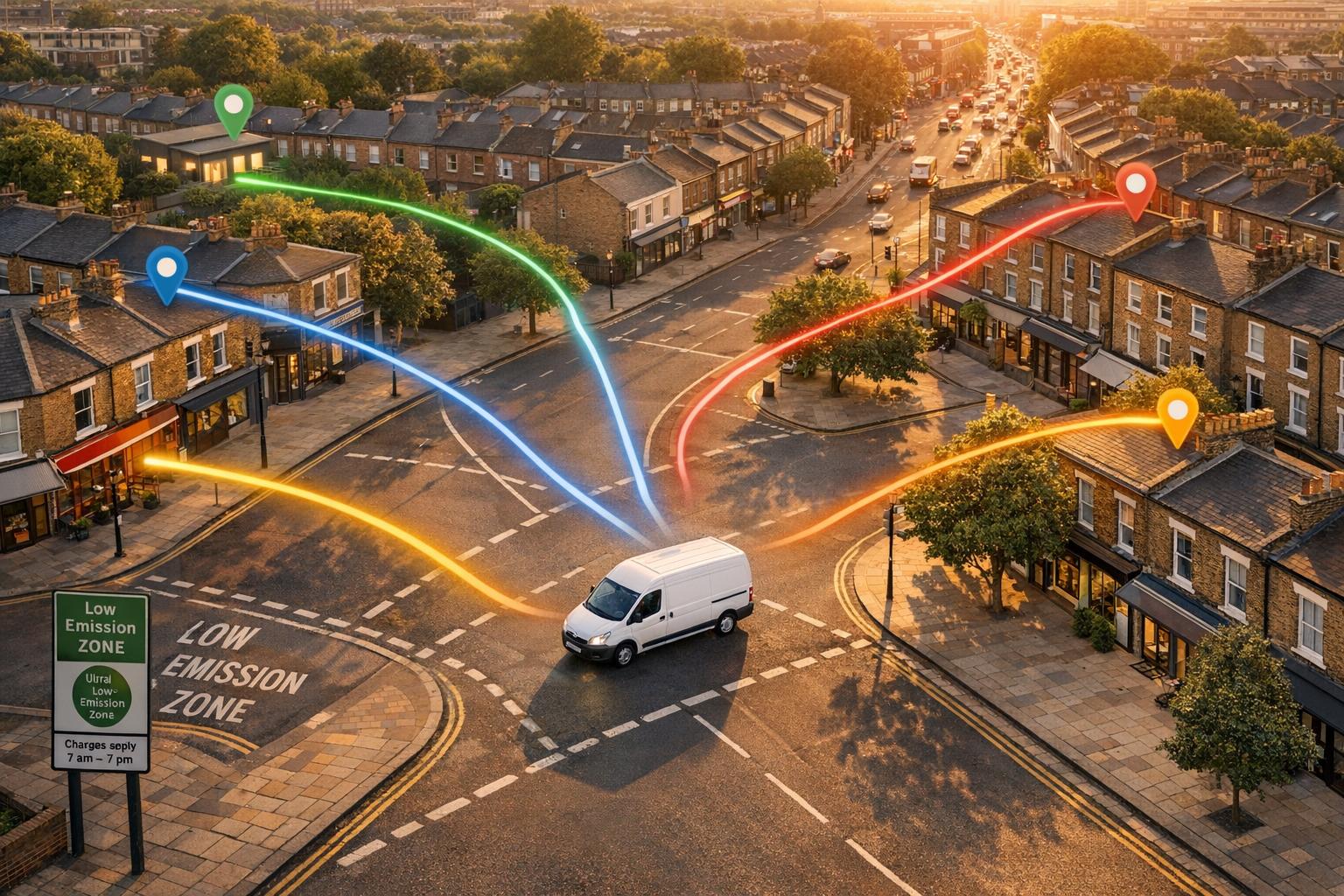
AI is transforming how fleets plan routes, especially in complex environments like the UK. By analysing live traffic data, delivery schedules, and vehicle constraints, these algorithms create efficient paths that save time, reduce costs, and improve delivery performance. Here’s a quick breakdown of five key AI algorithms driving these improvements:
- Genetic Algorithms: Mimic natural selection to refine routes over multiple iterations, ideal for large fleets and complex routing problems.
- Simulated Annealing: Uses a "temperature" mechanism to explore and improve solutions, avoiding getting stuck in suboptimal routes.
- Machine Learning-Based Dynamic Routing: Processes live data to adjust routes in seconds, ensuring flexibility during disruptions.
- Neural Networks for Traffic Prediction: Analyse road networks to forecast delays, improving ETA accuracy and reducing delivery times.
- XGBoost for Multi-Factor Optimisation: Considers multiple constraints like traffic, fuel, and delivery windows for efficient route planning.
These algorithms are often combined, leveraging their strengths to handle large-scale, real-time routing challenges. For example, GRS Fleet Telematics integrates these tools to cut fuel costs and boost productivity, offering tailored solutions for UK fleets.
1. Genetic Algorithms
Genetic algorithms take inspiration from natural selection to streamline fleet routing. They treat potential routes as "chromosomes", with individual stops acting as "genes." These algorithms refine solutions over multiple generations, gradually homing in on near-optimal routes.
The process begins with a random set of routes, which are evaluated based on factors like distance, time, fuel costs, and delivery priorities. Through methods such as crossover and occasional mutations (like swapping stops), the algorithm iteratively improves these routes. This approach typically delivers results within 1–5% of the theoretical optimum. Considering the complexity of the Vehicle Routing Problem - where, for example, a fleet with just 50 stops has more possible sequences than there are atoms in the observable universe - this level of efficiency is remarkable.
Scalability for Large Fleets
When it comes to managing large fleets, genetic algorithms shine. In September 2025, researchers Ido Greenberg and Alex Fender introduced EARLI (Evolutionary Algorithm with Reinforcement Learning Initialization), which demonstrated the ability to process 500 delivery locations in under one second. This was a 10× speed improvement compared to existing solutions, tested on real-world e-commerce data. Such speed enhancements open doors for integrating advanced techniques like neural networks to push optimisation even further.
Integration with Neural Networks
Hybrid systems are now taking these algorithms to the next level. Neural networks can provide an initial routing estimate based on historical data, which the genetic algorithm then fine-tunes. As Ido Greenberg explained:
"EARLI handles vehicle routing with 500 locations within one second, 10x faster than current solvers for the same solution quality, enabling real-time and interactive routing at scale".
This combination of speed and adaptability makes it possible to adjust routes quickly, even in the ever-changing conditions of urban environments.
2. Simulated Annealing
Inspired by the metallurgical process of annealing - where metals are cooled slowly to minimise defects - this algorithm uses a "temperature" concept to explore a wide range of possible solutions. When the "temperature" is high, it allows the system to accept less-than-ideal routes, helping it avoid getting stuck in local optima. As the temperature gradually drops, the algorithm becomes more selective, eventually homing in on a near-optimal solution.
What makes simulated annealing powerful is its ability to break free from local dead ends. Unlike "greedy" algorithms that might stop at the first acceptable solution, this method deliberately accepts poorer solutions early on to widen its search scope. For example, in a 100-stop delivery scenario, it can find a solution within 2–5% of the theoretical best in less than 30 seconds.
Computational Efficiency
Simulated annealing strikes a balance between thorough exploration and speed. Instead of trying every possible option (which would be impractical), it quickly delivers near-optimal results. This speed is crucial in fleet management, where route plans need to be finalised before drivers hit the road.
Integration with Neural Networks
Modern routing systems often combine simulated annealing with machine learning to tackle ever-changing conditions. Neural networks predict real-time factors - like traffic congestion, weather changes, and service times - and feed this data into the simulated annealing process. This combination allows for dynamic recalculations. In fact, AI-driven route optimisation can reduce total miles driven by 12–20% within the first three months of use. Additionally, optimised fleets achieve on-time delivery rates of 90–95%, compared to just 72–78% for those relying on manual routing.
This blend of simulated annealing and machine learning, as seen in GRS Fleet Telematics' routing solutions, significantly enhances fleet operations, improving both efficiency and reliability.
3. Machine Learning-Based Dynamic Routing
Machine learning-based dynamic routing allows fleets to adapt in real-time to the unpredictable challenges of daily operations. Instead of sticking to pre-set routes, these systems process live data - like GPS signals, traffic updates, and weather conditions - to create a virtual model of the logistics network. When disruptions such as accidents or road closures arise, the system makes small route adjustments without throwing off the entire fleet's schedule. This approach ensures operations remain flexible and efficient.
Real-Time Adaptability
Machine learning systems don't just react - they predict. If a vehicle breaks down or an urgent delivery pops up, the system recalculates routes within seconds. By leveraging historical data and time-based patterns (like time of day or day of the week), predictive models can anticipate delays. This proactive strategy helps businesses stick to service-level agreements even during busy periods or adverse weather. Additionally, the system continuously learns by comparing planned routes with actual outcomes, improving future routing decisions.
Computational Efficiency
To tackle complex routing problems, heuristic solvers combine optimisation techniques with metaheuristics, generating near-optimal solutions for thousands of stops in mere seconds. Instead of reworking entire routes when conditions change, the AI tweaks only a few stops between nearby vehicles, saving valuable processing time. This efficiency is a game-changer: while manual route planning can take over 90 minutes each day, AI systems complete the same task in under a minute.
Scalability for Large Fleets
Adoption of AI in logistics is growing rapidly. By 2025, 70% of logistics leaders are expected to utilise AI solutions, compared to 53% in 2024. Cloud-based systems with scalable microservices handle the complexity of managing hundreds or even thousands of vehicles at once. These systems also balance workloads across fleets, avoiding the uneven distribution often seen with manual planning. For instance, UPS's ORION system processes 250,000 routing requests daily, covering 97% of its fleet. This has led to 100 million fewer miles driven annually and cost savings of £240–320 million per year.
Integration with Neural Networks
Using continuous data streams, Graph Neural Networks analyse road networks for precise travel-time predictions at a granular level. Meanwhile, reinforcement learning builds routes step-by-step, choosing the next best delivery based on learned incentives and penalties. This advanced integration enables systems like GRS Fleet Telematics van tracking to achieve on-time delivery rates of 90–95%, a significant improvement over the 72–78% achieved with manual routing.
4. Neural Network Models for Traffic Prediction
Neural networks have revolutionised traffic prediction for fleets by treating road networks as interconnected graphs. Graph Neural Networks (GNNs), for instance, treat roads as nodes and intersections as edges, enabling them to capture how congestion on side streets impacts main roads. This concept, called spatiotemporal reasoning, helps analyse traffic flow across entire networks rather than focusing on isolated routes. The results have been transformative.
In September 2020, DeepMind researchers Oliver Lange and Luis Perez collaborated with Google Maps to integrate GNNs into traffic prediction systems. By dividing road networks into "Supersegments" - clusters of connected roads with shared traffic characteristics - they used message-passing algorithms to model how traffic flows through these clusters. The results were impressive: ETA accuracy improved by up to 50% in major cities like Sydney, Tokyo, Berlin, Jakarta, and Washington D.C.. Today, Google Maps achieves over 97% accuracy in predicting arrival times.
"In modelling traffic, we're interested in how cars flow through a network of roads, and Graph Neural Networks can model network dynamics and information propagation." - DeepMind
Modern traffic systems also combine Long Short-Term Memory (LSTM) networks for forecasting with Deep Q-Networks (DQNs) for real-time routing. This hybrid approach allows fleets to predict delays at critical points like turns, merges, and stop-and-go traffic. By analysing multiple intersections at once, these systems can reduce delivery times by up to 21%, cut fuel consumption by 13%, and improve vehicle utilisation by 17%.
Another major advantage lies in scalability. Instead of training millions of individual neural networks for each road segment - a logistical nightmare for global deployment - a single GNN can process variable-sized subgraphs efficiently. DeepMind enhanced this efficiency by using MetaGradients to adjust learning rates during training, enabling one model to handle millions of diverse road segments worldwide. This approach makes advanced traffic prediction viable even for smaller fleets in the UK, where navigating urban complexities like weight limits, low bridges, and congestion zones can be particularly challenging.
5. XGBoost for Multi-Factor Optimisation
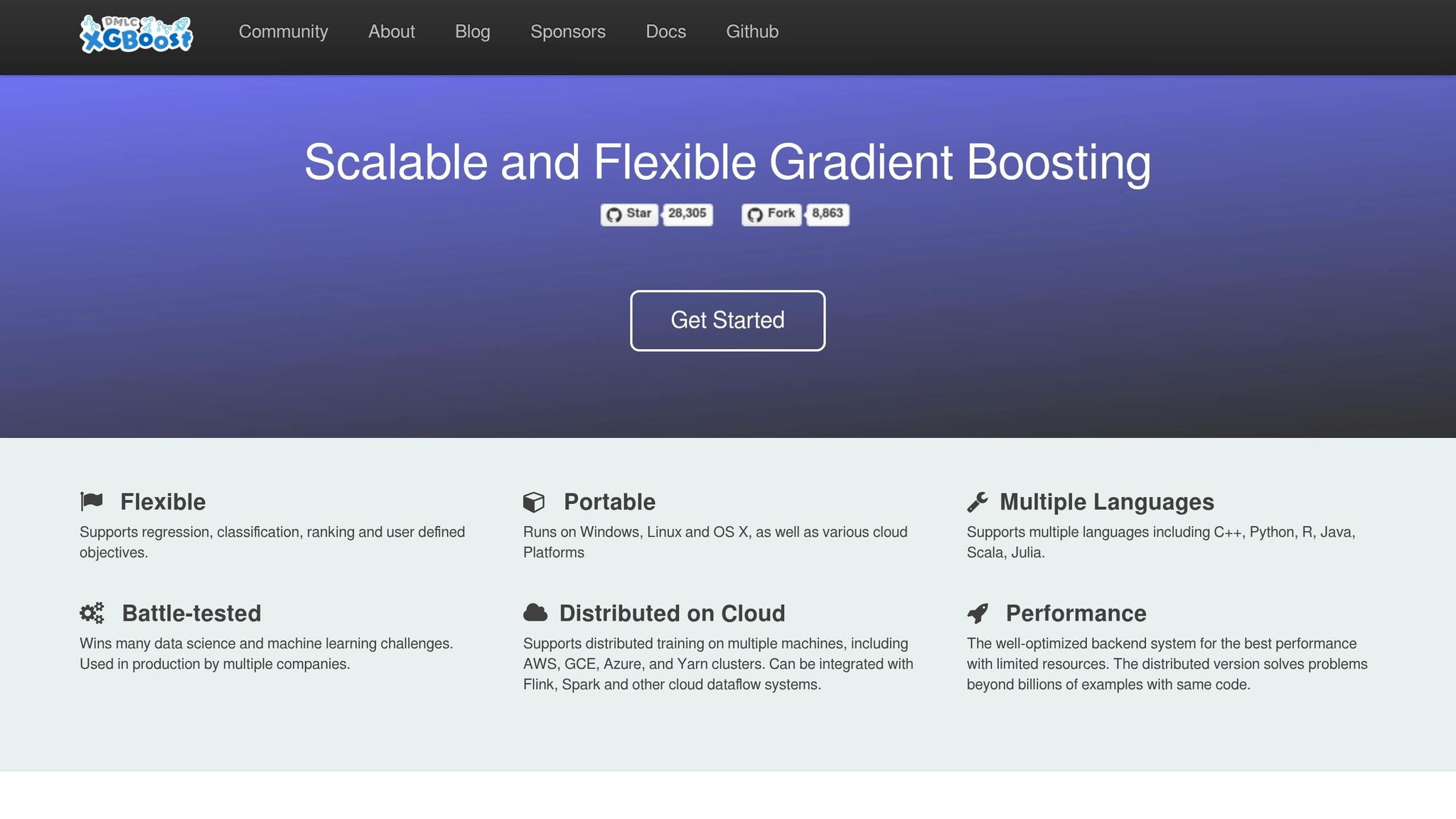
When it comes to tackling route optimisation with multiple variables, XGBoost (Extreme Gradient Boosting) stands out. Unlike neural networks, which focus on pattern recognition, XGBoost builds decision trees to analyse factors like traffic density, delivery windows, vehicle capacity, driver hours, and fuel costs. This makes it a key tool for modern fleet operations, where juggling multiple constraints is the norm.
Let’s dive into how XGBoost excels in real-time responsiveness, efficiency, and scalability while complementing neural networks.
Real-time Adaptability
One of XGBoost's standout features is its ability to adapt instantly to changing conditions. Imagine a delivery van stuck in unexpected roadworks on the M25 or a customer making a last-minute request to reschedule - XGBoost can recalculate the entire route in seconds. This agility ensures deliveries stay on track, boosting both efficiency and customer satisfaction. Compared to traditional routing methods, this kind of responsiveness can make a real difference in retaining loyal customers.
Computational Efficiency
XGBoost doesn’t demand heavy computing power, making it a cost-effective choice. It runs smoothly on standard hardware and can even be deployed on serverless platforms like AWS Lambda. This means routing calculations can be processed quickly and affordably, saving resources without compromising performance.
Scalability for Large Fleets
Whether you’re managing a small fleet of five vans in London or coordinating fifty lorries across the UK, XGBoost scales effortlessly. It evaluates each vehicle’s constraints individually before optimising the overall schedule. This capability is especially valuable in last-mile delivery, which accounts for a hefty 41% of total logistics costs. By cutting unnecessary mileage and improving vehicle use, fleets can significantly reduce expenses - a win for both businesses and the environment.
And it doesn’t stop there. XGBoost works seamlessly alongside neural networks to create even more powerful optimisation systems.
Integration with Neural Networks
In modern logistics, combining XGBoost with neural networks brings out the best of both technologies. Neural networks excel at forecasting traffic patterns and delivery times, while XGBoost focuses on multi-variable route decisions. Together, they form a hybrid system that’s further enhanced by IoT sensors and cameras feeding real-time data into the mix. This combination allows logistics teams to not only predict potential issues but also react to them swiftly and effectively.
Algorithm Comparison
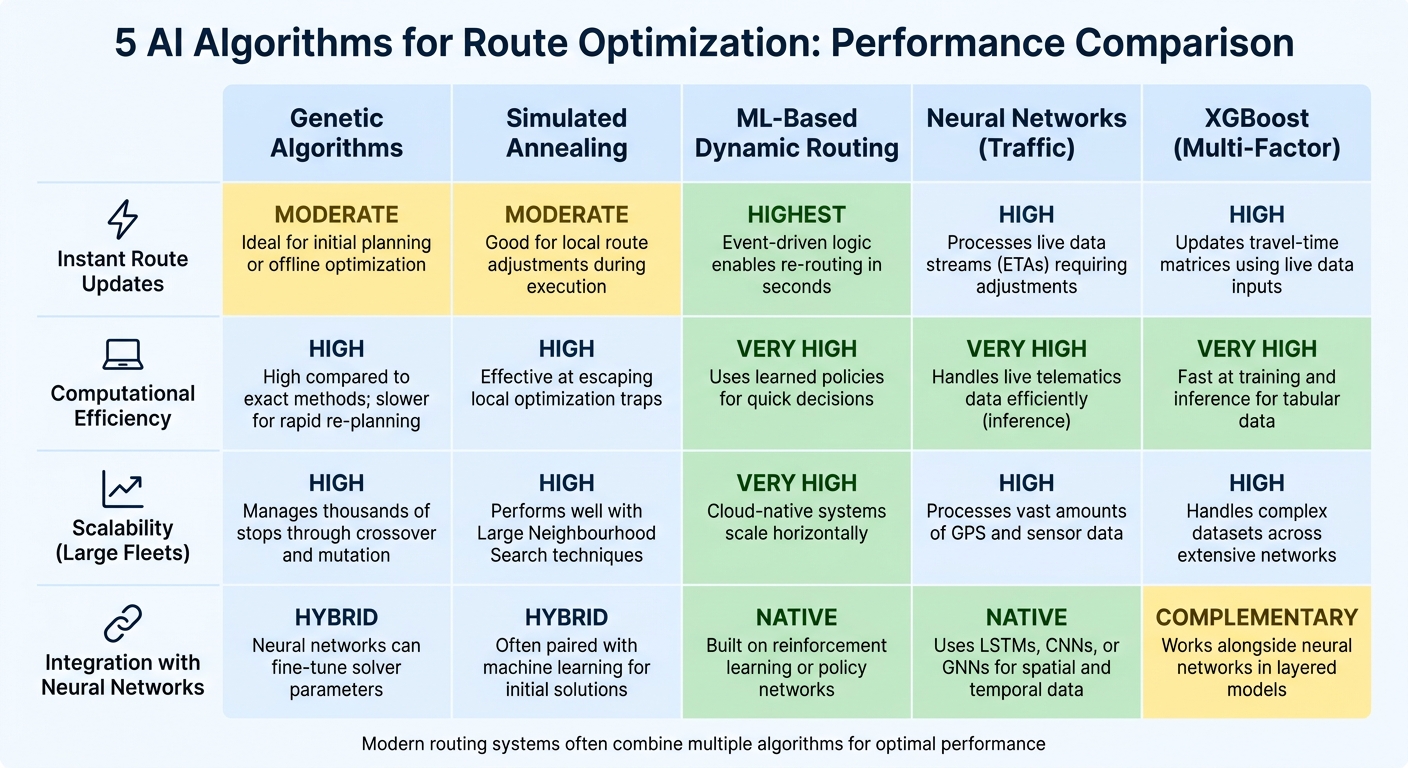
Comparison of 5 AI Route Optimization Algorithms for Fleet Management
AI algorithms bring different strengths to the table when it comes to routing systems. These strengths include how quickly they adapt to real-time changes, their processing efficiency, their ability to scale with larger fleets, and how seamlessly they work with neural networks. Understanding these distinctions is key to building a hybrid routing system that performs well under various conditions.
Here’s a breakdown of how these algorithms compare across four key areas: instant route updates (speed of response to changes), computational efficiency (processing power demands), scalability (handling large fleets), and integration with neural networks (compatibility with predictive AI).
| Algorithm | Instant Route Updates | Computational Efficiency | Scalability (Large Fleets) | Integration with Neural Networks |
|---|---|---|---|---|
| Genetic Algorithms | Moderate; ideal for initial planning or offline optimisation | High compared to exact methods; slower for rapid re-planning | High; manages thousands of stops through crossover and mutation | Hybrid; neural networks can fine-tune solver parameters |
| Simulated Annealing | Moderate; good for local route adjustments during execution | High; effective at escaping local optimisation traps | High; performs well with Large Neighbourhood Search techniques | Hybrid; often paired with machine learning for initial solutions |
| ML-Based Dynamic Routing | Highest; event-driven logic enables re-routing in seconds | Very high; uses learned policies for quick decisions | Very high; cloud-native systems scale horizontally | Native; built on reinforcement learning or policy networks |
| Neural Networks (Traffic) | High; processes live data streams (ETAs) requiring adjustments | Very high (inference); handles live telematics data efficiently | High; processes vast amounts of GPS and sensor data | Native; uses LSTMs, CNNs, or GNNs for spatial and temporal data |
| XGBoost (Multi-Factor) | High; updates travel-time matrices using live data inputs | Very high; fast at training and inference for tabular data | High; handles complex datasets across extensive networks | Complementary; works alongside neural networks in layered models |
The table highlights the advantages of combining algorithms to balance dynamic responsiveness with efficient processing. This multi-layered approach is especially useful for advanced route planning systems in the UK, ensuring timely deliveries even in complex urban environments.
Modern routing systems often integrate multiple algorithms. Predictive models, metaheuristics, and reinforcement learning work together to manage thousands of stops in real time. As NextBillion.ai explains, "AI is not a single algorithm. It is a layered stack: Optimisation layer, Prediction layer, and Control layer". This approach blends optimisation for route planning, prediction for anticipating changes, and control for instant adjustments, creating a system capable of handling the demands of large-scale, real-time routing.
Conclusion
AI algorithms are reshaping how UK fleets operate by calculating optimal routes in real time. Studies reveal these technologies can cut total mileage by 12–20%, boost on-time delivery rates from 72–78% to 90–95%, and reduce fuel costs by up to 20%. For a fleet of 50 vehicles, this translates into annual savings exceeding £247,000.
"AI-powered route optimisation is emerging as a game-changer... The integration of AI with GPS tracking, Internet of Things (IoT) sensors and cloud-based fleet management platforms has revolutionised logistics operations by enhancing vehicle utilisation, minimising fuel consumption, and improving last-mile delivery efficiency."
– Joel Paul, Senior Researcher, Stanford University
These dynamic systems are designed to adapt instantly to real-world disruptions. By tracking live conditions - such as accidents, road closures, or weather changes - AI recalculates routes in seconds, ensuring drivers stay on the most efficient path. Fleets using AI-optimised systems have reported a 23% increase in on-time deliveries within just 90 days of implementation.
GRS Fleet Telematics takes these advancements further by integrating cutting-edge tools into its van tracking platform. Combining real-time GPS data with intelligent route optimisation, the platform is tailored to meet the needs of UK businesses. With dual-tracker technology, it enhances both security and operational efficiency. Subscription plans start at just £7.99 per vehicle per month, offering a cost-effective way to connect live telematics data with predictive algorithms. This approach helps fleets improve vehicle utilisation, cut fuel consumption, and maintain high delivery standards across urban and rural areas alike.
FAQs
Which AI algorithm is best for my fleet size?
For your fleet, the best AI algorithm will vary depending on its size and specific operational demands. Smaller fleets can make great use of straightforward systems that combine machine learning with real-time traffic data, potentially cutting fuel costs by as much as 30%. On the other hand, larger fleets often see better results with advanced algorithms. These can account for factors like traffic patterns, weather conditions, and regulatory requirements, helping to achieve fuel savings of up to 20% while maintaining impressive on-time delivery rates of 95–99%. Your choice should align with the scale and complexity of your operations.
How does AI reroute drivers when traffic changes suddenly?
AI systems help drivers navigate more efficiently by processing real-time data, such as traffic patterns, weather conditions, and vehicle performance. By quickly spotting delays or congestion, these systems adjust routes on the fly to bypass potential hold-ups. This means drivers get continuously updated directions, enabling fleets to cut delivery times, conserve fuel, and stay efficient even when traffic takes an unexpected turn.
What data do I need to use AI route optimisation effectively?
To make the most of AI-powered route optimisation, having accurate, relevant, and complete data is non-negotiable. The key inputs for such systems include:
- Real-time traffic updates to account for current road conditions.
- Vehicle diagnostics to monitor performance and ensure safety.
- GPS data for precise location tracking.
- Vehicle specifications, such as load capacity or fuel type.
- Delivery schedules to prioritise and sequence stops efficiently.
- Historical traffic patterns to anticipate congestion and plan better routes.
Maintaining high-quality data is critical. AI systems depend on this information to streamline operations, cut costs, and ensure compliance with regulations specific to the UK.