Battery Degradation Models for Fleet Operators
How telematics, AI and charging practices predict and reduce EV battery wear to cut costs and preserve fleet range.
 By Michael Bar13 min read
EV battery degradation impacts fleet performance and costs. Batteries lose about 2.3% capacity annually, dropping to roughly 81.6% after eight years. Fleet operators face higher costs due to reduced range, faster wear in high-use vehicles, and the influence of factors like temperature, charging habits, and vehicle type. Predictive models now help manage these challenges, forecasting battery health with high accuracy using fleet telematics and AI.
Key Points:
- Degradation Rates: High-use vehicles degrade faster (up to 2.7% annually).
- Environmental Impact: Heat accelerates wear; cold climates have less effect.
- Charging Habits: Frequent DC fast charging increases annual degradation to 3%.
- Predictive Tools: AI and digital twins forecast battery lifespan, enabling better maintenance and cost planning.
- Economic Benefits: Accurate degradation forecasts improve TCO and resale value.
To mitigate wear, fleets should optimise charging, monitor temperature, and use data-driven tools for better planning and reduced costs.
Key Factors Influencing EV Battery Degradation
EV Battery Degradation Rates by Usage and Charging Habits
Understanding what drives battery degradation is essential for improving predictive models and making smarter fleet management decisions.
Environmental Stressors
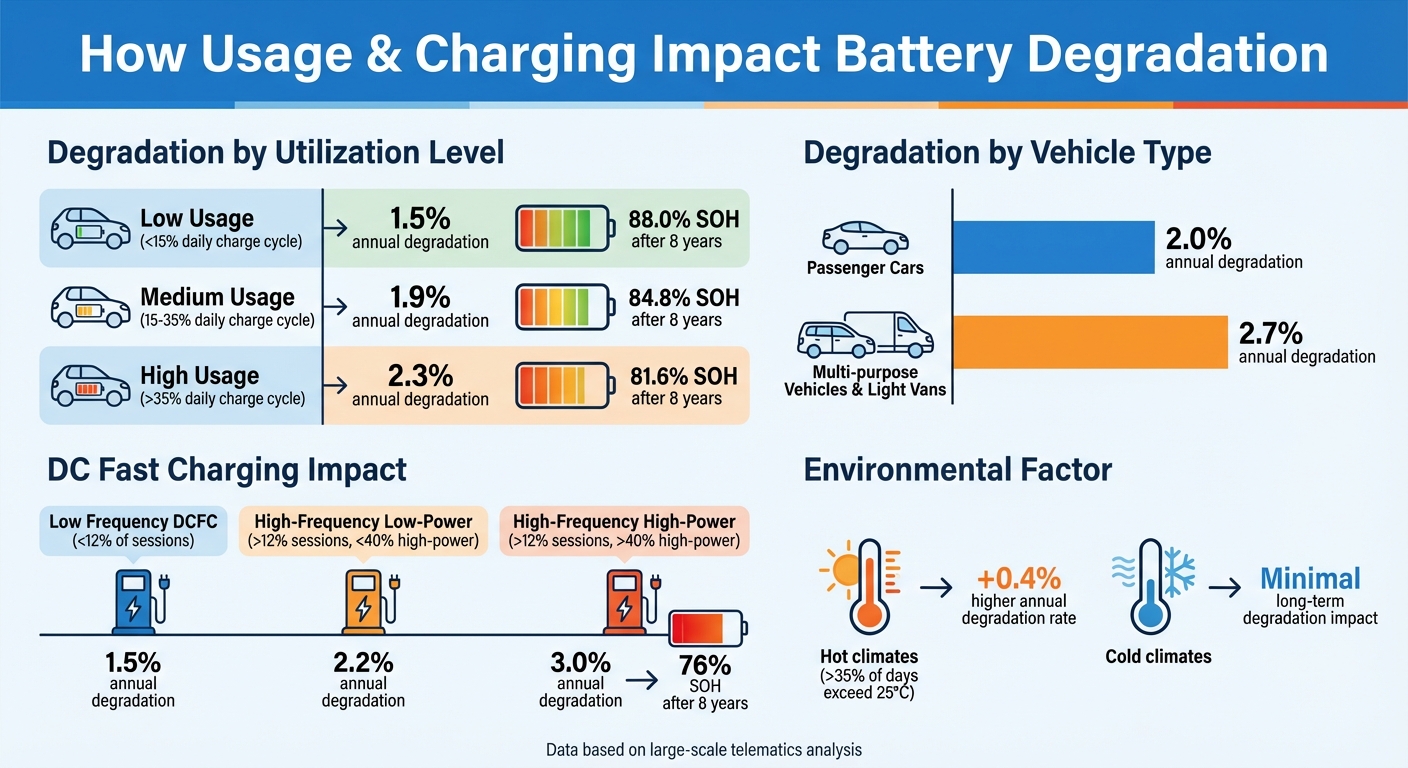
Temperature is the most impactful environmental factor when it comes to battery lifespan. Higher temperatures speed up chemical reactions and increase internal stress within battery cells, leading to quicker capacity loss. For instance, vehicles used in hot climates - where over 35% of days exceed 25°C - experience an annual degradation rate about 0.4% higher than those in cooler regions. While the UK generally enjoys a mild climate, Southern England sees more days above 25°C compared to the North. Battery Management Systems help regulate temperatures but can't fully offset the effects of prolonged heat exposure. Simple practices, like parking in shaded or indoor areas during heatwaves, can help reduce strain on the battery.
"Heat increases chemical activity and stress inside the cell." – Geotab
Interestingly, large-scale telematics data suggest colder climates don't cause significant long-term degradation, reinforcing heat as the primary concern. Charlotte Argue, Senior Manager of Fleet Electrification at Geotab, highlights the importance of monitoring fleet-specific data:
"If they start noticing that the drop is becoming faster all of a sudden, or that particular vehicle is dropping faster than similar vehicles in their fleet, that's when they probably want to pay attention".
While environmental conditions play a big role, how a vehicle is used also has a noticeable impact on battery health.
Operational Factors
How intensively a vehicle is used influences battery degradation. For example, multi-purpose vehicles and light vans tend to degrade faster (2.7% annually) compared to passenger cars (2.0%), likely due to the different types of batteries used and the more demanding driving cycles.
| Utilisation Level | Daily Charge Cycle | Avg. Annual Degradation | Projected SOH (8 Years) |
|---|---|---|---|
| Low | <15% | 1.5% | 88.0% |
| Medium | 15% – 35% | 1.9% | 84.8% |
| High | >35% | 2.3% | 81.6% |
Charlotte Argue explains:
"The increase in degradation from high daily use is a measurable but worthwhile trade-off for the gains in fleet productivity and ROI".
To extend battery life, older vehicles could be assigned to cooler regions or routes with less demanding usage, a strategy often employed in van tracking for rental and leasing companies. However, charging habits also play a critical role in how quickly batteries wear out.
Charging Habits and Methods
Charging frequency and power levels have become the dominant factors affecting battery health. Vehicles that rely on DC fast charging (DCFC) for over 12% of their charging sessions degrade at an average rate of 2.5% annually. In contrast, those using DCFC less often see rates closer to 1.5% . High-power DCFC sessions (over 100 kW) can accelerate degradation even further, pushing annual rates to around 3.0% and potentially reducing battery capacity to 76% after eight years .
| DCFC Usage Group | Usage Criteria | High-Power Sessions (>100 kW) | Avg. Annual Degradation |
|---|---|---|---|
| Low Frequency | <12% of sessions | N/A | 1.5% |
| High-Frequency Low-Power | >12% of sessions | <40% of DCFC sessions | 2.2% |
| High-Frequency High-Power | >12% of sessions | >40% of DCFC sessions | 3.0% |
Occasional full charges (to 100%) are not particularly harmful if the vehicle is driven soon after reaching full capacity. However, leaving the battery at 100% for extended periods should be avoided. As Charlotte Argue puts it:
"If I need high-power charging in order to meet the daily requirements for my vehicle, I'm going to use it, but I'm not going to fall into the trap of bigger is always better".
For optimal battery health, prioritising overnight AC charging and avoiding extreme charge levels for long periods are the most effective strategies .
Predictive Models for Battery Degradation
Predictive models are transforming how fleet operators handle battery degradation, offering a proactive way to manage maintenance, budget for replacements, and optimise their electric vehicle (EV) investments. By converting raw telematics data into actionable insights, these systems help businesses make informed decisions about their fleets.
Data-Driven Modelling Approaches
Real-time telematics plays a crucial role in monitoring battery health. Metrics like State of Health (SOH) and State of Charge (SoC) are tracked through data on energy flow and charge levels. Typically, predictive models require about a month of consistent driving and charging data to accurately estimate a vehicle's battery capacity and range.
Platforms such as GRS Fleet Telematics collect essential data - voltage, temperature, and current flow - to power predictive analytics. Some systems calculate SOH by comparing a vehicle's usable capacity to a crowd-sourced "original capacity" baseline from thousands of similar models.
Battery degradation often follows an "S-curve" pattern: rapid decline in the first 1–2 years, stabilisation into a steady phase, and a steeper drop near the end of its life. Fleet operators are encouraged to use third-party diagnostic tools quarterly to monitor SOH, ensuring they catch unexpected degradation early enough to make warranty claims. Beyond data collection, AI algorithms enhance the accuracy of these predictions, as explored in the next section.
AI and Machine Learning Models
Artificial intelligence has reshaped how battery lifespan is predicted. Algorithms like Long Short-Term Memory (LSTM), CatBoost, and Gaussian process regression analyse historical and live data to forecast degradation. These models can identify the relationship between charging cycles and battery capacity, even when charging patterns vary.
Machine learning also predicts the "first passage time" - the point when a battery reaches its end-of-life threshold. It provides probability distributions for individual vehicles and entire fleets. AI-driven models have shown impressive accuracy in real-world conditions, achieving a mean absolute percentage error (MAPE) below 0.49% and a root mean square error (RMSE) under 2.67 Ah for capacity predictions. By creating reliability curves, fleet operators can implement tiered maintenance strategies. These models also include correction functions to account for factors like temperature changes and charging currents. While AI enhances predictions with historical data, digital twins take it a step further by simulating real-time battery performance.
Digital Twin Simulations
Digital twins act as virtual replicas of battery packs, updated in real time with telemetry data to simulate health and predict future degradation. This hybrid approach combines physics-based models, which simulate internal processes like SEI layer growth and lithium plating, with machine learning that refines predictions using historical data. AI-enhanced digital twins can achieve an SOH prediction accuracy of 98.2%, enabling automated maintenance, optimised charging schedules, and route planning based on actual battery performance.
This technology can extend battery life by 15–25%. For example, optimised charging strategies informed by digital twins could save a 50-vehicle fleet around £800,000 in replacement costs over five years. Advanced models now treat the fleet as a "networked system", considering factors like charger congestion and overlapping routes to predict fleet-wide degradation patterns. As David Savage, VP UK & Ireland at Geotab, explains:
"With these higher levels of sustained health, batteries in the latest EV models will comfortably outlast the usable life of the vehicle and will likely not need to be replaced".
These predictive tools directly address the challenges of battery degradation, enabling fleet operators to cut costs and improve efficiency through proactive maintenance and planning.
Practical Strategies to Reduce Battery Degradation
Predictive models can help estimate battery wear, but fleet operators can take proactive steps to extend battery life. Focusing on charging habits, route planning, and temperature control can significantly protect their investments.
Smart Charging Practices
Charging habits now have a bigger impact on battery life than climate conditions. To minimise wear, prioritise depot-based charging over high-power DC fast charging. Reserve DC fast chargers for situations like tight schedules or long-range trips. As James Miller from Geotab explains:
"Fleets can preserve asset value by matching charger investments to duty cycles rather than reflexively buying more DC capacity".
Extreme charge levels - either near 0% or 100% - should be avoided for extended periods, as these states accelerate degradation. However, occasional 100% charges are fine if the vehicle is driven soon after. Miller elaborates:
"Occasional 100% charges are not a major liability if the vehicle is driven soon after. In short: avoid over-penalising occasional 100% charges - charging policies must be both flexible and practical".
To reduce strain on batteries, time full charges to align with shift starts. Additionally, using smart scheduling tools can help distribute battery wear evenly across the fleet. These adjustments align with degradation models and help maintain the predicted State of Health.
Optimised Route Planning
Efficient route planning reduces deep discharges, which are a major contributor to battery wear. Modern tools now consider factors like traffic, road inclines, vehicle load, and weather to create energy-efficient routes. Keeping batteries within the optimal charge range (20–80%) helps preserve their chemistry.
For example, FarEye's AI-powered EV route planning platform has helped fleets save over 600 million miles annually, cutting emissions by 550,000 metric tonnes. Raunaq Singh from FarEye highlights:
"The longevity of EV batteries is less about technology choices and more about operational discipline".
Telematics solutions like GRS Fleet Telematics provide live battery data for real-time range predictions and stress monitoring. Smart routing avoids congestion hotspots, which can cause temperature spikes in the battery and motor. Additionally, balancing mileage across the fleet prevents overuse of specific vehicles, reducing the need for emergency DC fast charging, a known accelerator of battery wear.
Temperature Management
While EVs feature internal Battery Management Systems to regulate temperature, external factors like climate can still impact battery health. For example, operating in hot climates increases degradation, particularly when combined with high-power charging.
For fleets in warmer regions, choosing vehicles with active liquid cooling systems can help minimise thermal stress. Workload balancing is another effective strategy, as high utilisation adds approximately 0.8% to annual degradation compared to low-use vehicles. Distributing mileage evenly not only reduces thermal stress but also extends battery life.
To monitor and adjust operations, track metrics such as vehicle State of Health trends, average charge power per session, and depot dwell times. These insights can reveal whether your policies are effectively preserving battery health or unintentionally accelerating wear, allowing for timely adjustments to maintain resale value.
Economic Impact of Battery Degradation Models
Predictive battery models play a big role in boosting fleet profitability by cutting down maintenance costs and improving how assets are managed. By understanding how batteries degrade over time, operators can shift from reactive fixes to a more strategic, risk-based maintenance approach. This involves using fleet-specific reliability curves to predict when issues might arise. With advanced predictive methods showing impressive accuracy (MAPE < 0.49%, RMSE < 2.67 Ah) in forecasting battery capacity loss, operators can confidently plan replacement cycles. This avoids wasting money on premature battery swaps and ensures maintenance schedules are optimised, supporting smarter economic decisions for fleet management.
Impact on Total Cost of Ownership
Accurate predictions of battery degradation are essential for determining when batteries reach their end-of-life, both for individual vehicles and across entire fleets. This level of precision allows for well-timed replacement planning, striking a balance between operational risks and maintenance costs.
Advanced models also take into account real-world factors like fluctuating ambient temperatures and varying charging currents. Ignoring these can lead to inaccurate capacity estimates and financial miscalculations. To improve long-term Total Cost of Ownership (TCO) projections, operators should use trend extraction algorithms alongside rain flow counting methods. These tools help normalise data from inconsistent charging patterns, ensuring reliability in financial and operational planning.
Residual Value Forecasting
Battery health predictions are a key factor in determining the resale value of electric vehicles (EVs). Since the battery can make up nearly 45% of an EV's total bill-of-materials, its condition significantly impacts the vehicle's worth. Unlike traditional internal combustion engine vehicles, EV depreciation depends heavily on usage patterns. For instance, two identical models with the same mileage can have vastly different resale values if one was fast-charged in hot climates while the other was slow-charged in milder conditions.
Remaining Useful Life (RUL) models are more valuable than simple State of Health (SOH) snapshots because they forecast the battery's trajectory and estimate how long it will take to reach its end-of-life threshold (typically 70–80% SOH). Interestingly, EVs often misreport their own SOH by up to 9%. As Elysia, a battery analytics firm, points out:
"The current battery health is only part of the concern – the health trajectory is in fact more relevant to the residual value than the health itself".
Advanced analytics can differentiate between "self-limiting" degradation and "knee-point" scenarios, where capacity suddenly drops off. This insight is crucial for evaluating long-term asset value. To address buyer concerns and prevent undervaluation, fleet operators should use telematics from the start. This creates a verified "data pedigree" of the battery's usage history, reducing the information gap that often leads to lower resale values for used EVs.
Better Decision-Making with Telematics
Accurate residual value predictions can be further improved with telematics, which enhances operational decision-making. For instance, GRS Fleet Telematics offers continuous, cloud-based battery analytics that leverage historical data. Operators can monitor key metrics like State of Health trends, average charging power per session, and depot dwell times. This real-time visibility makes it easier to identify whether current policies are preserving battery health or unintentionally accelerating wear.
Conclusion and Key Takeaways
Summary of Key Points
Predictive models are now essential for optimising the economics of electric vehicle (EV) fleets. Advanced approaches have achieved impressive accuracy, with errors as low as 0.49% MAPE and 2.67 Ah RMSE over a four-year period. This level of precision is enabling a move away from traditional fixed-interval maintenance strategies toward risk-based approaches. These newer methods strike a balance between reducing operational costs and maximising vehicle availability.
Battery health is influenced by several interconnected factors, including temperature swings, usage intensity, and charging behaviours. These interactions are often too complex for standard predictive techniques to handle effectively. However, advanced analytics can accurately model battery health under varying charging conditions. This allows fleet operators to develop reliability curves and implement tiered maintenance strategies based on "first passage time" predictions, making maintenance schedules more efficient and tailored.
Next Steps for Fleet Operators
To build on these findings, fleet operators should focus on adopting a forward-thinking strategy. Instead of relying solely on static snapshots of battery health, they should prioritise predicting degradation trajectories. Continuous telematics data plays a critical role here, ensuring predictions align closely with the real-world performance of the fleet. Monitoring environmental factors, such as temperature changes and charging current variations, is particularly important for maintaining accurate capacity estimates in the UK's diverse climate and charging conditions.
Telematics solutions, like GRS Fleet Telematics, can be a game-changer for implementing this strategy. These systems provide ongoing cloud-based analytics, enabling operators to forecast battery end-of-life more accurately, improve residual value assessments, and gain a deeper understanding of fleet performance. By combining predictive modelling with real-time data, operators can transform battery degradation from a costly uncertainty into a manageable element of long-term fleet planning.
FAQs
How much battery capacity will my EV fleet lose each year?
On average, EV fleets experience about a 2.3% drop in battery capacity each year. However, this decline can speed up to roughly 3.4% annually in warmer climates or when fast charging is used frequently. Key factors such as temperature and charging behaviour heavily influence battery longevity.
What battery data is needed to predict degradation accurately?
Accurately predicting battery degradation hinges on tracking key metrics like State of Charge (SoC), State of Health (SoH), temperature, cycle count, charging patterns, and energy efficiency. By leveraging telematics systems and battery management tools, fleet operators can monitor these factors effectively, enabling smarter decisions around maintenance and optimising performance.
How can I cut battery wear without disrupting operations?
To keep your batteries in good shape while ensuring smooth operations, focus on a few key strategies:
- Optimise charge levels: Avoid letting the battery drop below 20% or charge beyond 80%. This simple adjustment can significantly reduce wear over time.
- Limit high-power DC fast charging: Use fast charging only when absolutely necessary, as frequent use can strain the battery.
Additionally, keep an eye on thermal conditions and driving habits. Driving with smoother acceleration and braking can minimise unnecessary strain on the battery.
Another game-changer is predictive maintenance. By using real-time data to monitor battery health, you can address potential issues before they escalate. This not only extends the battery's lifespan but also ensures your fleet remains efficient and reliable.