
Cost Analysis: Scaling EV Charging for Fleets
Compare Level 2, DC fast, depot and shared hub costs, grid upgrade risks and telematics tactics to scale UK EV fleet charging.
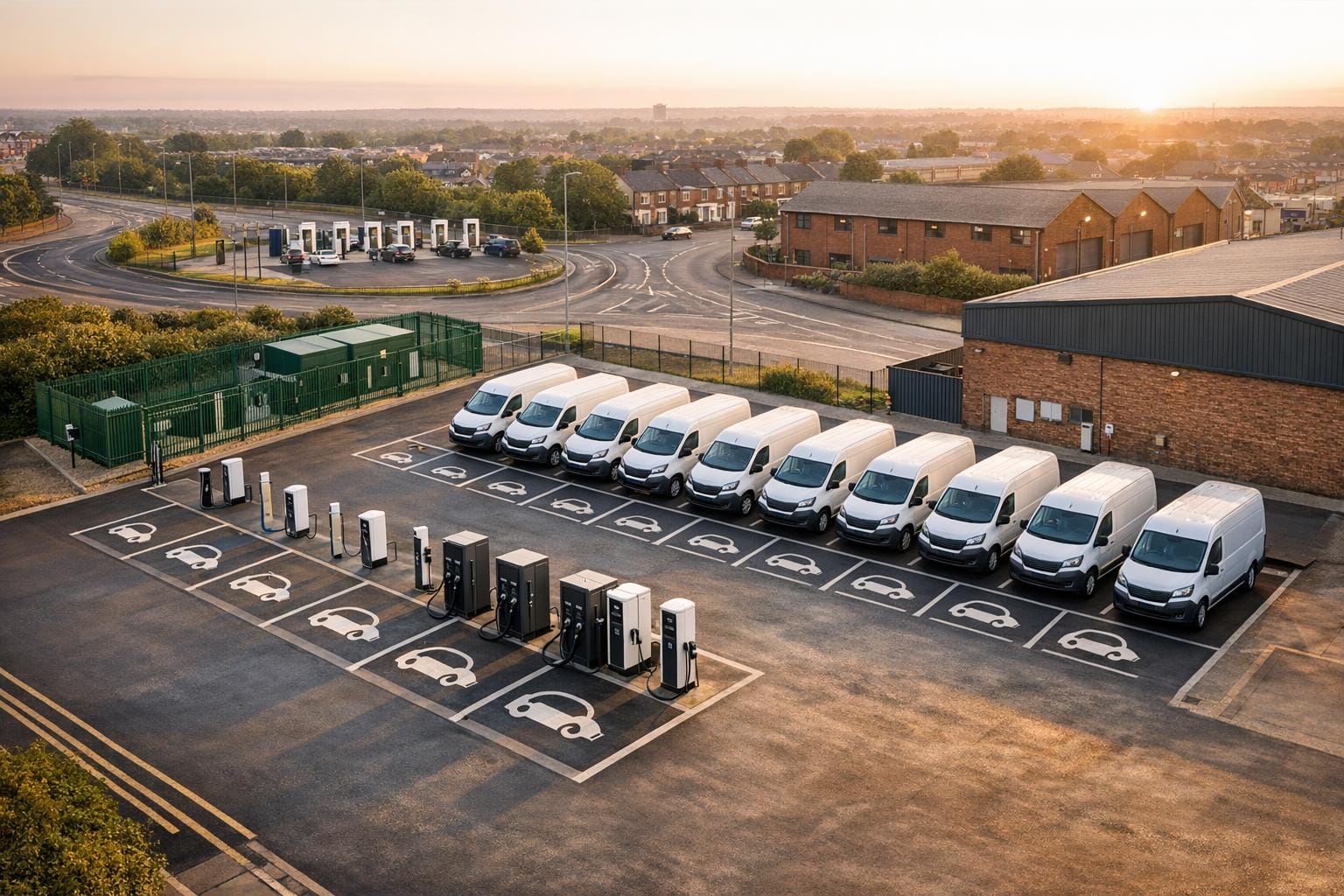
Electrifying fleets in the UK can save operators up to £3,605 per vehicle annually in fuel, tax, and maintenance costs. However, scaling EV charging infrastructure is challenging due to grid capacity limitations and high upfront costs. Fleet managers must choose between Level 2 chargers, DC fast chargers, dedicated depot charging, or shared hubs, each with distinct costs, installation requirements, and scalability.
- Level 2 chargers: Affordable (£2,000–£3,000 per unit installed), slower (4–12 hours for a full charge), suitable for overnight charging.
- DC fast chargers: Expensive (£15,000–£50,000+ installed), faster (20–60 minutes for 80% charge), ideal for multi-shift fleets.
- Depot charging: Centralised but costly (£150,000+ for grid upgrades), offers long-term savings with managed energy use.
- Shared hubs: Pay-per-use model, avoids upfront costs but comes with higher per kWh rates.
Early grid assessments, smart charging software, and government grants (e.g., Workplace Charging Scheme, Depot Charging Scheme) can reduce costs and delays. Using van tracking solutions to optimise charging schedules and energy needs ensures fleets operate efficiently while minimising expenses.
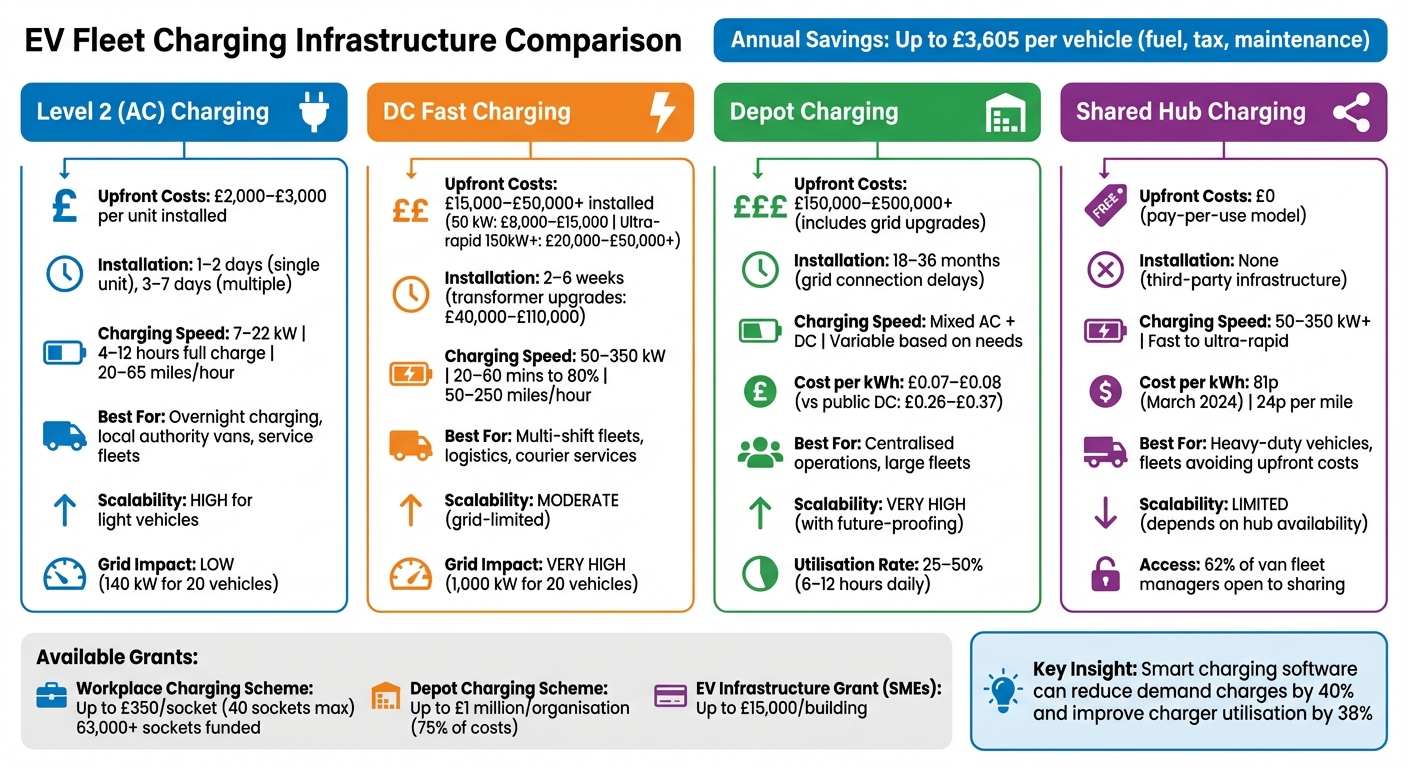
EV Fleet Charging Options: Cost and Performance Comparison
1. Level 2 Charging
Upfront Costs
Level 2 chargers, offering 7–22 kW AC, are often the most affordable starting point for fleet electrification. The hardware itself costs between £1,000 and £3,000 per unit. On top of that, professional installation adds another £1,000 to £1,500, bringing the total cost per charging point to around £2,000–£3,000 + VAT.
However, installation costs can sometimes exceed the price of the charger itself, especially when significant groundworks are involved. Tasks such as trenching, ducting, laying foundations, and adding protective measures can range from £500 to over £3,000 per charger, depending on the site’s surface and the distance to the power supply. To help with these expenses, the Workplace Charging Scheme (WCS) offers up to £350 per socket for up to 40 sockets across multiple sites. By July 2025, this scheme had funded over 63,000 charging sockets throughout the UK.
Installation Complexity
Installing a single Level 2 charger is relatively simple and typically takes 1–2 days. However, projects involving multiple chargers can take 3–7 days, depending on site-specific factors like the distance to the power supply, the existing infrastructure, and the grid’s capacity. For sites that need upgrades - such as new distribution boards, high-capacity cabling, or switchgear - costs can range from £1,000 to over £20,000.
When installing multiple chargers, three-phase power is often required, which may necessitate upgrading from single-phase power. To avoid surprises, it’s essential to conduct a grid capacity assessment with your Distribution Network Operator (DNO) and arrange an early site survey.
Charging Speed
Level 2 chargers provide a range boost of 20–65 miles per hour, with a full charge taking roughly 4–12 hours. This makes them ideal for operations where vehicles return to a central base and remain parked overnight or for extended periods. Examples include local authority vans, service fleets, and NHS operational vehicles. The slower charging pace also helps preserve battery health over time.
Scalability
Level 2 systems are not only practical but also easier to scale compared to DC fast charging. They are more affordable and place less strain on the local grid. For instance, a fleet of 20 vans charging simultaneously on 7 kW chargers would create a peak demand of about 140 kW - a manageable load for most commercial sites, especially when using smart load management.
To prepare for future expansion, it’s wise to oversize cabling and switchgear during the initial installation. This reduces the need for costly additional trenching later. Smart charging software can also help by enabling dynamic load balancing, which prevents site overloads and delays the need for immediate grid upgrades. A project in Leeds demonstrated how extended vehicle dwell times significantly reduced peak grid demand, showcasing the benefits of strategic planning.
sbb-itb-499a7f0
2. DC Fast Charging
Upfront Costs
DC fast charging stands out for its speed, but it comes with a hefty price tag and more demanding installation requirements compared to Level 2 chargers. A 50 kW DC fast charger typically costs between £3,000 and £8,000, while ultra-rapid chargers (150 kW or more) can exceed £60,000 just for the hardware. When you factor in installation costs - which include equipment, labour, and groundwork - a 50 kW unit can cost £8,000 to £15,000 to install. For ultra-rapid chargers, this figure can climb to £20,000–£50,000 or more. In contrast, Level 2 installations generally cost less than £4,000 per unit.
Tom Bowen, President of Qmerit Solutions, highlights the complexity of these systems:
DC fast chargers are the most complex and costly type of EV charging station, requiring the most energy and added complexities for installation.
Installation Complexity
Setting up DC fast chargers is far more intricate than installing Level 2 systems. These chargers need a 480V DC utility supply, which often necessitates significant infrastructure upgrades. For example, transformer replacements alone can cost between £40,000 and £110,000, and additional work like upgrading distribution boards and trenching may be required.
Grid approvals from your Distribution Network Operator (DNO) can also complicate matters. While a Level 2 installation might take just 1–2 days, DC fast charger projects often require 2–6 weeks to move from planning to commissioning. Early coordination with the DNO is essential, as grid capacity issues can sometimes double the expected costs. Despite these challenges, the faster charging times make these systems appealing for certain applications.
Charging Speed
One of the biggest advantages of DC fast charging is its speed. These chargers can deliver between 50 and 250 miles of range per hour, which is roughly ten times faster than Level 2 systems. Charging to 80% capacity typically takes just 20–60 minutes, making them ideal for time-sensitive operations like logistics and courier fleets. Integrating white-label van tracking solutions can further optimize these operations by providing real-time data on vehicle location and battery status. However, charging speeds slow beyond 80% to help preserve battery health. Many operators follow the 80/20 rule, keeping batteries charged between 20% and 80% to maintain efficiency and longevity.
Scalability
Scaling DC fast charging systems presents its own set of challenges, particularly around grid capacity and demand management. For instance, charging 20 vehicles simultaneously on 50 kW units would require around 1,000 kW of power, which could easily exceed the electrical capacity of many sites. Without proper scheduling, monthly demand charges for just 10 vehicles could reach £20,000–£26,000.
To address these challenges, optimising charger usage is crucial. US Foods, for example, operates 30 electric trucks with only 6 chargers, achieving a 5:1 truck-to-charger ratio. Similarly, PepsiCo’s Sacramento site cut its demand charges by 40% by using managed charging software for its 21 Tesla Semis. Planning for the future is also important - oversizing cabling and switchgear during installation can make it easier to expand the system later without incurring additional groundwork costs.
3. Depot Charging
Upfront Costs
Depot charging offers a centralised solution tailored to the needs of fleet operations. The cost of setting up a depot charging system varies based on the complexity of the infrastructure. For example, a basic overnight AC charging setup for a small fleet of vans might start at around £10,000. On the other hand, more advanced installations - featuring multiple DC rapid chargers, significant grid upgrades, and a Battery Energy Storage System (BESS) - can easily reach hundreds of thousands or even millions of pounds.
One of the biggest expenses is upgrading the Maximum Import Capacity (MIC) of the grid connection. These upgrades can cost hundreds of thousands of pounds and may take over a year to complete. However, smart charging software and Energy Management Systems (EMS) can help manage energy loads effectively, potentially avoiding the need for immediate grid upgrades.
Despite the higher upfront costs, depot charging offers long-term savings. Public DC fast charging typically costs 2.5 to 3.5 times more per kWh than optimised depot charging. While depot charging can cost as little as £0.07–£0.08 per kWh, public DC fast charging rates range between £0.26 and £0.37 per kWh. Over time, these savings can offset the initial investment.
Installation Complexity
Setting up a depot charging system involves careful planning, including site assessments, securing permissions, and completing the necessary civil and electrical work. A thorough evaluation of the existing electrical infrastructure is crucial to ensure it can handle the load from multiple chargers.
ZAPME highlights a common pitfall in this process:
"A common and costly mistake is underestimating the need for a grid upgrade. A thorough site assessment helps you budget accurately and avoid months of unexpected delays."
Grid connection delays in the UK can range from 18 to 36 months, with some HGV operators facing wait times of up to 14 years for upgrades. Will Reeves, Commercial Vehicle Section Manager at SMMT, notes:
"Grid connection delays remain a major bottleneck, particularly for HGV operators. Some are facing wait times of up to 14 years for upgrades."
To avoid delays, it's essential to engage with your local Distribution Network Operator (DNO) early in the process. Additionally, using telematics and route history data can help accurately calculate daily energy needs and peak power requirements. The UK government’s Depot Charging Scheme can also ease the financial burden, offering up to £1 million per organisation to cover up to 75% of eligible infrastructure costs (excluding grid upgrades).
Charging Speed
Depot charging systems are designed to balance AC and DC charging to meet both long dwell and rapid turnaround needs. For vehicles parked overnight, AC chargers (typically 7–22 kW) are ideal, taking 4–12 hours for a full charge. This slower charging rate helps reduce costs and extends battery life.
For fleets with multi-shift operations or quick turnaround requirements, DC rapid chargers can deliver an 80% charge in just 20–60 minutes. By aligning the charging infrastructure with the fleet's operational needs, depot charging can provide both cost efficiency and flexibility.
Scalability
Depot charging systems should be designed with future growth in mind. Many fleets start with a pilot phase, involving 3–5 vehicles, before scaling up. Incorporating features like oversized conduit and flexible electrical infrastructure during initial construction can help avoid costly upgrades later. Similarly, planning for additional charging bays, solar panels, or BESS from the outset is a smart move.
Load management software is another key component. By staggering charging sessions based on schedules, fleets can reduce peak demand and cut electricity costs by up to 40%. This software also improves charger utilisation by 38%. Adding a BESS to the system allows gradual grid charging and rapid discharge, effectively increasing capacity without requiring a full grid upgrade.
| Operational Factor | Implication for Depot Scalability |
|---|---|
| Dwell Time | Long dwell times (8+ hrs) enable the use of slower, cheaper AC chargers |
| Shift Patterns | Multi-shift operations require DC rapid charging to maintain fleet uptime |
| Grid Constraints | Limited capacity can be managed with a BESS or smart load balancing software |
| Site Layout | Must accommodate vehicle flow and manoeuvring for larger fleet assets |
This approach ensures that depot charging systems remain adaptable and efficient, complementing the broader strategies for Level 2 and DC fast charging discussed earlier.
4. Shared Hub Charging
Upfront Costs
Shared charging hubs use existing capacity to significantly reduce the need for large upfront investments. Instead of building entirely new infrastructure, fleets can utilise spare capacity at other operators' sites. This is especially useful for heavy-duty vehicles, where infrastructure costs can be extraordinarily high.
The concept spreads costs across multiple users. For instance, the Welch Group has teamed up with Voltloader to make its charging sites accessible to other fleet operators. This helps tackle the high expense of heavy-duty vehicle charging while also supporting emissions reduction efforts. It also makes electrification a more feasible option for organisations that might struggle to afford standalone infrastructure.
Interestingly, a survey by the Association of Fleet Professionals shows that 62% of van fleet managers are open to sharing depot access, and 58% are considering sharing public charging facilities to accelerate electric vehicle adoption.
While the cost advantages are clear, shared hubs also bring installation challenges.
Installation Complexity
Although shared hubs minimise the need for entirely new installations, they introduce logistical hurdles that require careful coordination. Managing access, scheduling, and payments demands robust software solutions.
To address these challenges, the Association of Fleet Professionals, with input from organisations like the AA, National Grid, and Royal Mail, is working on an online platform. This tool will help match fleets with spare capacity to those in need, streamlining booking and access. Similarly, the Private Infrastructure Network Solution (PINS) project is collaborating with local stakeholders to optimise shared infrastructure usage.
Legal agreements are also essential to define responsibilities and establish site rules. Additionally, "zone-aware" or smart charging software is critical to avoid grid overloads when multiple fleets charge vehicles at the same time.
These complexities can also influence operational schedules, particularly when it comes to charging speeds.
Charging Speed
Different types of chargers cater to varying needs. AC chargers, with ratings between 7 and 22 kW, are ideal for vehicles that can charge over longer periods. On the other hand, DC rapid chargers are better suited for quick turnarounds, making them perfect for multi-shift operations.
In shared hubs, scheduling access becomes a key factor. Platforms like Paua Share or FPS Operate allow third-party access during off-peak hours - typically from 9 am to 5 pm. This ensures priority access for host fleets while maximising the use of charging infrastructure.
Scalability
From a cost perspective, shared hubs offer a scalable solution. They allow for phased deployment, aligning infrastructure growth with fleet demand. By connecting fleets with surplus capacity, these hubs make better use of existing infrastructure and minimise idle time.
However, challenges like limited urban space and grid constraints can slow down or limit expansion beyond initial phases. In the UK, connection lead times can also delay project timelines.
Despite these obstacles, shared charging models provide flexible options for fleets transitioning to electric vehicles. By treating infrastructure as a platform that can grow over time, shared hubs are designed to expand without the need for costly redesigns.
Road Test: DC Fast Charging | Real-World EV Charging for Fleet Drivers
Advantages and Disadvantages
This section breaks down the key advantages and drawbacks of each charging model, building on the earlier cost and performance details.
Each option comes with its own set of trade-offs, impacting both costs and operational flexibility. Let’s start with Level 2 (AC) charging. It’s the most affordable in terms of upfront costs - ranging from £3,000 to £12,000 per unit. It also requires minimal electrical work, making it a great choice for light vehicles that can charge overnight (8+ hours). However, with speeds of 7–22 kW, a full charge takes 4–10 hours, which makes it less practical for multi-shift or heavy-duty operations.
DC fast charging (DCFC), on the other hand, offers much faster charging - anywhere from 20 minutes to 2 hours depending on the power output (50–350 kW). But this speed comes at a price: hardware costs range from £28,000 to over £150,000 per unit, with installation costs adding another £15,000–£100,000 due to the need for transformer upgrades and trenching. Maintenance costs are also significant, running between £2,500 and £3,000+ annually per charger. Plus, demand charges can make up 68–81% of operating costs, and grid upgrades can delay implementation by 12–18 months.
Depot charging takes a different approach by focusing on cost optimisation and scheduling. Well-managed depot sites can achieve charger utilisation rates of 25–50% (6–12 hours daily). This model is scalable if the infrastructure is designed with future growth in mind - oversizing conduits and transformers during initial construction can prevent costly retrofits later. However, site costs are steep, ranging from £150,000 to £500,000 after incentives, and the operator is fully responsible for maintenance and grid coordination.
Finally, there’s shared hub charging, which eliminates upfront costs entirely. Fleets can access third-party infrastructure on a pay-per-use basis, making it particularly appealing for heavy-duty vehicles where building standalone infrastructure is often too expensive. The downside? Operating costs are significantly higher. In March 2024, public rapid charging averaged 81p per kWh (24p per mile), compared to depot rates of roughly 25p per kWh (8p per mile). Scalability is also limited by the availability and location of hubs, and fleets have no control over charging schedules during peak usage.
Here’s a quick comparison of the key features across all four models:
| Technology / Model | Upfront Costs | Installation Requirements | Charging Speed | Scalability Potential |
|---|---|---|---|---|
| Level 2 (AC) | Low (£3k–£12k total) | Standard electrical panel; minimal groundworks | Slow (7–22 kW); 4–10 hours | High for light vehicles; limited for heavy-duty |
| DC Fast (DCFC) | High (£46k–£280k+ total) | Transformer upgrades; trenching; 3-phase power | Fast (50–350 kW); 20 mins–2 hours | Scalable via modular power cabinets; grid-limited |
| Depot Charging | Very High (site-level) | Grid upgrades; dedicated switchgear; software | Variable (mix of L2 and DCFC) | High; requires future-proofed conduits |
| Shared Hub | Zero (subscription/pay-per-use) | None (third-party infrastructure) | Fast to ultra-rapid (50–350 kW+) | Limited by third-party availability/location |
These comparisons highlight the trade-offs involved in each charging model and set the stage for exploring how telematics can help optimise charging costs further.
Using Telematics to Reduce Charging Costs
Telematics can be a game-changer when it comes to cutting down charging expenses for electric vehicle (EV) fleets. By using telematics, fleet managers can fine-tune battery capacity requirements, avoiding unnecessary spending. For instance, analysing average and maximum daily distances - whether for short urban deliveries or longer routes - helps determine the exact battery capacity each vehicle needs. This insight can prevent costly investments in DC fast chargers when overnight AC charging might be enough.
Telematics also helps identify idle periods, like overnight stops of 8+ hours, 45-minute lunch breaks, or quick 20-minute loading intervals. By syncing charging schedules with these natural breaks, fleets can charge vehicles without disrupting operations, saving money in the process.
Energy Management Systems (EMS) play a crucial role here, too. They monitor battery levels and schedule charging during off-peak electricity hours to keep costs low. Smart charging software ensures vehicles don’t draw power during peak times, potentially saving fleets tens of thousands of pounds annually. Additionally, dynamic load balancing prevents sites from exceeding their Maximum Import Capacity (MIC), helping avoid hefty grid penalties and demand charges.
Telematics doesn’t just stop at charging schedules - it also enhances driver performance analysis. Metrics like miles per kilowatt-hour and payload weight can reveal inefficiencies such as harsh acceleration or excessive idling. Addressing these behaviours not only reduces energy consumption but also improves cost predictability.
When combined with a comprehensive charging infrastructure strategy, telematics ensures every decision is both economical and efficient. For fleets moving to EVs, solutions like GRS Fleet Telematics - offering real-time tracking, eco-driving insights, and route optimisation for just £7.99 per vehicle per month - make it easier to base charging decisions on solid data, keeping costs under control.
Conclusion
Selecting the right charging setup for your fleet hinges on its size and how it operates. For small fleets, a Turnkey Model paired with AC charging (7–22kW) works well, especially when combined with the Workplace Charging Scheme grant, which offers up to £350 per socket. Medium-sized fleets can cut costs by as much as 40% using a Hybrid Model that blends fixed wallboxes with industrial plug-in chargers. For larger fleets, a Managed Model or Charging as a Service (CaaS) is ideal. These approaches often incorporate Energy Management Systems, which use battery storage to balance peak energy demands and avoid costly grid upgrades. These models provide scalable solutions for fleets of varying sizes.
When it comes to technology, AC charging is the go-to option for most depots in the UK. However, DC fast charging (50kW and above) is better suited for high-use, multi-shift fleets where minimising downtime is critical. This ensures your technology matches the unique requirements of your fleet.
Before investing in charging hardware, analyse your telematics data. For example, a fleet of 20 vans driving 60 miles daily, with an efficiency of 2.5 miles per kWh, would need around 480 kWh of energy each day. This can typically be handled with managed AC charging, avoiding the expense of DC units. Additionally, apply for grants early to offset installation costs. The Workplace Charging Scheme and the EV Infrastructure Grant for SMEs (offering up to £15,000 per building) can significantly reduce expenses. It’s also a good idea to consult your local Distribution Network Operator to confirm your site’s Maximum Import Capacity, helping you avoid surprise demand charges. During installation, oversizing cabling and ducting ensures your infrastructure can handle future expansions.
The key to a smooth fleet transition lies in viewing charging infrastructure as a long-term operational platform rather than a one-off purchase. As Blink Charging aptly explains:
Fleet charging infrastructure is not a one-time build, it's a platform. The most future-ready depots are designed to expand without rework.
FAQs
How do I choose between AC and DC charging for my fleet?
When deciding between AC and DC charging, it's all about what suits your fleet's needs and how quickly you need to charge. AC chargers work well for slower, overnight charging at depots, making them a budget-friendly choice for regular top-ups. DC chargers, however, are built for speed, delivering rapid charging to keep downtime during the day to a minimum. To choose the right option, think about your fleet's schedules, route requirements, and the space you have available at your site.
When will I need a DNO grid upgrade at my depot?
If your EV charging needs surpass the capacity of your current electricity connection, you'll require a DNO grid upgrade. This often happens with high-power chargers or when managing large fleets. The process might involve implementing load management systems or going through a formal connection upgrade. It's best to consult your DNO (Distribution Network Operator) to understand the specific requirements and the steps to take.
How can telematics reduce my EV charging costs?
Telematics helps lower EV charging costs by offering detailed insights into energy usage, charging patterns, and battery condition. With this information, fleet managers can adjust charging schedules to take advantage of off-peak electricity rates, significantly reducing expenses. It also highlights inefficiencies in charging processes or battery performance, allowing for timely adjustments that improve energy efficiency and prolong battery life. This smarter strategy can reduce operational costs by as much as 30%, while also promoting more efficient fleet management practices.