Scalable Drone and AV Solutions for Logistics
How drones and AVs cut costs, speed last‑mile delivery and scale with telematics, AI and pilot projects.
 By Michael Bar9 min read
Logistics is changing fast. Drones and autonomous vehicles (AVs) are solving delivery challenges, especially for the last mile, which makes up over 50% of logistics costs. With e-commerce booming and urban areas congested, these technologies offer faster, cost-effective delivery options.
Key insights:
- Drone deliveries are forecasted to grow from 5 million in 2024 to 808 million annually by 2034.
- Goods delivered by drones could exceed £50 billion in value by 2034.
- Drones and AVs reduce delivery times, improve efficiency, and lower emissions by up to 45 tonnes of CO₂ per year.
Technologies driving this shift include AI-powered route planning, advanced sensors, and fleet management tools. Companies are also using hybrid systems to coordinate drones and AVs, cutting delivery costs by up to 28%.
Scaling up requires addressing challenges like battery life, regulations, and infrastructure costs. Pilot projects and van tracking solutions are essential to test and manage fleets effectively.
Drones and AVs are no longer experimental - they're reshaping logistics now.
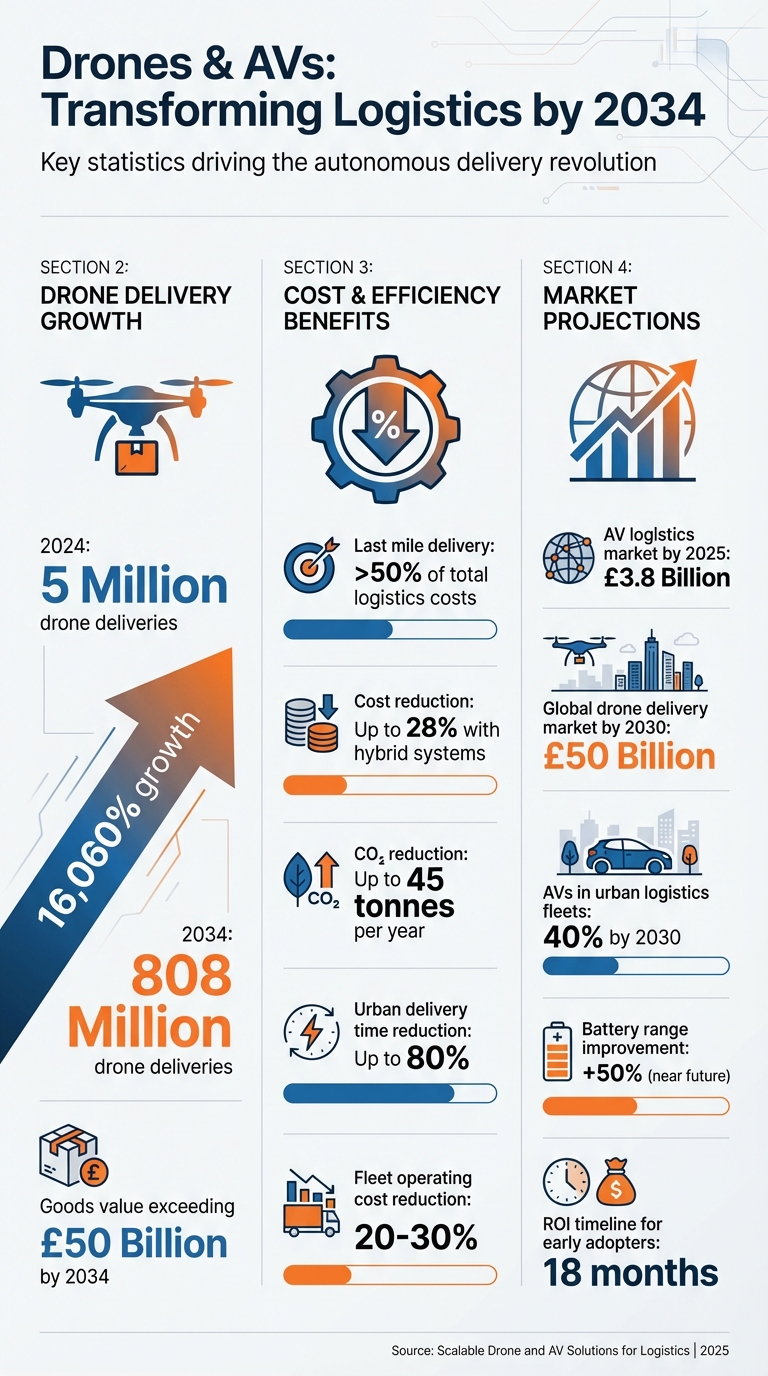
Drone and AV Logistics Growth Statistics 2024-2034
Key Technologies for Scalable Operations
Drone Payload and Navigation Systems
In December 2025, DJI unveiled the FlyCart 100, a heavy-lift delivery drone designed to carry up to 100 kg using its coaxial eight-rotor system. This drone can transport a 65-kg payload over a distance of 12 km. To minimise downtime, it features hot-swappable 41Ah batteries that recharge in under 20 minutes. Safety is prioritised with integrated sensors, including LiDAR, millimetre-wave radar, and penta-vision cameras, which enable autonomous flight. In emergencies, a factory-installed parachute slows its descent to seven metres per second.
The FlyCart 100 also includes an advanced winch system with 30-metre cables and electric hooks, allowing it to deliver cargo without landing. The winch retracts at a speed of 1.2 m/s. Additional features, like ultra-fast charging and battery incubators for cold-weather operations, enable these drones to perform in extreme conditions - operating at altitudes of up to 20,000 feet, in winds up to 27 mph, and temperatures ranging from -20°C to 40°C. These advancements not only enhance drone performance but also serve as a foundation for AI-driven decision-making in autonomous operations.
AI and Sensors in Autonomous Vehicles
Autonomous vehicles (AVs) complement drone technology by using AI and advanced sensors for real-time navigation. These systems process raw data from LiDAR, radar, and cameras to make immediate, safe decisions on the road. Vehicle-to-Everything (V2X) communication further enhances their capabilities, enabling interaction with infrastructure and other vehicles to streamline traffic flow.
Digital twin technology, combined with AI-powered HD Live Maps, acts as a virtual super-sensor, helping fleets navigate complex road conditions, intersections, and sharp turns with precision. Predictive analytics also play a key role, improving efficiency by optimising inventory levels and scheduling proactive maintenance, which can potentially cut transportation costs by 40%. The logistics market for autonomous vehicles is projected to grow to approximately £3.8 billion by 2025. Advanced telematics systems offer fleet operators comprehensive oversight, ensuring smooth management of increasingly complex and diverse fleets.
Coordinating Mixed Fleets
Managing a combination of drones and autonomous vehicles requires advanced coordination tools. Hybrid quantum-classical optimisation methods, such as the Quantum Approximate Optimization Algorithm (QAOA) paired with Deep Q-Networks (DQN), have shown promise in cutting logistics costs by 28% and reducing delivery times by 32%.
Unmanned Traffic Management (UTM) software is vital for drone navigation, helping them avoid collisions with other drones, manned aircraft, and obstacles. Geo-awareness systems provide real-time alerts about restricted airspace, ensuring compliance with regulations. For instance, drones typically operate below 120 metres and maintain a horizontal distance of at least 50 metres from uninvolved people. A practical example of this coordination is Zipline International Inc., which completed 1,036,276 deliveries by May 2024, showcasing the effectiveness of these systems.
However, regulatory hurdles remain a significant challenge, accounting for 92% of practical errors in mixed fleet operations. Addressing energy constraints through high-density solid-state batteries (at least 400 Wh/kg) can further improve reliability. These developments are paving the way for quantum-enhanced logistics systems, which are essential for scaling operations in smart cities and other demanding environments.
Examples of Scalable Drone and AV Deployments
Drone Delivery Systems in Practice
IONA serves as a striking example of how drone technology is being applied in logistics on a larger scale. By leveraging advanced technology, IONA provides a white-labelled, plug-and-play drone delivery solution. This system integrates autonomous drones directly into existing logistics networks, making it suitable for express deliveries, e-commerce, and industrial applications. Their drones are designed to handle precision tasks, such as transporting medical samples or efficiently navigating low-density rural areas.
Challenges and Solutions for Scaling Drone and AV Logistics
Regulatory and Compliance Requirements
Expanding drone and autonomous vehicle (AV) operations means tackling the maze of airspace regulations and road safety standards. Tools like GRS Fleet Telematics simplify this process with features such as real-time GPS tracking and geofencing. These tools set virtual boundaries and send alerts if drones or vehicles stray into restricted zones or deviate from approved routes. Additionally, the system monitors driver behaviour and working hours, ensuring safety protocols are followed during scaled operations. Another layer of security comes from engine immobilisation, which prevents unauthorised use. For larger fleets, GRS Fleet Telematics' dual-tracker system provides real-time data on speed and vehicle status, making compliance oversight quicker and more efficient. Together, these measures address key roadblocks to scaling operations.
Battery Life and Range Constraints
Beyond regulations, technical hurdles like battery performance significantly affect scalability. Advances in battery technology are expected to lower delivery costs per drone from £5–£21 to under £6 within the next decade. To support continuous operations, automated charging stations and maintenance facilities are becoming essential. Another strategy is micro-warehousing, where distribution hubs are located closer to customers to reduce the strain on drone autonomy. Choosing VTOL (Vertical Take-Off and Landing) aircraft instead of standard multirotors can also boost range and efficiency. Additionally, AI-powered route planning plays a critical role, optimising airspace use, predicting potential technical failures, and improving battery performance.
Infrastructure and Deployment Costs
The financial side of scaling operations is another major challenge. Setting up the necessary infrastructure, such as charging stations and operational hubs, comes with a hefty price tag - typically ranging from £260,000 to £300,000 for the initial phases. A commercial fleet of 20 drones costs roughly £850,000 (£43,000 per unit). Monthly overhead for ground stations, including rent (£8,500), cloud services (£4,300), and insurance (£2,100), adds up to about £23,500. However, integrated fleet management systems like GRS Fleet Telematics can help offset these costs. By offering real-time GPS tracking, route optimisation, and fuel efficiency analytics, the system reduces operational expenses. With hardware starting from £35 per unit and a monthly service fee of just £7.99 per vehicle, it provides an affordable way to monitor fleet performance and plan charging infrastructure. The dual-tracker technology, which combines hardwired GPS with a hidden Bluetooth backup, also protects valuable autonomous equipment.
How to Implement Scalable Drone and AV Solutions
Start with Pilot Projects
Launching with a pilot project is a smart way to test drone and autonomous vehicle (AV) technologies on a manageable scale. It allows you to identify potential technical challenges, evaluate feasibility, and gather real-world performance data - all while keeping financial risks low. Focus on a specific delivery route or a small geographic area for the trial. Track crucial metrics like battery life, navigation accuracy, and delivery success rates. This data helps refine your processes before scaling up. Once the pilot confirms the technology’s effectiveness, integrating advanced telematics systems becomes essential for managing a growing fleet.
Leveraging GRS Fleet Telematics for Mixed Fleets
As fleets expand, managing both traditional and autonomous vehicles can become complex. GRS Fleet Telematics offers a single platform to monitor mixed fleets in real time via web and mobile apps. The geofencing feature is particularly useful, setting operational boundaries and triggering alerts if vehicles deviate. Its dual-tracker system combines hardwired GPS with a hidden Bluetooth backup, ensuring continuous monitoring. Additional features like remote immobilisation protect high-value equipment by preventing unauthorised engine starts. The hardware is affordable, starting from £35 per unit, with a monthly service fee of £7.99 per vehicle.
Scaling Operations with Data Insights
Once your pilot project is complete and telematics systems are in place, data becomes your best ally for scaling up. Performance analytics can help you monitor everything from maintenance schedules and energy usage to route efficiency. Predictive maintenance tools reduce unexpected downtime, while tracking fuel consumption and eco-driving behaviours can reveal cost-saving opportunities. Some logistics companies report recovering their telematics investment within six months through fuel savings alone. Real-time route optimisation tools further enhance efficiency by streamlining delivery paths. Additionally, monitoring driver behaviour and ensuring safety compliance keeps operational standards high. For added flexibility, white-label telematics platforms allow you to customise tracking systems for internal use or resale.
Conclusion: The Future of Scalable Logistics with Drones and AVs
Drones and autonomous vehicles (AVs) are reshaping logistics, offering faster deliveries, reduced costs, and a competitive edge. With advancements like AI-driven navigation and mixed fleet coordination, automation is transforming traditional logistics. In the UK, early adopters are already reaping the benefits, with urban delivery times slashed by up to 80% and fleet operating costs cut by 20–30% through optimised routing and fuel efficiency. What was once experimental is now becoming a core component of logistics strategies.
The road ahead demands strategic planning. Pilot projects are a great starting point to test and refine these systems. Battery technology is improving rapidly, with ranges expected to increase by 50% in the near future. The global drone delivery market is also forecast to hit £50 billion by 2030, while AVs are predicted to make up 40% of urban logistics fleets. These advancements aren't on the distant horizon - they're shaping the industry as we speak.
Effective fleet management is key to scaling operations. Telematics platforms bring real-time visibility, route optimisation, and analytics to the table, ensuring smooth coordination of expanding fleets. Tools like GRS Fleet Telematics provide comprehensive tracking from just £7.99 per month, offering features like geofencing and remote immobilisation to safeguard valuable assets. Whether managing traditional vehicles, drones, or a combination of both, robust tracking systems are vital for growth.
Embracing drones and AVs today positions businesses to lead the logistics market of tomorrow. Start with pilot programmes, implement strong telematics systems, and use performance data to scale effectively. The technology is ready, regulations are evolving, and the financial benefits - such as ROI within 18 months for many early adopters - are hard to ignore.
Take the first step towards optimised logistics by integrating drones and AV solutions. Partner with GRS Fleet Telematics to secure and streamline your operations from just £7.99 per month.
FAQs
Where do drones or AVs fit best in my delivery network?
Drones and autonomous vehicles (AVs) shine when used alongside traditional transport methods. Drones are perfect for handling last-mile delivery of small, time-sensitive packages, especially in busy city environments where traffic congestion is a challenge. On the other hand, AVs are better suited for managing larger-scale operations, efficiently transporting medium to heavy loads. Their ability to integrate with telematics systems allows for real-time tracking and safety monitoring, making them a great fit for urban logistics and smart city infrastructure.
What approvals do I need to run drone deliveries in the UK?
To use drones for deliveries in the UK, you’ll need a Flyer ID, which requires passing a theory test if the drone weighs 100g or more. Additionally, an Operator ID must be visibly displayed on every drone. For more complex tasks, like beyond visual line of sight (BVLOS) operations or deliveries in urban areas, you’ll need Operational Authorisation from the Civil Aviation Authority (CAA) and advanced pilot certification.
How do I keep mixed fleets compliant and secure at scale?
To maintain compliance and security across mixed fleets on a large scale, it's essential to adopt reliable telematics solutions. GRS Fleet Telematics offers a range of features, including dual-tracker systems, geo-fencing capabilities, remote immobilisation, and automated diagnostics.
Combining telematics with fleet management software enhances the ability to monitor compliance and oversee operations effectively. Additionally, regular system reviews, proper hardware installation, and thorough staff training play a crucial role in ensuring security and adhering to regulatory requirements.