
API Reliability: Why It Matters for Fleet Management
Dependable APIs ensure accurate tracking, timely maintenance and stronger security—cutting fleet downtime and costs.
 By Michael Bar11 min read
Fleet management relies on APIs to ensure smooth data sharing between systems like van tracking solutions, route planners, and maintenance tools. When APIs fail, the consequences are severe - delayed updates, missing vehicle data, and higher costs. Reliable APIs ensure uninterrupted uptime, accurate data, and secure communication, which are critical for real-time tracking, predictive maintenance, and theft prevention.
Key takeaways:
- Reliable APIs: Maintain 99.99% uptime, respond within 200ms, and have error rates below 0.1%.
- Unreliable APIs: Cause delays, missed alerts, and increased costs (e.g., emergency repairs cost 3–5x planned maintenance).
- Security risks: Poor APIs expose sensitive data like vehicle locations and routes.
- Cost savings: Reliable APIs reduce inefficiencies by 20–30% and improve theft recovery rates by 75%.
For fleet managers, choosing an API with strong security, low error rates, and fast response times is essential to avoid disruptions and improve efficiency.
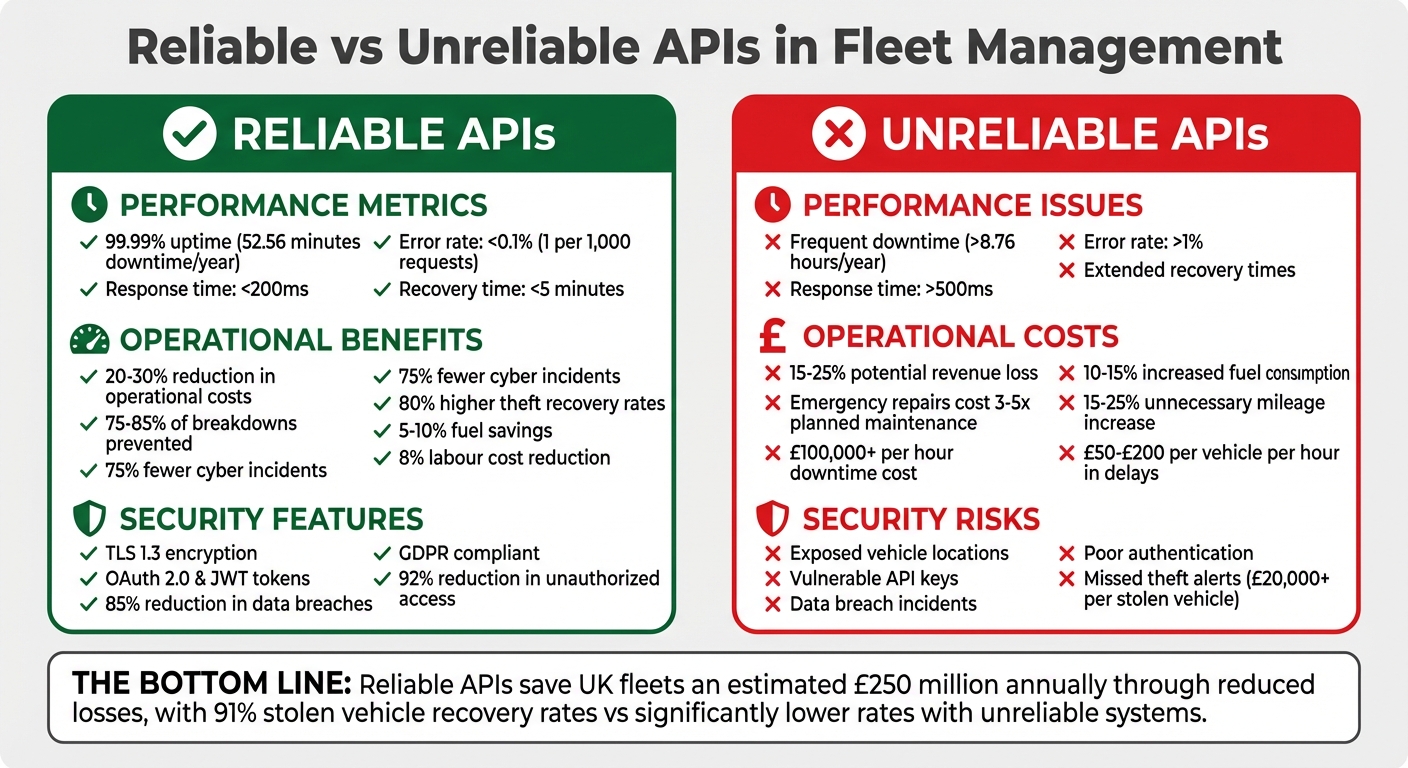
Reliable vs Unreliable APIs: Impact on Fleet Management Performance
Demo: Create an AI Agent to Power a Smart Fleet Management Software with MongoDB

How Unreliable APIs Affect Fleet Operations
When APIs fail or behave inconsistently, the consequences can disrupt nearly every aspect of fleet management. Fleet managers are left operating "blind", unable to access real-time data on vehicle health, driver behaviour, or route efficiency. This forces teams to address problems after they occur, rather than proactively resolving them. The absence of reliable data impacts critical areas like vehicle tracking, maintenance planning, and overall operational security.
The financial toll is substantial. Fleet operations can lose between 15% and 25% of their potential revenue due to inefficiencies that could have been avoided with real-time data. Gene Whaley from Keystone Technology Consultants highlights the issue, stating that "integration complexity represents the primary cost and failure risk in IoT fleet management".
Problems with Real-Time Vehicle Tracking
When location data is delayed or inaccurate, delivery schedules and customer service take a hit. If tracking APIs fail, dispatchers lose the ability to reroute vehicles in response to traffic or weather conditions, leading to missed delivery windows. This is particularly problematic given that 80% of consumers now expect same-day delivery.
Reliable GPS tracking APIs typically help fleets cut labour costs by 8%. Without them, dispatchers often resort to manual check-ins, wasting time that could be better spent on strategic tasks. The lack of accurate tracking data also leads to increased fuel consumption - by as much as 10–15% - and unnecessary mileage, which can rise by 15–25% when route optimisation systems go offline.
Another critical issue is "silent data drift", where discrepancies arise between Transportation Management System metrics and IoT platform data. This erodes trust in the data, pushing teams to make decisions based on instinct rather than facts. Beyond tracking, unreliable APIs can also disrupt maintenance schedules, escalating operational costs.
Higher Costs and Missed Maintenance Alerts
Predictive maintenance APIs are designed to prevent 75–85% of unexpected breakdowns by monitoring engine diagnostics and fault codes in real time. When these systems fail, fleet managers may miss crucial alerts, allowing small issues to turn into costly breakdowns.
The financial impact is stark. Emergency repairs caused by missed maintenance alerts cost 3–5 times more than planned maintenance activities. This can also lead to vehicles sitting idle for extended periods, creating "unplanned maintenance storms" that strain both budgets and schedules.
Security Risks from Unstable APIs
Unstable APIs don’t just create operational challenges - they also expose fleets to significant security risks. For example, unreliable systems can act as "attack paths", making sensitive data like vehicle locations, routes, and operational systems vulnerable to unauthorised access.
Poor exception handling in APIs can inadvertently expose internal server logic, database schemas, or even API keys to malicious actors. Additionally, intermittent connectivity can disrupt authentication processes, leaving active tokens lingering longer than they should. Without strong access controls like Multi-Factor Authentication or role-based permissions, fleet management systems can become vulnerable to unauthorised use. The risks go beyond data breaches, extending to fraud detection failures and even vehicle theft.
Metrics for Measuring API Reliability
Measuring API reliability is key to preventing issues before they disrupt operations. For fleet managers, tracking specific metrics ensures telematics platforms perform consistently, supporting the demands of real-time fleet management. These metrics offer clear benchmarks to evaluate reliability and keep systems running smoothly.
Uptime and Availability
Uptime refers to the percentage of time an API operates without interruptions. In fleet management, the standard is 99.9% uptime (or "three nines"), which translates to a maximum of 8.76 hours of downtime annually. For critical operations, 99.99% uptime (or "four nines") is often the goal, limiting downtime to just 52.56 minutes per year.
Even brief outages can be costly. A 2023 survey of 500 IT leaders revealed that 68% reported API downtime costing over £100,000 per hour in fleet operations. For a mid-sized fleet managing vans across UK motorways, 99.95% availability is essential to avoid disruptions like missed fuel stops or delivery delays. Each hour of downtime can cost between £1,000 and £10,000 in lost productivity. When tracking systems fail, dispatchers lose visibility of vehicle locations, making it impossible to respond to traffic incidents or adjust routes in real time - critical when distances are measured in kilometres.
Response Time and Data Accuracy
Response time measures how quickly an API processes and delivers information, typically in milliseconds. Fleet management APIs should aim to respond within 200ms for 95% of requests to enable real-time updates on vehicle locations or traffic conditions. Delays beyond 500ms can add 10–15 minutes to arrivals, costing £50–£200 per vehicle per hour.
Data accuracy ensures the information provided by the API matches actual conditions. For example, GPS data should be accurate within 5 metres. Inaccurate data can lead to poor decisions - if an API incorrectly reports a van's speed by 10 km/h, it could trigger false speeding alerts, damaging trust and causing compliance issues with UK road safety regulations. High accuracy also supports safety and efficiency. Fleets maintaining response times under 300ms and precise GPS data often see efficiency gains of 20–30%, with fuel savings of 5–10% through optimised routing, measured in litres per 100 km.
Error Rates and Recovery Time Objectives
Error rates measure the percentage of failed API requests, such as 4xx or 5xx HTTP errors. A reliable API should maintain an error rate below 0.1% (1 error per 1,000 requests). Higher error rates - above 1% - can reduce operational efficiency by 15%, leading to issues like missed theft alerts, which could cost over £20,000 per stolen vehicle based on UK recovery data.
Recovery Time Objective (RTO) defines the maximum acceptable downtime before an API is restored. Fleet management APIs should aim for an RTO of under 5 minutes to quickly regain tracking capabilities after failures. This is crucial for maintaining visibility of high-value assets, often worth £50,000 or more. For just-in-time deliveries, delays can ripple through supply chains, amplifying costs. According to Gartner, meeting service-level agreements (SLAs) of 99.99% uptime and response times under 100ms can reduce security incidents by 25% and cut costs by 15% through accurate predictive maintenance.
Tracking these metrics not only improves operational efficiency but also strengthens overall fleet security, ensuring reliable performance for day-to-day operations.
How Reliable APIs Improve Fleet Security
Reliable APIs play a critical role in safeguarding fleet operations by protecting sensitive data and assets. A security breach can lead to hefty financial losses and potential violations of GDPR regulations. APIs with high reliability mitigate these risks by offering multiple layers of security, ensuring operational stability while bolstering overall safety. Below, we’ll explore how secure data transmission, strong authentication, and theft prevention measures are enhanced through the use of reliable APIs.
Secure Data Transmission
In fleet management, secure data transmission is just as crucial as maintaining uptime and fast response times. Reliable APIs employ TLS 1.3 encryption to safeguard sensitive fleet data during transmission. This ensures that details like real-time GPS locations, driver identities, and route information remain protected. By using HTTPS endpoints with mutual TLS authentication, they effectively block man-in-the-middle attacks while maintaining 99.99% uptime, which prevents data exposure during transmission issues.
In the UK, GDPR compliance demands stringent data protection measures. Reliable APIs provide audit trails by logging all transmissions, which reduces the likelihood of breaches by up to 85%. If latency exceeds 200ms, these APIs queue and securely retransmit data, ensuring no information is lost. Research shows that encrypted, reliable APIs cut data breach incidents in logistics by 70%, significantly reducing the risks of eavesdropping or unauthorised access.
Authentication and Access Controls
Authentication and access control are critical for preventing unauthorised entry into fleet systems. Reliable APIs use OAuth 2.0 and JWT tokens to enforce role-based access control (RBAC). For example, dispatchers can access complete location data, while drivers are limited to viewing their personal routes. Tokens are validated for every request with a 99.9% success rate, and they can be revoked immediately if user roles change. This ensures that hackers or unauthorised users cannot impersonate legitimate users, adhering to the principle of least privilege.
Additional measures, like multi-factor authentication (MFA) and short-lived tokens (lasting just 15 minutes), further reduce unauthorised access by 92%. Reliable APIs also monitor failed login attempts, applying rate limits after five unsuccessful tries. For UK fleets, these practices support compliance with ISO 27001 standards for information security.
APIs in Theft Prevention
Reliable APIs don’t just protect data - they also enhance theft prevention. They enable real-time commands for vehicle immobilisation through secure endpoints. For instance, if a vehicle breaches a geofence, the API can trigger an engine cut-off within five seconds, preventing drive-away thefts. Integrated with telematics systems, these APIs send instant alerts, achieving recovery rates exceeding 90%. For UK businesses, this means faster police coordination using tamper-proof, reliable location data.
One example is GRS Fleet Telematics, which uses reliable APIs to support dual-tracker technology. Both primary and backup trackers communicate securely through encrypted channels, ensuring continuous location data even if one tracker fails. This system offers optional remote immobilisation and alert features starting at just £7.99 per month. Designed for UK fleets, it uses metric units (km/h) and complies fully with GDPR requirements. Statistics reveal that fleets using reliable APIs report 75% fewer cyber incidents and 80% higher theft recovery rates, saving UK businesses an estimated £250 million annually through reduced losses.
How to Select and Implement Reliable APIs
Selecting the right API provider is crucial for smooth fleet management. Fleet managers should prioritise data ownership, avoiding closed systems that restrict how operational data can be exported or reused. Reliable APIs should include secure authentication, role-based permissions, encrypted communication, and audit logs to ensure telematics data flows securely and transparently across systems.
Choosing an API Provider
When evaluating API providers, focus on how well they align with your fleet's operational needs. Start by reviewing their documentation - good documentation can significantly reduce integration challenges. Check for SDK availability and responsive support teams, as these can save valuable time during implementation. Providers offering sandbox environments are particularly useful, allowing you to test integrations safely without affecting live operations.
Make sure the API offers predictable versioning with backward compatibility. This ensures that future updates won’t disrupt your existing integrations. Performance limitations are another key consideration - look at rate limits, data caps, and scalability to confirm they meet your long-term needs. Additionally, clarify outage protocols, as telematics data is often time-sensitive.
As Alena Kalionava, Content Marketing Team Lead at Wialon, puts it:
"A powerful and open API, in contrast, is what turns your expertise into a scalable product. It allows you to move from selling a simple tracking service to delivering high-value, integrated solutions that solve your clients' core operational pains."
Steps for Successful API Integration
Once you’ve chosen a provider, follow these steps to ensure a smooth integration process. Begin by working within a sandbox environment. This allows you to develop and test connections without interfering with live operations. Automate workflows wherever possible - link your fleet platform directly to ERP systems, accounting tools, and maintenance management platforms to eliminate manual data entry and keep records updated in real time.
Set up audit logs to track the flow of fleet data, providing transparency and accountability. It’s also essential to establish clear protocols for handling incidents like errors or outages, so your team knows how to respond effectively. Lastly, monitor API performance regularly. A dependable API should maintain consistent uptime and be capable of handling increased data volumes as your fleet expands.
GRS Fleet Telematics serves as an excellent example, offering secure data transmission and comprehensive connectivity tailored to the needs of modern fleets.
Conclusion
API reliability plays a crucial role in modern fleet management, directly influencing operational efficiency, cost management, and security. With features like 99.99% uptime, response times under 200ms, and error rates below 0.1%, fleet managers can access real-time vehicle tracking, timely maintenance updates, and uninterrupted data sharing across systems. This level of dependability helps avoid issues like missed service schedules leading to costly breakdowns (£500–£2,000), inefficient routes that waste fuel, and potential security breaches that could be exploited by thieves.
These performance standards translate into measurable cost savings. Reliable APIs can reduce operational expenses by 20–30% through predictive maintenance and smarter scheduling. At the same time, secure and stable data transmission helps mitigate the risks of theft and downtime. For UK businesses grappling with over 60,000 van thefts annually, a dependable API can enable instant geo-fencing alerts and recovery signals - often determining whether a stolen vehicle is lost for good or recovered swiftly.
GRS Fleet Telematics showcases the practical benefits of reliable APIs. By using dual-tracker technology, the company offers real-time fleet insights starting at just £7.99 per month. This highlights how dependable APIs can deliver both financial savings and enhanced security.
For UK fleet managers, selecting an API provider with a proven record of uptime, rapid recovery (under five minutes), and strong security measures is essential. Testing integrations in sandbox environments ensures smooth operations and compliance with GDPR. In today’s competitive landscape, reliable APIs are the backbone of effective and secure fleet management.
FAQs
How can I tell if an API is reliable enough for my fleet?
When evaluating API reliability, look for robust security features like encryption and role-based access control. It's also important to confirm compliance with regulations such as the UK GDPR. The API should deliver real-time, precise data, support scalability, and integrate smoothly with your existing systems. Regular updates and dependable support are also key. These elements help maintain efficiency, security, and flexibility for managing your fleet.
What should I monitor to catch API issues before they affect operations?
To keep things running smoothly and avoid disruptions, it's important to keep an eye on a few key areas:
- API activity logs: These logs can reveal unusual patterns or unexpected behaviour, helping you spot issues before they escalate.
- Authentication attempts: Monitoring login activity can alert you to unauthorised access attempts or security weaknesses.
- Data transmission security: Ensuring data is securely transmitted protects sensitive information and maintains trust.
- System performance metrics: Tracking performance indicators helps you address bottlenecks or inefficiencies early.
By regularly reviewing these areas, you can catch potential problems early and maintain seamless operations.
How does API reliability improve security and theft recovery?
APIs play a crucial role in boosting security and aiding theft recovery by enabling real-time tracking, geofencing, and remote immobilisation. These tools not only help deter theft but also allow for the swift recovery of stolen vehicles. When APIs function reliably, they ensure these features work without interruption, offering businesses consistent protection and smoother operations.