
Fleet Tracking Regulations Explained: A Guide for Courier Businesses in Northern Ireland
Practical guide to UK GDPR, tachograph rules, operator licences and DVA/ICO duties for courier fleet tracking in Northern Ireland.
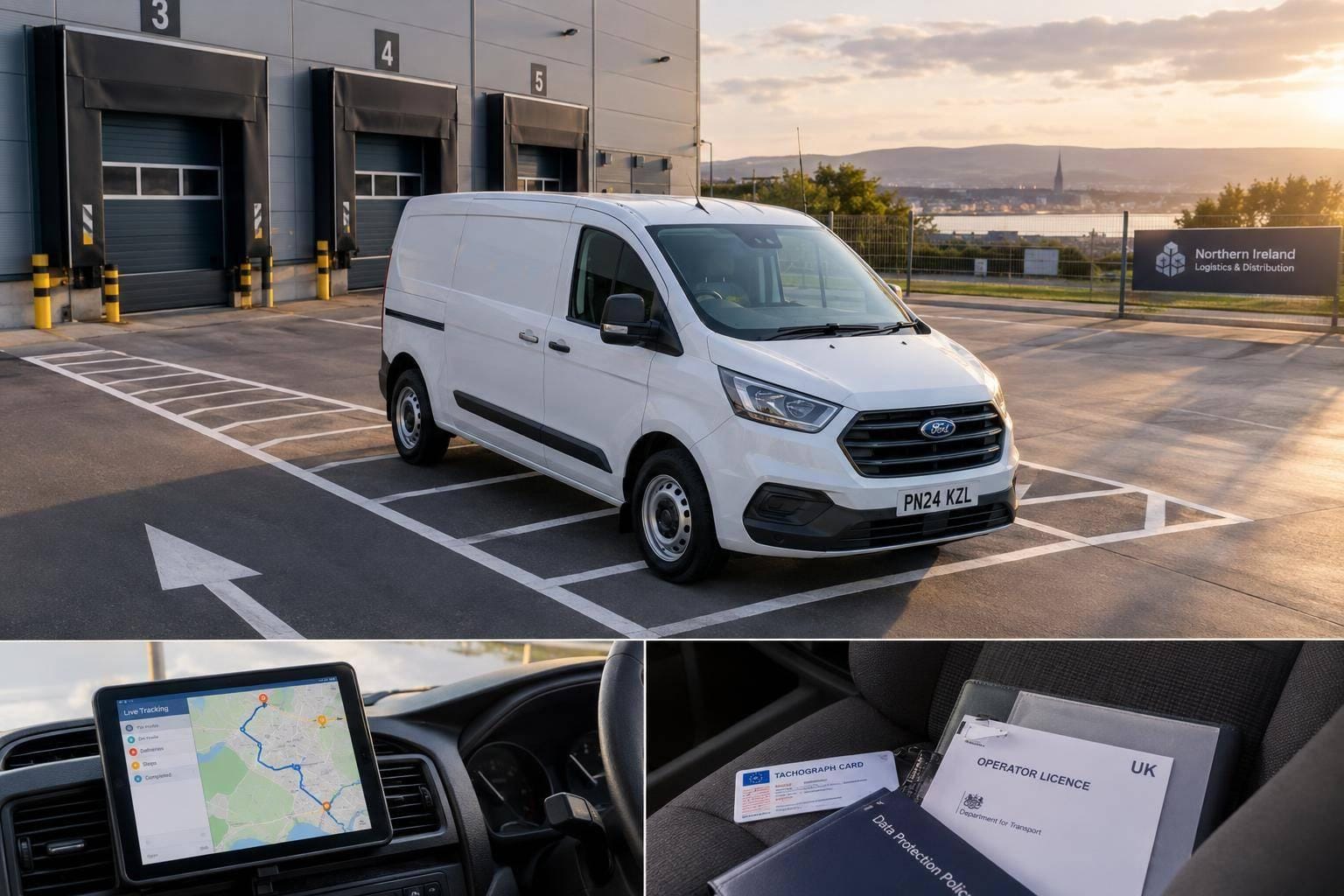
Jurisdiction Scope
Northern Ireland, with UK-wide data-protection rules and Northern Ireland-specific goods-vehicle licensing and DVA enforcement.
sbb-itb-499a7f0
Overview of Fleet Tracking Laws
Applicable Business Type
Courier and delivery businesses operating goods vehicles in Northern Ireland.
Country or Region
United Kingdom — Northern Ireland.
A practical compliance guide for Northern Ireland courier businesses using GPS tracking or telematics. It covers UK GDPR and Data Protection Act 2018 duties for identifiable driver-location data, privacy information, lawful basis, proportionality, DPIAs for high-risk monitoring, private-use safeguards, tachograph record obligations, operator licensing, and DVA compliance checks.
Legal Requirements Summary
Northern Ireland couriers may use fleet tracking, but identifiable location and telematics data is personal data. They must establish a lawful basis, provide clear privacy information, minimise and secure monitoring, assess high-risk systems through a DPIA, and retain data only as long as necessary. Tracking during private use requires particular restraint. Separate transport-law duties apply where vehicles are subject to tachograph/drivers’ hours rules, including retaining or producing relevant records for 12 months, and goods-vehicle operator-licensing and DVA compliance requirements may apply.
Main Regulatory Topics
- Data Privacy and UK GDPR
- Lawful Basis and Transparency
- Driver Consent and Private Use
- DPIAs and Proportionate Monitoring
- Vehicle Telematics and Real-Time Tracking
- Tachographs and Drivers’ Hours Record-Keeping
- Goods-Vehicle Operator Licensing
- DVA Audits, Inspections, and Enforcement
Key Compliance Obligations
- Identify and document a UK GDPR lawful basis for tracking identifiable drivers.
- Tell drivers and passengers what is monitored, why, under what circumstances, and who controls the data; provide appropriate vehicle signage or privacy information.
- Limit tracking to necessary and proportionate business purposes, and disable or restrict monitoring during authorised private use where possible.
- Complete a DPIA before high-risk monitoring, including driver-behaviour analytics, cameras, audio, or other intrusive/inferential systems.
- Apply appropriate security, access controls, data minimisation, and a retention period based on the purpose; do not assume ordinary GPS data has a fixed statutory retention period.
- Comply with tachograph and drivers’ hours recording, downloading, inspection, and production requirements where the vehicle and operation fall within that regime.
- Obtain the appropriate goods-vehicle operator licence where applicable, including for goods vehicles over 3.5 tonnes and certain 2.5–3.5 tonne EU operations.
- Keep fleet, driver-hours, maintenance, and licensing records available for DVA/operator-compliance audits.
Driver Consent Requirement
Consent Rule: Prior driver consent is not universally required. The courier must identify and document an appropriate lawful basis, give drivers and passengers clear privacy information, and ensure monitoring is necessary and proportionate. Consent is generally unsuitable as the ordinary employment basis because of the imbalance of power; private-use tracking is rarely justifiable unless properly controlled.
Data Retention Period
Minimum Retention: No general statutory minimum for ordinary GPS/fleet-tracking data; where drivers’ hours/tachograph rules apply, relevant records must be produced for 12 months.
Enforcement Authorities
- Driver and Vehicle Agency (DVA), Northern Ireland — roadworthiness, drivers’ hours/tachograph and operator-licensing enforcement functions.
- Department for Infrastructure (DfI), Northern Ireland — operator-licensing and road-transport policy/licensing framework.
- Information Commissioner’s Office (ICO) — UK data-protection enforcement for employee, passenger and public monitoring and telematics processing.
- HM Revenue & Customs (HMRC) — parcel-movement data requirements and submissions for relevant Great Britain–Northern Ireland express-operator movements.
Penalties for Non-Compliance
Non-compliance can lead to operator-licence action, roadside or premises scrutiny, prohibition or other enforcement concerning vehicles and drivers’ hours, and prosecution or financial penalties under applicable road-transport legislation. Failure to keep required records or provide documents can itself create enforcement exposure. Unlawful or excessive worker/location monitoring can result in ICO investigation, enforcement notices, compulsory remedial action and UK GDPR penalties, including potentially substantial administrative fines. For relevant GB–NI parcel movements, failure to meet authorised-carrier or HMRC data obligations can jeopardise authorisation and attract customs/compliance enforcement. The exact sanction depends on the breach, vehicle, route, seriousness and enforcement history; no single fixed “fleet tracking fine” applies.
Implementation Best Practices
Build a vehicle-by-vehicle compliance register covering MAM, trailer weights, registration date, routes, operator-licence status, tachograph type, driver-card status and data-download dates. Configure telematics around a documented operational purpose, with role-based access, encryption, short and justified retention, private-use controls and an auditable deletion process. Provide a concise driver privacy notice and in-vehicle signage before deployment; consult workers and record the DPIA and alternatives assessment for intrusive monitoring. Keep tachograph and fleet-tracking data logically separated where possible, because tachograph records meet a legal road-safety obligation while optional GPS/behavioural monitoring requires its own UK GDPR justification. Use supplier contracts covering security, access, retention, international transfers and incident handling. Test alerts and data exports regularly, reconcile tachograph downloads, and review the system whenever routes, vehicle weights, private use or legal requirements change.
Compliance Checklist
- Map each vehicle’s maximum authorised mass (MAM), trailer combination and route; determine whether operator licensing, drivers’ hours or tachograph rules apply.
- Obtain the appropriate Northern Ireland goods vehicle operator licence where carrying goods for hire or reward: standard national for UK-only operations or standard international for international operations. Do not confuse this with a restricted licence, which is for carrying the operator’s own goods.
- For standard licences, maintain a Northern Ireland premises where business documents are kept, appoint a suitably qualified transport manager where required, demonstrate financial standing and disclose relevant convictions and penalties.
- For vehicles within tachograph scope, fit and use the required approved tachograph; issue driver cards and company cards, train drivers, download vehicle-unit data at least every 90 days and driver-card data at least every 28 days, and analyse compliance.
- For international goods journeys, check the post-1 July 2026 Smart Tachograph Version 2 requirement for vehicles over 2,500kg and up to 3,500kg MAM, including any trailer.
- Define and document the lawful basis, purpose, scope and retention period for GPS/telematics processing; collect only data necessary for delivery, safety, security or another documented purpose.
- Give drivers and passengers clear privacy information and vehicle signage, identify the controller and explain access and other UK GDPR rights.
- Complete a Data Protection Impact Assessment before high-risk monitoring, particularly behavioural analytics, cameras, audio or intrusive driver surveillance; consider less intrusive alternatives.
- Disable or restrict tracking during authorised private use unless there is a documented, compelling justification. Switch audio off by default and use it only exceptionally with strong justification.
- Control access to live and historical location data, set deletion/retention rules, manage supplier and insurer data-processing arrangements, and keep audit records.
- If moving eligible consumer parcels from Great Britain to Northern Ireland under the Windsor Framework, meet authorised-carrier conditions and submit required parcel data to HMRC through its File Transfer Service within the applicable deadline.
Industry-Specific Guidance
A Northern Ireland courier normally carries customers’ goods for hire or reward, so operator-licensing status depends on the vehicles and whether work is UK-only or international. A standard national licence covers hire-or-reward carriage within the UK; a standard international licence is needed for relevant international work. Ordinary GPS fleet tracking is not itself a universal substitute for, or automatic trigger of, a tachograph: tachograph duties depend principally on vehicle/combination weight, use and route. Goods vehicles generally over 3.5 tonnes (including trailers) fall within tachograph rules, while international goods journeys bring additional rules for many vans over 2.5 tonnes. Tracking delivery vehicles can expose drivers’ whereabouts, homes, customers and members of the public, so courier firms should avoid continuous off-duty monitoring and should not assume driver consent alone makes monitoring lawful. For cross-channel parcel work, Windsor Framework authorised-carrier and HMRC parcel-data obligations may apply in addition to vehicle rules.
Recent Legal Updates
The key current change for this guide is 1 July 2026: vehicles used on international journeys carrying goods, with MAM including trailer over 2,500kg and up to 3,500kg, must be fitted with a Smart Tachograph Version 2. This extends tachograph obligations to many light commercial vans used internationally. Existing guidance also states that goods vehicles first registered after 20 February 2024 must have Smart Tachograph Version 2, and international vehicles already in tachograph scope must use Version 2. The GB-to-NI express-operator guidance published 19 March 2025 sets out Windsor Framework authorisation and HMRC parcel-data processes, including deadlines that vary by consumer/business movement; operators should verify the current HMRC technical requirements before each filing.
Authoritative Resources
- ICO — Surveillance in vehicles: https://ico.org.uk/for-organisations/uk-gdpr-guidance-and-resources/cctv-and-video-surveillance/guidance-on-video-surveillance-including-cctv/additional-considerations-for-technologies-other-than-cctv/surveillance-in-vehicles/
- ICO — Data protection and monitoring workers: https://ico.org.uk/for-organisations/uk-gdpr-guidance-and-resources/employment/monitoring-workers/data-protection-and-monitoring-workers
- GOV.UK — Goods vehicle operator licence (Northern Ireland): https://www.gov.uk/find-licences/goods-vehicle-operator-licence-northern-ireland
- Department for Infrastructure (Northern Ireland) — Tachograph rules for international journeys: https://www.infrastructure-ni.gov.uk/articles/tachograph-rules-international-journeys-what-you-need-know
- nidirect — Tachograph and drivers’ hours: https://www.nidirect.gov.uk/articles/tachograph-and-drivers-hours
- GOV.UK — Drivers’ hours: goods vehicles, tachograph rules: https://www.gov.uk/guidance/drivers-hours-goods-vehicles/4-tachograph-rules
- GOV.UK — Parcels from Great Britain to Northern Ireland for express operators: https://www.gov.uk/guidance/how-to-move-parcels-from-great-britain-to-northern-ireland-for-express-operators
- legislation.gov.uk — Goods Vehicles (Licensing of Operators) Act (Northern Ireland) 2010