
Fleet Tracking Regulations Explained: A Guide for Van Rental Companies in Scotland
Van-rental fleet tracking in Scotland must treat telematics as personal data and follow UK GDPR, DPIAs, retention and secure-access rules.
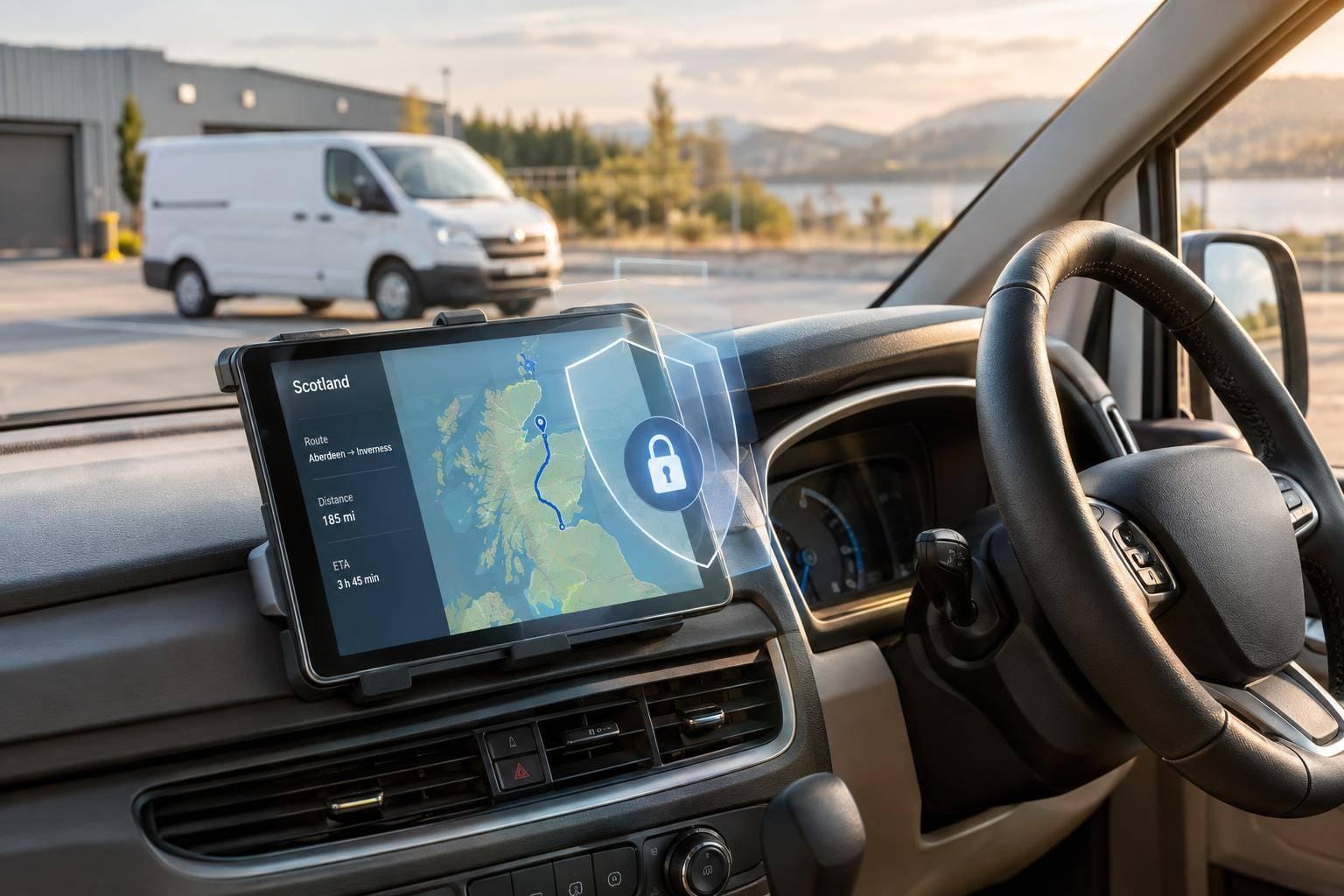
Jurisdiction Scope
Scotland, under UK-wide data-protection law; no separate Scottish fleet-tracking installation or consent regime was identified in the sources.
sbb-itb-499a7f0
Overview of Fleet Tracking Laws
Applicable Business Type
Van rental companies, including businesses operating shared-use rental vehicles in Scotland.
Country or Region
United Kingdom — Scotland-specific business context; UK GDPR and Data Protection Act 2018 framework.
A compliance guide for Scottish van-rental businesses using GPS, telematics, or related vehicle-monitoring systems. It covers lawful basis, transparency to renters and drivers, privacy information in shared vehicles, data minimisation, retention, access controls, and practical implementation.
Legal Requirements Summary
Scottish van-rental businesses may use fleet tracking, but must treat location, utilisation, driving-behaviour, and related telematics data as potentially personal data. They should establish a lawful basis, provide transparent notices to renters and drivers, minimise collection, secure access, set and follow proportionate retention periods, and assess high-risk monitoring through a DPIA. Driver consent is not invariably required for rental tracking, although any reliance on consent must meet UK GDPR standards. Separate tachograph download and analysis duties apply where the vehicle and journey fall within the goods-vehicle drivers'-hours regime.
Main Regulatory Topics
- UK GDPR lawful basis
- Data privacy and transparency
- Driver and renter information
- Data minimisation
- Retention and deletion
- DPIAs and risk assessment
- Telematics security and processor controls
- Private-use monitoring
- Vehicle surveillance and signage
- Tachographs and record-keeping
- Data-subject rights and access
Key Compliance Obligations
- Identify and document a UK GDPR lawful basis before collecting tracking data.
- Give renters, approved drivers, passengers where relevant, and employees clear privacy information before or at the point of tracking; use vehicle signage where appropriate.
- Explain the controller's identity, purposes, categories of data, access, rights, and retention period.
- Apply data minimisation and define a documented retention schedule; delete or anonymise data when no longer required.
- Carry out a Data Protection Impact Assessment where the monitoring is likely to create a high risk, particularly for systematic location or behaviour monitoring.
- Use appropriate security, access controls, and processor agreements for telematics suppliers.
- Restrict monitoring during private use to what is necessary and proportionate, and avoid using tracking for incompatible purposes.
- For vehicles subject to tachograph rules, download and analyse tachograph data at the required intervals: vehicle units every 90 days and driver cards every 28 days.
Driver Consent Requirement
Consent Rule: Driver consent is not automatically required where tracking is supported by another valid UK GDPR lawful basis, such as contract necessity or legitimate interests. The rental company must provide clear advance privacy information explaining what is tracked, why, who can access it, and retention. If consent is relied upon, it must be specific, informed, freely given, and documented; consent is generally problematic in an employment relationship because of the power imbalance.
Data Retention Period
Minimum Retention: No universal statutory minimum period identified for rental-vehicle tracking data. Retain only for as long as necessary for the stated purpose, document retention periods, and delete or anonymise data when no longer needed; any incident, insurance, contractual, or regulatory retention period should be separately justified.
Enforcement Authorities
- Information Commissioner’s Office (ICO), for UK data-protection compliance and enforcement
- Department for Transport / GOV.UK Rental Vehicle Security Scheme authorities, for the RVSS Code of Practice and engagement with law enforcement
- Police and other lawful enforcement authorities, which may request relevant rental or vehicle information
- Driver and Vehicle Licensing Agency (DVLA), for licensing and vehicle-register information processes
Penalties for Non-Compliance
Non-compliance can lead to ICO regulatory action under UK data-protection law, including investigation, enforcement notices, and potentially administrative fines; it can also create compensation, complaints, contract, reputational, and data-breach costs. Failure to meet applicable RVSS security or information-handling requirements may jeopardise scheme compliance and trigger law-enforcement or contractual consequences. The cited sources do not establish a single Scotland-specific fixed fine for ordinary rental-vehicle tracking, so penalties depend on the breach, processing scale, harm, and applicable scheme or contract.
Implementation Best Practices
Design the system around documented purposes such as theft recovery, accident response, breakdown assistance, fleet security, or contract administration—not generalised surveillance. Before installation, map the data flows, controller/processor roles, lawful bases, recipients, international transfers, retention periods, and data-subject rights in a DPIA and privacy notice. Configure least-privilege access, encryption and audit logs; make live tracking available only to authorised personnel and only when operationally justified. Use customer-facing rental terms and a layered privacy notice to explain tracking without relying on obscure wording, and keep a record of consent where consent is used. Maintain a disclosure log for law-enforcement requests and periodically test deletion, access-request, security-incident, and device decommissioning procedures.
Compliance Checklist
- Identify and document a lawful UK GDPR basis for each tracking purpose; do not assume customer consent is always required or sufficient.
- Complete and document a Data Protection Impact Assessment before deploying intrusive location, telematics, ANPR, or comparable monitoring where processing is likely to create high risk.
- Provide clear, timely privacy information to hirers, authorised drivers, passengers where relevant, and staff; explain what is collected, why, retention, access, sharing, and controller contact details.
- Use visible in-vehicle or site signage where surveillance or recording takes place, including the controller identity where practicable.
- Limit collection to what is necessary and proportionate; disable audio recording by default unless an exceptional, justified use exists.
- Set purpose-specific retention periods, review them, and securely delete data when no longer necessary.
- Restrict access, secure tracking data, and document disclosures to police, authorities, insurers, recovery providers, or other third parties.
- Use written data-sharing arrangements and disclose information only where lawful and necessary.
- For face-to-face commercial-vehicle hires, verify the renter’s identity and driving licence and fit required security technology under the RVSS Code of Practice where the scheme applies.
- Train staff on UK GDPR, the Data Protection Act 2018, secure information handling, lawful information sharing, and incident escalation.
Industry-Specific Guidance
A van-rental company in Scotland generally operates under UK-wide data-protection rules rather than a separate Scottish fleet-tracking regime. A vehicle’s location, journey history, registration mark, or telematics data can become personal data when linked to a hirer, driver, or identifiable user. Rental companies should explain tracking at booking and handover, ensure the contract and privacy information match the actual purposes, and avoid using security/recovery data for unrelated profiling or employee-style continuous monitoring. If vans are hired to businesses, the rental company should clarify whether it or the business customer is controller, joint controller, or processor for each processing activity. Commercial-vehicle hires should receive enhanced identity and licence checks where the RVSS Code applies. DVLA disclosures and requests must have a lawful basis or reasonable cause; DVLA guidance states that keeper information can be released to private or public organisations where reasonable cause is demonstrated. There is no general rule in the cited sources requiring every rental van to have real-time tracking; whether tracking is needed depends on the documented purpose, proportionality, contract, insurance/security requirements, and applicable scheme or customer arrangement.
Recent Legal Updates
The GOV.UK Rental Vehicle Security Scheme Code of Practice search result is dated 7 April 2026 and sets out current requirements including GDPR-compliant data handling, staff training, lawful and documented information sharing with law enforcement, identity and licence verification for face-to-face rentals, extra checks for commercial-vehicle hires, and security technologies such as immobilisers and trackers. As at 4 October 2026, the cited materials do not identify a new Scotland-specific real-time-tracking mandate or a universal retention deadline. Companies should verify the live GOV.UK and ICO pages before publication because scheme guidance and regulator guidance can change.
Authoritative Resources
- Information Commissioner's Office (ICO): Surveillance in vehicles
- Information Commissioner's Office (ICO): Automatic Number Plate Recognition guidance
- GOV.UK: Rental Vehicle Security Scheme (RVSS) Code of Practice
- Driver and Vehicle Licensing Agency (DVLA): Release of information from DVLA’s registers