Pay-As-You-Go vs Contract Fleet Tracking
Compare PAYG vs contract fleet tracking — costs, flexibility, device types and reporting to pick the right model.
 By Michael Bar8 min read
If I need fleet tracking with room to scale up or down, I’d pick pay-as-you-go. If my fleet size is steady for 12 to 36 months, I’d usually pay less with a contract.
Here’s the short version:
- Pay-as-you-go usually costs £15 to £25 per vehicle, per month
- Contract tracking is often £7.99 to £15 per vehicle, per month
- PAYG gives me a rolling setup with easy exits
- Contract plans cut monthly cost, but can include early exit fees
- PAYG often uses moveable devices
- Contract setups often use hardwired trackers
- PAYG tends to cover the basics: live location, trip history, route replay
- Contract plans often add more data, such as idling, mileage, geofencing, driver scoring, and service reminders
Put simply: PAYG buys me freedom, while a contract buys me a lower monthly bill. That trade-off matters most when I look at cost, fleet size changes, device setup, support, and reporting depth.
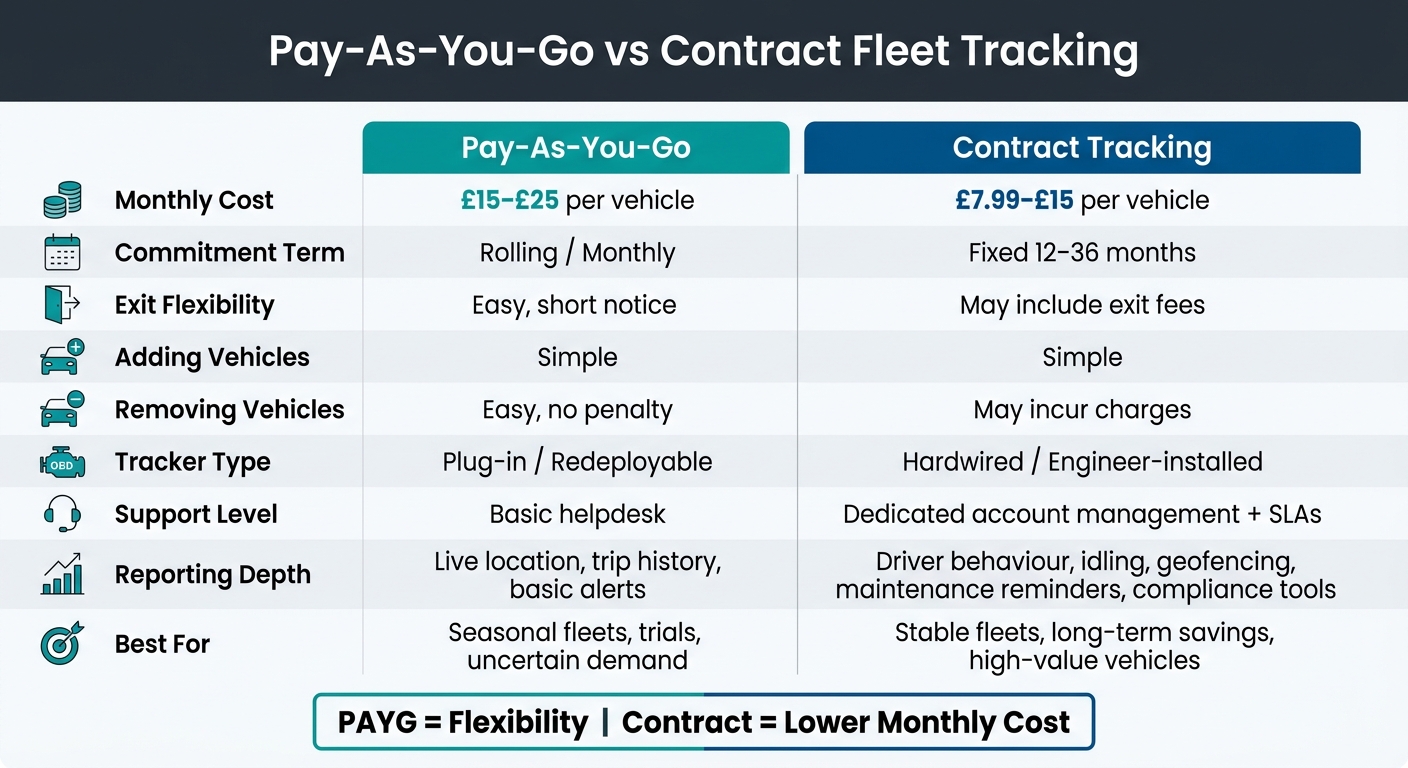
Pay-As-You-Go vs Contract Fleet Tracking: Side-by-Side Comparison
Quick Comparison
| Criteria | Pay-as-you-go | Contract tracking |
|---|---|---|
| Monthly cost | £15–£25 per vehicle | £7.99–£15 per vehicle |
| Term | Rolling, usually monthly | Fixed, often 12–36 months |
| Leaving the plan | Usually simple with short notice | May include exit charges |
| Adding/removing vehicles | Easy to add and remove | Easy to add, harder to remove early |
| Tracker type | Plug-in or easy-to-move unit | Hardwired unit |
| Support | Basic helpdesk support | More set service and account support |
| Reporting | Core tracking and usage data | Deeper fleet reports and controls |
| Best for | Seasonal fleets, trials, changing demand | Stable fleets, longer use, lower monthly spend |
If I’m comparing the two, I’d focus on one question first: Will my fleet stay about the same size over the next 24 to 36 months?
How pay-as-you-go tracking works for flexible fleets
PAYG works well for fleets that go up and down in size. You can add or remove vehicles with little notice, which gives you control without locking you into a long deal.
Higher monthly cost, lower long-term commitment
PAYG plans usually cost more per vehicle. That’s because the provider takes on more risk if you cancel. You may also see setup, activation or SIM charges. Still, you only pay for the vehicles you need, which helps if your fleet changes often.
Redeployable trackers and standard support
PAYG setups often use plug-in devices or units with a light install. That makes them easier to move from one vehicle to another.
If you bring hired vans in and out over the year, that can be a big help. You’re not stuck with trackers fitted to vehicles you no longer use. The downside is fairly simple: devices that are easy to move may not give you the same level of concealment or the same fixed, hardwired feel as permanently installed units.
Support is usually fairly basic, not tailored. In most cases, that includes:
- Account setup
- Device activation
- App access
- Basic troubleshooting
You’re less likely to get a dedicated account manager or help with custom reporting setup.
Core reporting for day-to-day fleet visibility
PAYG tracking covers the main day-to-day needs well. You’ll usually get real-time location, trip history, route replay, and basic driver and usage reports.
For many fleets, that’s enough to keep tabs on where vehicles are and how they’re being used. But if you need deeper analysis or custom alerts, PAYG can feel a bit limited. Contract-based systems often go further when it comes to reporting and fleet controls.
How contract fleet tracking works for long-term operations
Contract fleet tracking runs on a fixed term - usually 12, 24 or 36 months - in return for a lower monthly rate and more set support. That makes it a stronger match for fleets with steady vehicle numbers and longer planning cycles.
Lower monthly rates tied to a fixed term
The lower monthly price comes from the longer commitment. But there’s a catch: early exit fees can wipe out that saving fast. If vehicles come out of service before the contract ends, the money saved each month can disappear just as fast.
Hardwired devices and structured service levels
Contract setups use hardwired trackers rather than plug-in units. An engineer installs the device straight into the vehicle’s electrical system, so it draws constant power without depending on a rechargeable battery. In plain terms, that makes the unit harder to tamper with or pull out.
Support also tends to be more structured. You can usually expect dedicated account management, onboarding help, installation coordination and clearer service expectations for platform access and issue resolution. That setup works well for vehicles that stay in service for years and need tighter security.
Broader reporting and fleet controls
Contract packages often include mileage reporting, idling data, geofencing, driver behaviour scoring and maintenance reminders. Some also offer custom reports shaped around day-to-day fleet activity.
That extra depth matters because it helps you spot patterns over time, not just see a live dot on a map. Track driver behaviour across 12 months, for example, and you get trends you can act on - not just a one-off view of where a van was yesterday. For fleets dealing with compliance, fuel costs or driver safety, that level of data becomes more useful as the fleet gets bigger. Those differences stand out most when you compare the options side by side.
Pay-As-You-Go vs Contract Fleet Tracking: direct comparison
Put simply, this choice is about lower commitment vs lower monthly cost.
Cost, flexibility and adding or removing vehicles
On a per-vehicle basis, pay-as-you-go usually costs £15–£25 per month. Contract tracking solutions often come in lower, at £7.99–£15 per month on a fixed term. Stretch that across the full term and the price gap becomes much more obvious.
That said, monthly price is only part of the picture. Contract tracking locks you in, and early exit charges can wipe out those savings if vehicles leave service before the term ends. PAYG works well for fleets that may need to shrink fast, without paying exit fees.
Adding vehicles is usually simple under both models. The big difference shows up when you need to remove them. Pay-as-you-go makes it easy to scale down in the same way you scaled up. That makes it a good match for seasonal demand, short projects, or fleets dealing with uncertain demand. Contract tracking tends to suit fleets with steady vehicle numbers and predictable day-to-day use.
Ownership, support and reporting depth
Comparison at a glance:
| Criterion | Pay-as-you-go | Contract tracking |
|---|---|---|
| Monthly cost | Higher (typically £15–£25/vehicle) | Lower (typically £7.99–£15/vehicle) |
| Commitment | Rolling or short-term; easy to exit | Fixed term (usually 24–36 months) |
| Flexibility | Add or remove vehicles with minimal notice | Adding is simple; removing may incur charges |
| Tracker ownership | Leased or redeployable devices | Hardwired units; ownership terms vary by provider |
| Support | Standard helpdesk; largely reactive | Structured SLAs with dedicated account management |
| Reporting | Core visibility: live location, trip history, basic alerts | Advanced analytics: driver behaviour, idling, maintenance reminders, compliance tools |
| Best fit | Seasonal demand, trials, uncertain fleet size | Steady growth and long-term savings |
If you want room to move, PAYG gives you that. If your fleet is stable and you're focused on a lower monthly bill, a contract can make more sense.
Choosing the right tracking model for your fleet
You’ve already looked at cost, flexibility and reporting. At this point, the choice mostly comes down to fleet stability. The main question is simple: how stable is your fleet over the next 24 to 36 months? What matters here is how those trade-offs play out for your fleet over the next few years.
Best fit for seasonal demand, trials and uncertain fleet size
If your vehicle numbers go up and down through the year, or you’re trying telematics for the first time with a small group of vans, pay-as-you-go is usually the lower-risk choice. That flexibility works well for fleets with changing demand. It matters most when you’re dealing with short-term contracts, project-based work, or any setup where a vehicle might leave the fleet before a fixed term ends.
PAYG also makes sense if you want to test telematics before rolling it out across the whole fleet. Starting with a smaller fleet gives you room to check van tracking solutions for your industry before you commit. Yes, the monthly cost is a bit higher, but for many operators that’s a fair trade for the extra freedom.
That same logic flips for fleets with stable vehicle numbers and longer planning cycles.
Best fit for steady growth, security and long-term savings
If your fleet is stable and you expect most vehicles to stay in service for several years, a contract model will often cost less and give you more control day to day. That makes contract tracking a better fit for fleets that keep vehicles in service for years. Hardwired devices and stronger security features may also matter more if you’re tracking high-value vehicles and equipment.
Put simply, pay-as-you-go buys flexibility, while contract tracking buys stability. Choose PAYG for fleets that change often. Choose contract tracking for fleets that stay steady.
FAQs
Which option is cheaper over time?
It depends on the size of your fleet and what matters most over the long run.
Pay-as-you-go tracking often makes more sense for growing businesses. Instead of a big upfront bill, you spread the cost through monthly payments that are easier to plan for, starting from £7.99 per vehicle.
Fixed contract systems can look appealing at first glance, but the full cost is often higher than it seems. You may need to pay for hardware and installation upfront, which can come to more than £250 per vehicle, and that’s before the monthly fees start.
Over a few years, insurance discounts of 15% to 30% can help balance out some of those higher long-term costs.
What fees are not included in the monthly price?
The £7.99 per month subscription covers the lot: SIM usage, data, platform access, and dedicated account management. That means no hidden recurring charges creeping in later.
Hardware is paid for separately as a one-off upfront cost. Recovery services are only charged if you use them.
Can I switch from PAYG to a contract later?
Yes. You can switch between service models as your business changes.
GRS Fleet Telematics offers flexible, modular solutions that grow with your fleet. That means you can start with basic tracking and move to more advanced security features later, without paying for a costly infrastructure overhaul.