Personal vs Fleet Trackers: Key Differences
Compare personal GPS trackers and fleet telematics: features, alerts, reports, costs and when to upgrade for multi-vehicle management.
 By Michael Bar9 min read
If I need to protect one vehicle, I’d pick a personal tracker, or compare van trackers if I need business-grade security. If I need to watch several vehicles, drivers, trips, and servicing, I’d move to fleet telematics.
That’s the short answer. A personal tracker is mainly for location, theft alerts, and basic trip history. A fleet system adds multi-vehicle visibility, driver behaviour data, mileage records, idle-time checks, maintenance prompts, and shared access for teams.
Before I choose, I’d look at these points:
- Purpose: one vehicle vs several
- Users: owner or sole trader vs manager and team
- Data: basic trips vs driver and vehicle use data
- Alerts: movement and geofence vs speeding, braking, idling, and site time
- Reports: light history vs mileage, route, utilisation, and service records
- Cost: about £7.50–£15 a month for a personal tracker vs about £8–£30 per vehicle a month for fleet telematics
- When to switch: when I need to compare drivers, track mileage, cut idle time, or keep tabs on more than one van
A useful marker: one provider in the article lists fleet telematics from £7.99 per vehicle per month. That shows the price gap is not always as large as people think once a business needs more than basic tracking.
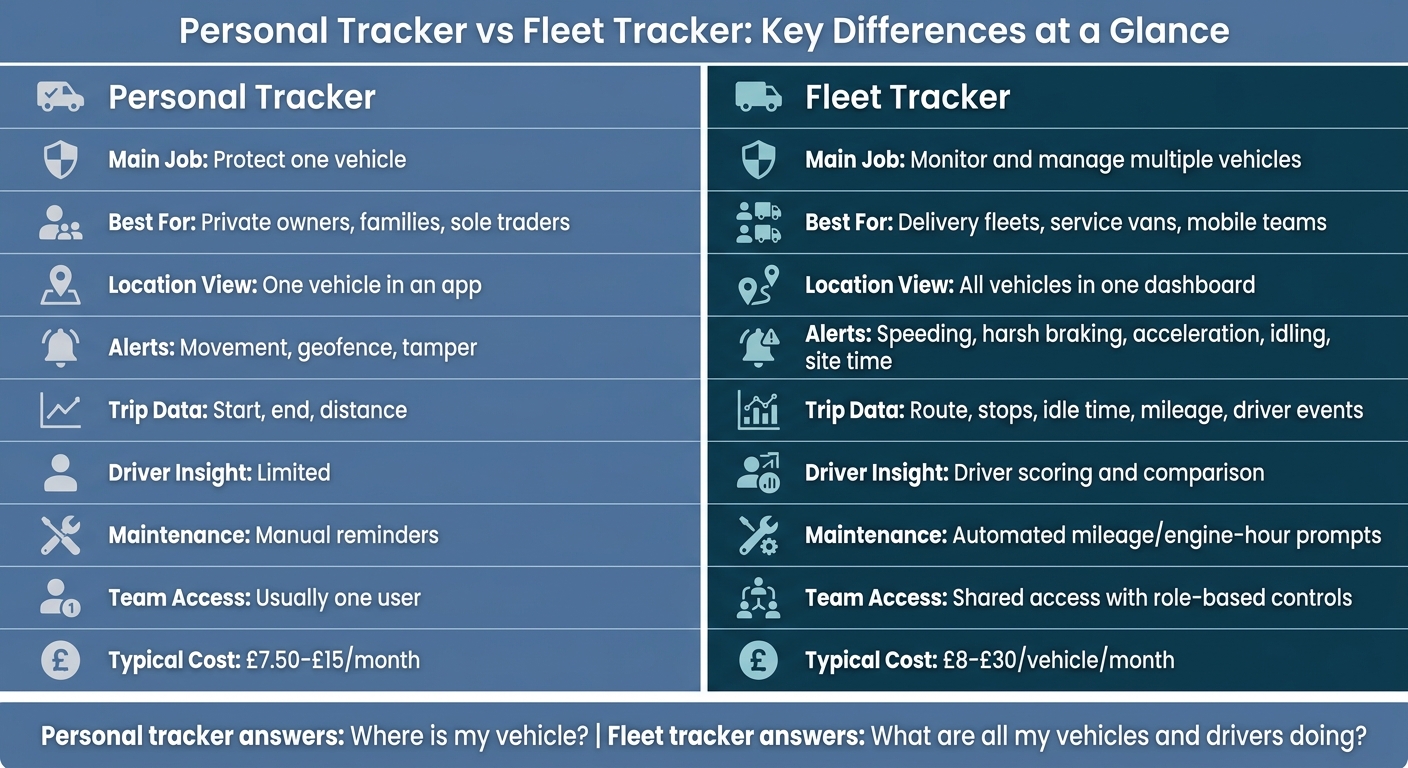
Personal Tracker vs Fleet Tracker: Key Differences at a Glance
Quick Comparison
| Criteria | Personal tracker | Fleet tracker |
|---|---|---|
| Main job | Protect one vehicle | Monitor and run several vehicles |
| Best for | Private owners, families, some sole traders | Delivery fleets, service vans, mobile teams |
| Location view | One vehicle in an app | All vehicles in one dashboard |
| Alerts | Movement, geofence, tamper | Speeding, harsh braking, acceleration, idling, site time |
| Trip data | Start, end, distance | Route, stops, idle time, mileage, driver events |
| Driver view | Limited | Driver scoring and comparison |
| Maintenance | Usually manual | Mileage or engine-hour based prompts |
| Team access | Usually one user | Shared access with user controls |
| Typical cost | £7.50–£15/month | £8–£30/vehicle/month |
My takeaway: a personal tracker answers “Where is my vehicle?” A fleet system answers “What are all my vehicles and drivers doing, and what needs attention?”
If I only want peace of mind for one car or van, a personal tracker is fine. If I’m dealing with multiple vehicles each day, that extra data and shared view start to matter fast.
Personal trackers vs fleet trackers: the main differences
A personal tracker tells you where one vehicle is. A fleet tracker shows how a whole group of vehicles is doing. That’s the big split. It’s not only about the device itself, but about how much data you get and how much control sits in the system.
| Aspect | Personal trackers | Fleet trackers |
|---|---|---|
| Primary purpose | Theft protection and basic location monitoring | Operational control, reporting, and fleet management |
| Typical users | Private car owners, families, young drivers, sometimes sole traders | Delivery vans, service fleets, mobile teams |
| Core features | Live location, geofencing, movement alerts, trip history | Live map, trip history, driver behaviour, maintenance alerts, reports |
| Access model | Simple app for one vehicle | One dashboard for multiple vehicles, with custom permissions |
| Daily value | Reassurance and theft recovery for a single vehicle | Better oversight, fewer admin tasks, faster decisions across the fleet |
Personal vehicle tracking for single-vehicle security and basic oversight
Personal trackers are built to be simple. If you own a private car, want to keep an eye on a young driver, or run a small job with one main vehicle, one app or portal is often enough.
You open the app and see:
- where the vehicle is on a map
- recent trips
- alerts if something looks off
Most of those alerts focus on theft prevention. If the vehicle moves when it shouldn’t, or leaves a set area, the owner gets a notification straight away. For most private owners, that does the job. But once you’re dealing with several vehicles, theft alerts alone don’t get you very far.
Fleet tracking for multi-vehicle control and day-to-day oversight
Fleet telematics is built for a different kind of work. Instead of checking one vehicle at a time, a fleet manager gets one dashboard showing every vehicle at once. That changes the job from simple tracking to day-to-day control.
Managers can see every vehicle in one place. They can also look beyond location and get the data that helps keep the business moving: trip history, driver behaviour, maintenance reminders, and reports.
That’s the real shift. A personal tracker helps you find a vehicle. A fleet system helps you run vehicles as part of a business. Once you need oversight across multiple vans, drivers, or mobile teams, those extra layers of data start to matter.
Data, reporting, and alerts: how fleet telematics goes further
The gap shows up fastest in the data. Fleet telematics answers a much bigger set of day-to-day questions: where the vehicle is, how it’s being driven, whether it’s being used well, and when it’s due for service.
App access and theft-focused alerts in personal tracking
Personal trackers are built around a small set of practical alerts. You’ll usually get a notification if the vehicle moves when it shouldn’t, crosses into or out of a set area, or if someone tampers with the device.
That works well for theft prevention. But the data is light. Trip history tends to cover the start point, end point, and distance travelled. Useful, yes, though it only tells you that the vehicle moved, not how it was used.
Reporting and driver behaviour alerts in fleet systems
Fleet telematics pulls journey data, driver events, and vehicle use into one dashboard. Each journey is logged with speed patterns, stop durations, idle time, and the route taken.
The alerts also go far beyond theft. Instead of only flagging movement, fleet systems can warn managers about speeding, harsh braking, rapid acceleration, and excessive idling. Those events are tied to individual drivers, which means the data isn’t vague or guesswork. It points to a specific person and a specific driving habit.
That’s where driver scoring comes in. Managers get a clear view of who may need coaching and who’s doing the job well.
| Feature | Personal trackers | Fleet telematics |
|---|---|---|
| Data access | Single-user app, one vehicle | Centralised dashboard, role-based access |
| Report depth | Basic trip history, distance, start/end points | Driver scoring, idle time, mileage, utilisation, route analysis |
| Alert types | Movement, geofence entry/exit, tamper | Speeding, harsh braking, rapid acceleration, idling, time on site |
| Maintenance | Manual service reminders | Automated triggers based on mileage or engine hours |
| Compliance | No built-in compliance reporting | HMRC mileage logs, MOT and service scheduling |
Different teams use that data in different ways. Operations looks at live locations and ETAs. Finance uses HMRC mileage logs. Managers check fleet utilisation metrics to cut waste.
Role-based dashboard access helps here. Each team sees the data that matters to them, without getting buried in everything else. And once you move from tracking one vehicle to managing several, that extra visibility starts to shift the cost equation too.
Cost models and when to move from one tracker to fleet telematics
This is where the gap becomes much clearer. Fleet systems gather more than location data, so the pricing reflects that. A personal tracker is usually sold as a single-vehicle setup: a one-off hardware fee, then a monthly subscription for live location and theft recovery. Fleet telematics is more often priced per vehicle, per month.
So the big question isn't just price. It's what you get back for that spend.
| Personal tracker | Fleet telematics | |
|---|---|---|
| Device cost | Low one-off fee or included in the package | Varies by hardware tier |
| Monthly charge | Roughly £7.50–£15 per month | Roughly £8–£30 per vehicle per month |
| Best for | Single-vehicle security | Multi-vehicle management |
| Admin burden | Minimal; app access for one vehicle | Shared dashboard reduces admin across multiple vehicles |
| Reporting and maintenance | Limited trip history and theft-focused alerts | Mileage reports, idle-time insights and maintenance reminders |
When single-vehicle tracking is still enough
If your business runs one or two vehicles and you only need basic location checks, a personal tracker will usually do the job. The lower cost makes sense when security is the main goal. But once more than one person needs visibility, or vehicles need to be watched as a group, fleet telematics starts to make more sense.
Signs a business has outgrown personal tracking
The tipping point comes when tracking stops being passive and starts helping with day-to-day choices. In plain terms, you no longer just need to know where a vehicle is. You need to manage how it's being used.
That often shows up when you need things like:
- oversight across several vans
- driver comparison
- mileage checks
- idle-time monitoring
- maintenance reminders
- route-efficiency reporting
At that stage, the lower price of a basic tracker can be a false saving. The time spent juggling separate apps, piecing together mileage, or chasing maintenance soon adds up.
How GRS Fleet Telematics fits growing UK fleets
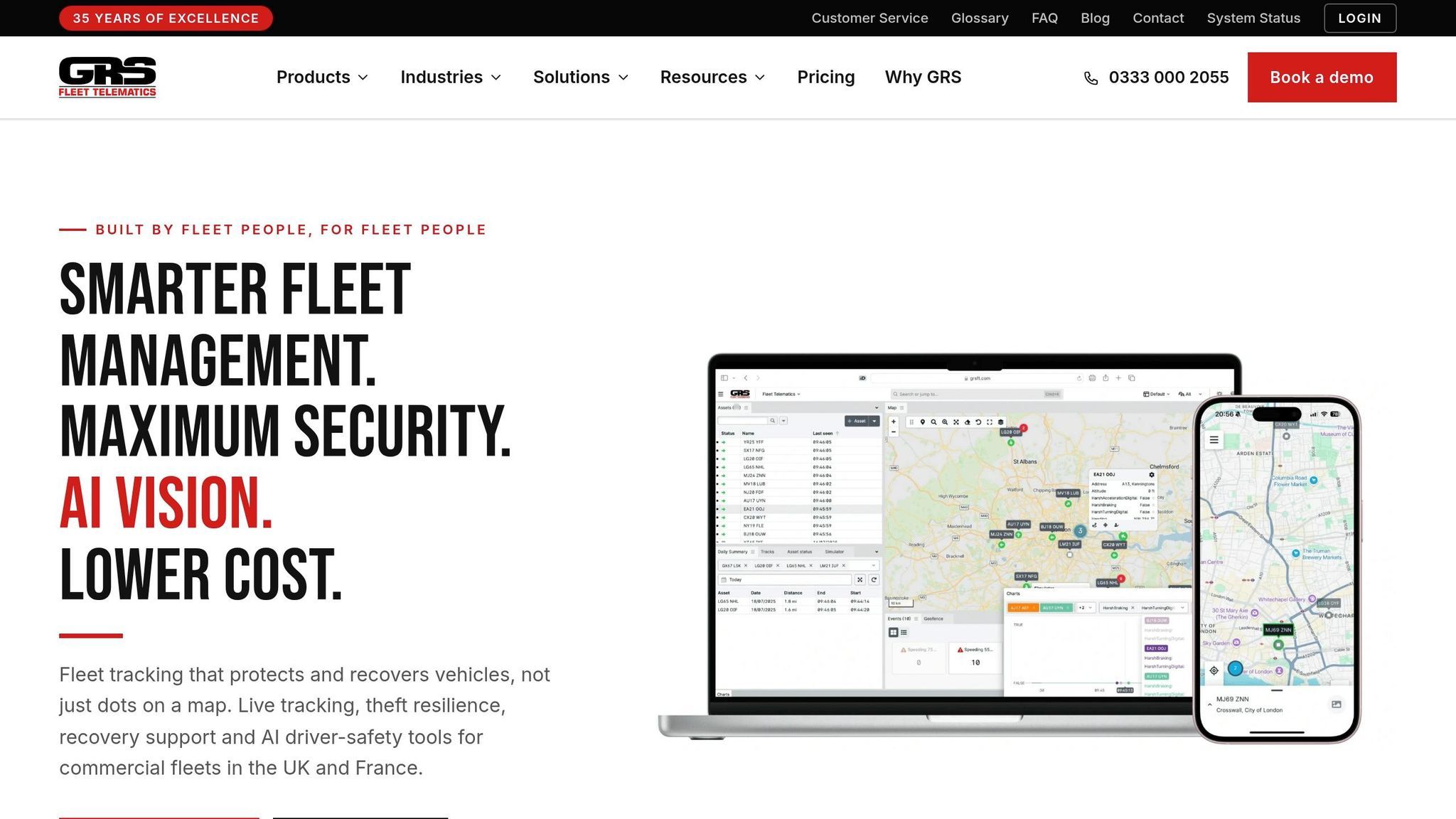
GRS Fleet Telematics starts from £7.99 per vehicle per month and includes dual-tracker security. For growing UK fleets that need shared oversight, reporting, and day-to-day control, that mix of fleet-level visibility and clear per-vehicle pricing is where the value starts to show.
Conclusion: choosing the right tracker for your needs
The choice comes down to one thing: what you need the tracker to do.
If you're looking to protect a single vehicle, a personal tracker may do the job. If you need to manage several vehicles, drivers and journeys, fleet telematics makes more sense.
The main turning point isn't who owns the vehicle. It's how much oversight you need. Once you're comparing driver performance, checking mileage across multiple vehicles, or pulling records for clients or compliance, personal tracking starts to fall short.
You see that gap most clearly in the data. Personal trackers can show where a vehicle is. Fleet telematics goes further, with driver-behaviour data and day-to-day alerts that help with running the business, not just recovering a stolen vehicle.
And that's where cost can get a bit misleading. A lower monthly fee may look good at first, but it can end up costing more if fuel waste, unauthorised use, or poor routing keep slipping through.
GRS Fleet Telematics offers dual-tracker technology and pricing from £7.99 per month - a strong option for businesses that need more than basic location tracking.
FAQs
Can a sole trader use fleet telematics?
Yes. A sole trader can use fleet telematics, even with just one vehicle. Tools like real-time tracking, security, and digital mileage logging can be just as handy for an independent professional as they are for a larger fleet.
Modern systems scale well, so you don’t need a big operation to use pro-level tools. GRS Fleet Telematics has options for businesses of all sizes, with subscriptions from £7.99 per vehicle per month.
Do fleet trackers help lower running costs?
Yes. Fleet trackers can cut running costs in a few direct ways.
They help you plan better routes, which can trim mileage and fuel use by as much as 25%–30%. That matters fast, especially if you run several vehicles and fuel bills keep creeping up.
They also keep an eye on driving habits, including:
- harsh braking
- rapid acceleration
- excessive idling
Why does that help? Because small habits on the road add up. A van left idling here and a sharp stop there might not seem like much on their own, but across a full fleet, the cost can sting.
There’s more to it than fuel, too. Fleet trackers can help reduce accident rates by up to 30%, spot maintenance issues before they turn into bigger garage bills, and improve vehicle security. In some cases, they may also help lower insurance costs.
For many UK businesses, the savings are pretty clear: around £660 per vehicle each year.
Can I start with one vehicle and scale up later?
Yes. You can start with one vehicle and build from there as your business grows.
GRS Fleet Telematics offers flexible options, so you can begin with a single tracker and add more vehicles later. You can also move to more advanced telematics when the time feels right. With a monthly subscription from £7.99 per vehicle, it’s easy to grow without needing to replace the whole system.