
Fleet Tracking Regulations Explained: A Guide for Field Service Companies in the UK
UK GDPR rules for GPS and telematics in field-service fleets: lawful bases, worker transparency, DPIAs, private-use limits and retention.
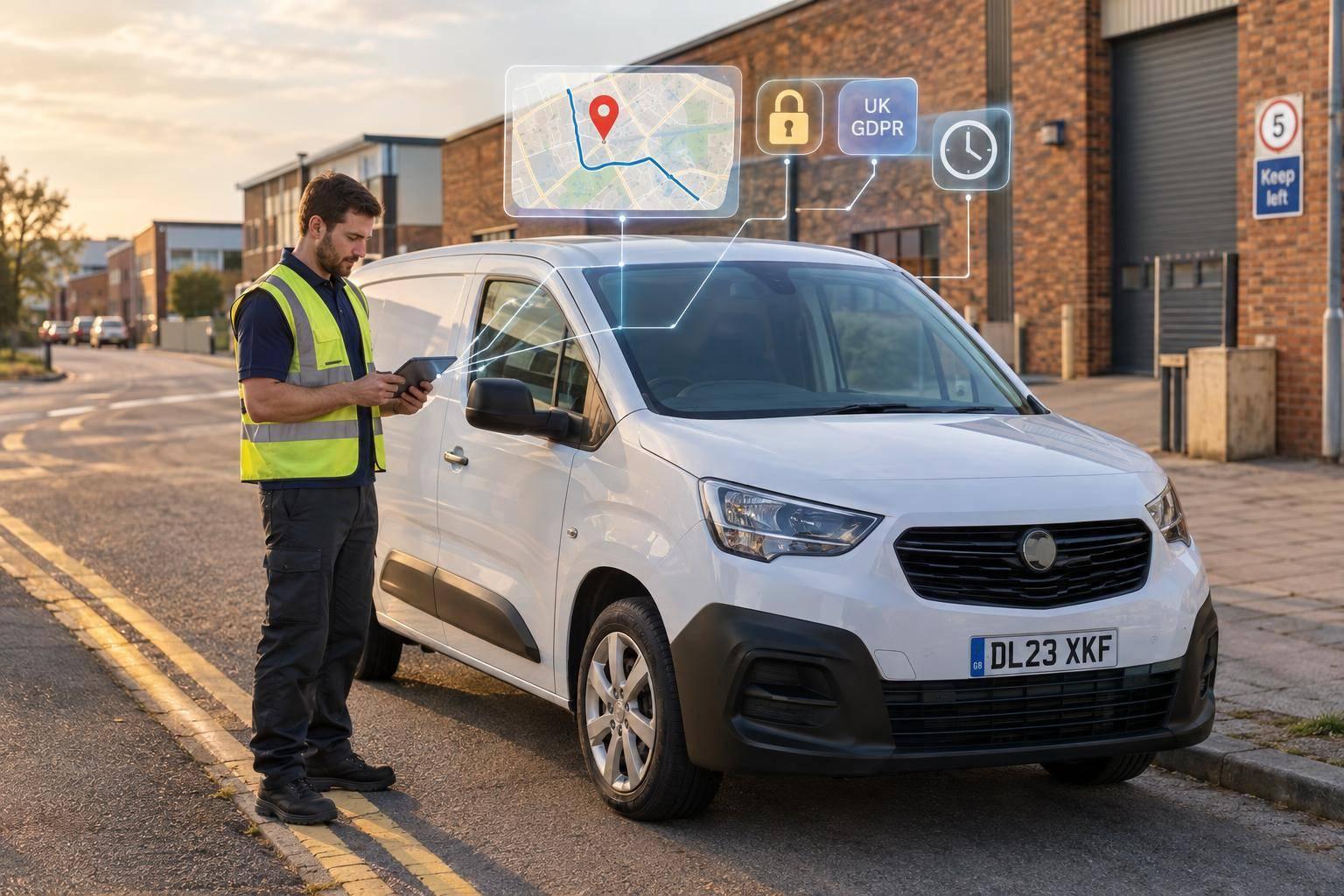
Jurisdiction Scope
UK-wide data-protection framework, with the ICO as the principal supervisory authority; specific employment and vehicle-use practices may vary across the UK.
Overview of Fleet Tracking Laws
Applicable Business Type
Field service companies and other employers operating work vehicles with mobile workers.
Country or Region
UK
A UK-focused compliance guide for field service companies using GPS, telematics or other vehicle-monitoring systems. It explains lawful bases, transparency, worker and passenger privacy, DPIAs for higher-risk monitoring, limits on private-use tracking, and proportionate retention and access controls.
Legal Requirements Summary
UK fleet tracking is primarily governed by UK GDPR and the Data Protection Act 2018 rather than a single fleet-tracking statute. Field service employers must establish a lawful and proportionate purpose, tell workers and passengers about monitoring, avoid unjustified private-use tracking, and apply stricter assessment—including a DPIA—to intrusive or analytical monitoring. There is no blanket retention period: records must be kept only as long as necessary and the period communicated. Consent is not normally the required legal basis, but transparency and privacy safeguards are mandatory.
Main Regulatory Topics
- UK GDPR and lawful basis
- Worker and passenger transparency
- Driver consent and private-use controls
- Data minimisation and purpose limitation
- DPIAs and high-risk monitoring
- Data retention and deletion
- Vehicle telematics, CCTV and audio
- Driver-behaviour analytics
- Tachograph obligations
- ICO oversight
Key Compliance Obligations
- Identify and document an appropriate UK GDPR lawful basis before tracking; legitimate interests requires a balancing assessment.
- Provide clear, accessible privacy information to workers and passengers covering the monitoring, purposes, data involved, retention, recipients and rights.
- Do not normally monitor private journeys; provide a means to disable tracking or otherwise separate business and private use where private use is permitted.
- Complete a DPIA before high-risk monitoring, including driver-behaviour analytics, cameras, audio or intrusive continuous monitoring.
- Use proportionate, purpose-limited tracking and restrict access to authorised personnel.
- Set and document a retention period based on necessity; delete or anonymise data when it is no longer needed.
- Apply heightened justification and risk assessment to cameras, audio and driver-behaviour monitoring; audio should generally be off by default.
- Where tachograph obligations apply, comply with the applicable driving-time, speed and distance recording rules.
Driver Consent Requirement
Consent Rule: Prior worker consent is not generally required where tracking has another valid UK GDPR lawful basis, such as legitimate interests, contract or legal obligation. However, workers and passengers must be informed; monitoring during private use is rarely justifiable, so a privacy mode or disable function should be used where appropriate.
Data Retention Period
Minimum Retention: No universal statutory minimum period for fleet-tracking records; retain only for as long as necessary for the documented purpose, and state the period in the privacy information.
Enforcement Authorities
- Information Commissioner’s Office (ICO) for UK data-protection compliance and worker monitoring.
- Driver and Vehicle Standards Agency (DVSA) for relevant drivers’ hours, tachograph and operator-compliance enforcement.
- Health and Safety Executive (HSE), or the relevant enforcing authority, for work-related road-risk and workplace health-and-safety duties.
Penalties for Non-Compliance
Non-compliance can lead to ICO regulatory action for unlawful or unfair monitoring, including investigation, enforcement notices and potentially UK GDPR/Data Protection Act 2018 administrative fines; it can also create data-subject complaints, compensation and reputational risk. Failure to comply with drivers’ hours or tachograph requirements can result in DVSA enforcement, penalties and operator-licensing consequences. Breaching work-related road-safety duties can trigger HSE or other enforcing-authority action, including improvement or prohibition notices and prosecution. The exact outcome depends on the breach, seriousness, evidence and applicable regime.
Implementation Best Practices
Before deployment, document the purpose, lawful basis, proportionality assessment and—where applicable—DPIA. Configure the system to collect only necessary location and operational data, disable or suspend tracking during authorised private use, and make drivers and passengers aware of monitoring. Apply role-based access, encryption and defined retention/deletion rules; review supplier and insurer data-processing arrangements. Use telematics primarily to support dispatch, route safety, vehicle maintenance and incident response rather than continuous intrusive productivity surveillance. Keep policies, training records, access logs and audit evidence, and periodically review whether the monitoring remains necessary and proportionate. For regulated goods vehicles, integrate tachograph downloads and exception management with the compliance calendar.
Compliance Checklist
- Define and document the specific business purposes for tracking field-service vehicles.
- Identify and document a UK GDPR lawful basis; do not rely on employee consent routinely where it may not be freely given.
- Complete a DPIA before high-risk monitoring, including driver-behaviour analytics, cameras, audio, or inferences about drivers.
- Provide a clear privacy notice to drivers and passengers explaining what is collected, purposes, lawful basis, access, retention, sharing, and rights.
- Use proportionate, data-minimising settings; limit tracking to working time where vehicles are available for private use and provide a genuine privacy/off-duty mode.
- Restrict access to authorised personnel, secure the telematics platform, and establish retention and deletion periods.
- Keep an audit trail of the DPIA or legitimate-interests assessment, policy approvals, worker communications, access requests, incidents, and deletions.
- Manage work-related road-risk through risk assessment, suitable vehicles and equipment, training, instruction, supervision, and monitoring.
- Where drivers’ hours rules apply, use an approved tachograph and download vehicle-unit data at least every 90 days and driver-card data at least every 28 days.
- Retain and be able to produce required tachograph records to enforcement officers for 12 months.
Industry-Specific Guidance
Field-service companies commonly need live location for dispatch, customer ETA updates, lone-worker or incident response, route planning and proof of attendance. Those operational purposes do not automatically justify unrestricted employee surveillance: identifiable location and driving-behaviour data are personal data, and private use requires a clear off-duty control because monitoring during private journeys will rarely be justifiable. Inform employees and passengers, address household members or members of the public captured by tracking, and use less intrusive alternatives where possible. If vans or other vehicles fall within drivers’ hours and tachograph rules—particularly applicable goods vehicles—separate tachograph obligations apply; ordinary service vans outside those rules are not made subject to tachograph requirements merely because GPS tracking is installed. HSE duties to manage road risk continue regardless of whether telematics is used.
Recent Legal Updates
As at 13 October 2026, the core position reflected in the cited official guidance remains that vehicle monitoring is permitted only with a lawful, transparent and proportionate purpose; monitoring during private use is generally difficult to justify, and high-risk monitoring requires a DPIA. Current GOV.UK tachograph guidance states that vehicle-unit data must be downloaded at least every 90 calendar days, driver-card data at least every 28 calendar days, and records must be producible to enforcement officers for 12 months. No source reviewed establishes a new UK field-service-specific GPS-tracking deadline; companies should check ICO, GOV.UK/DVSA and HSE updates before implementation.
Authoritative Resources
- Information Commissioner’s Office (ICO): worker and vehicle-monitoring guidance
- GOV.UK: drivers’ hours and tachographs guidance
- Health and Safety Executive (HSE): driving and riding safely for work
- GOV.UK/DVSA operator and tachograph compliance guidance
Related Blog Posts
- Fleet Tracking Regulations Explained: A Guide for Delivery Firms in the UK
- Fleet Tracking Regulations Explained: A Guide for Delivery Firms in England
- Fleet Tracking Regulations Explained: A Guide for Vehicle Leasing Companies in the UK
- Fleet Tracking Regulations Explained: A Guide for Vehicle Leasing Companies in England