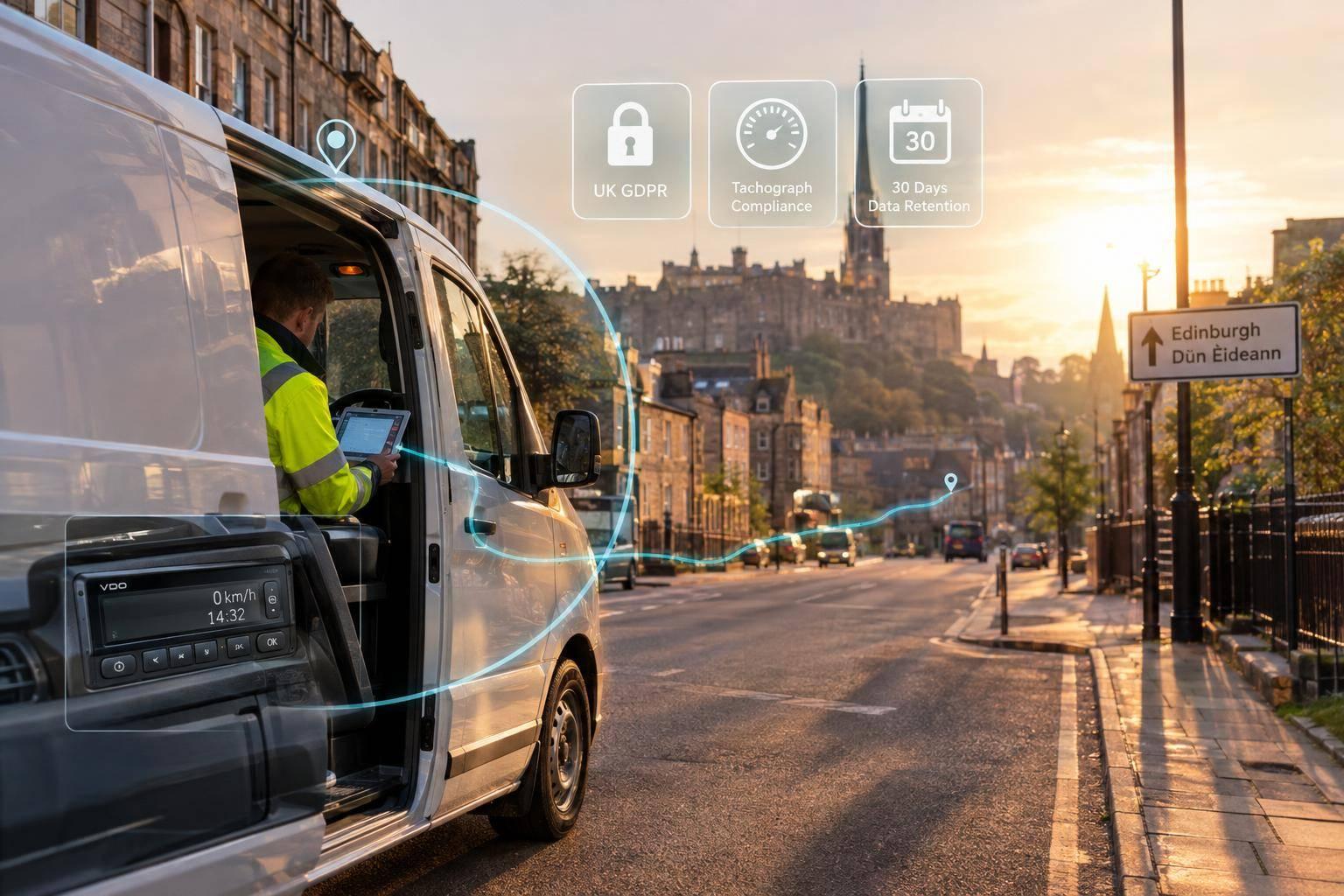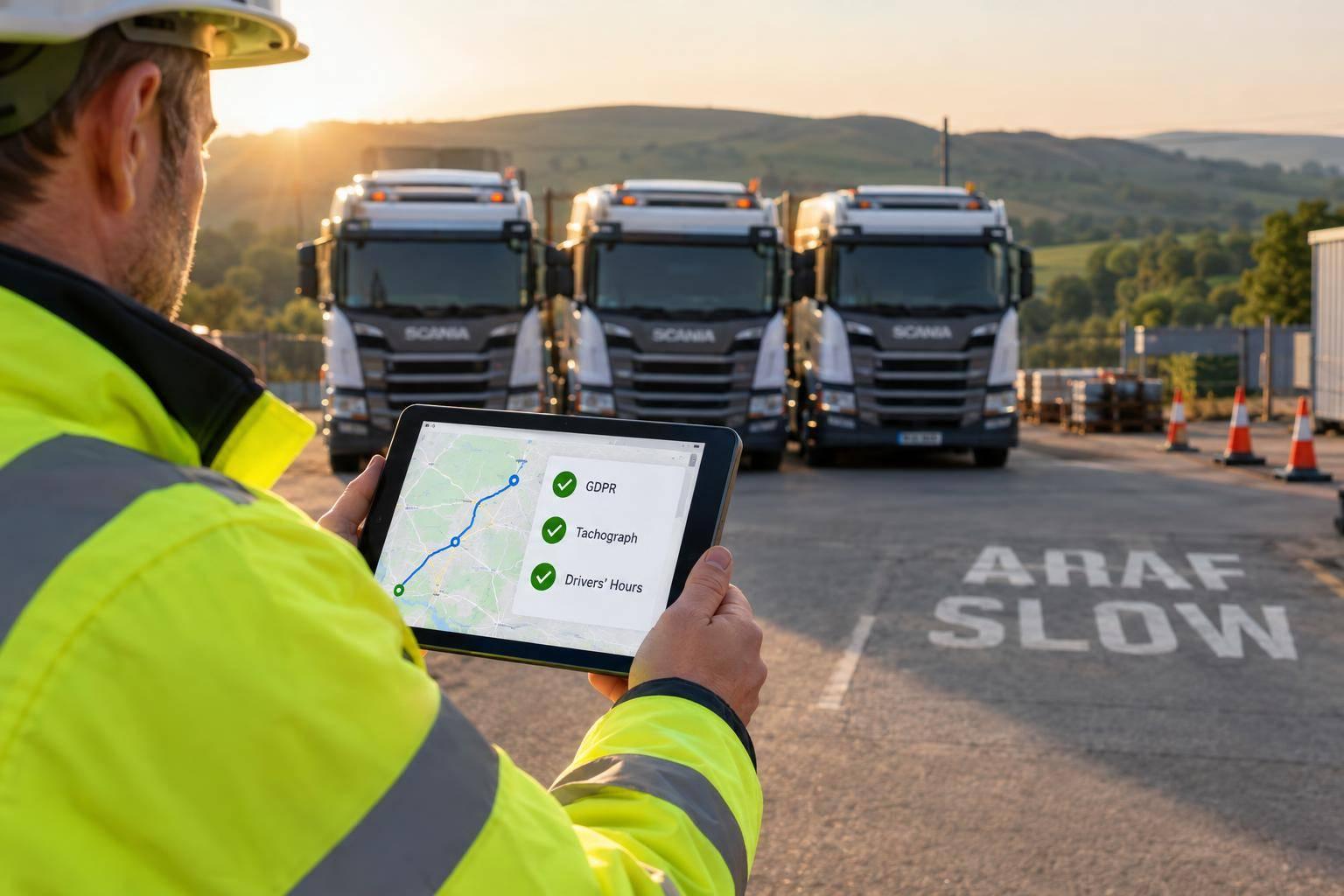
Fleet Tracking Regulations Explained: A Guide for Field Service Companies in Wales
UK GDPR and DVSA guidance for Welsh field service fleets on lawful GPS/telematics use, privacy, DPIAs, retention and tachographs.
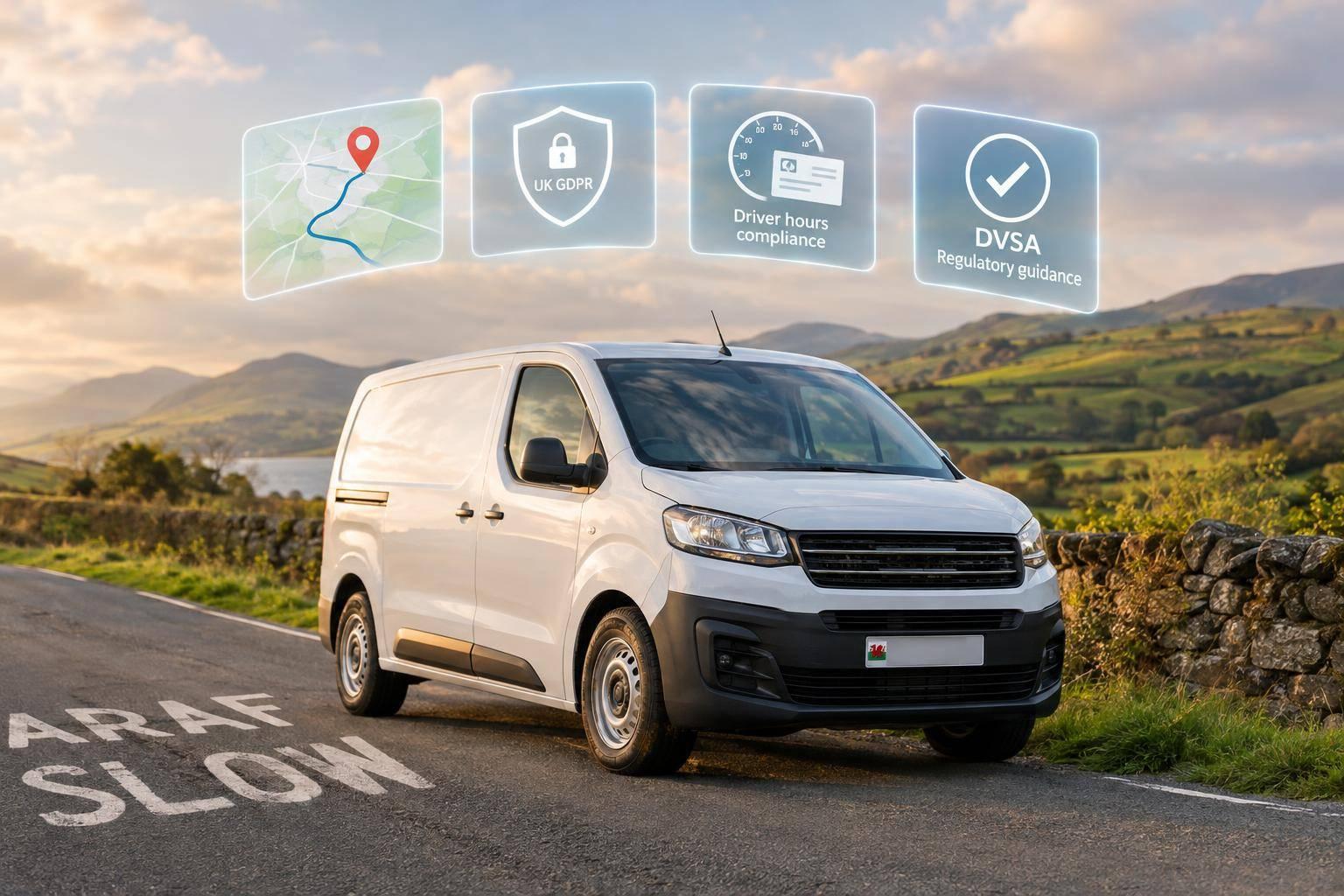
Jurisdiction Scope
Wales, under UK-wide data-protection and road-transport rules; enforcement and operator oversight may involve the Information Commissioner’s Office, DVSA and traffic commissioners, depending on the activity.
Overview of Fleet Tracking Laws
Applicable Business Type
Field service companies operating work vehicles, including businesses whose employees travel to customer sites.
Country or Region
United Kingdom (Wales).
A Wales-focused compliance guide for field service businesses using GPS, telematics or other vehicle-monitoring systems. It covers UK GDPR and Data Protection Act 2018 duties for worker and passenger monitoring, privacy during private vehicle use, DPIAs for high-risk monitoring, and relevant operator, tachograph and vehicle-record obligations where the fleet falls within those regimes.
Legal Requirements Summary
Field service companies in Wales may use fleet tracking, but identifiable driver and passenger data is subject to UK data-protection law. The business must establish a documented lawful basis and purpose, be transparent, use monitoring only where necessary and proportionate, protect the data and retain it only for as long as needed. Private-use tracking is difficult to justify and should normally be switched off or restricted. A DPIA is required for high-risk monitoring such as driver-behaviour analytics, cameras or audio. If vehicles are subject to operator-licensing or tachograph rules, additional maintenance, tachograph and working-time records must be downloaded, retained and produced for inspection.
Main Regulatory Topics
- UK GDPR and Data Protection Act 2018
- Worker and passenger privacy
- Lawful basis and transparency
- Driver consent
- Private-use restrictions
- Data Protection Impact Assessments
- Data minimisation, security and retention
- Vehicle maintenance records
- Tachograph downloads and record-keeping
- Drivers’ hours and working-time compliance
- DVSA and traffic-commissioner inspections
Key Compliance Obligations
- Document a lawful basis and a specific, necessary and proportionate purpose for vehicle monitoring.
- Provide clear privacy information to workers and passengers explaining what is collected, why, how it is used and how it is stored.
- Avoid or disable monitoring during private use unless it can be justified; apply suitable privacy controls.
- Complete and document a Data Protection Impact Assessment for high-risk monitoring, including driver-behaviour analytics, cameras or audio.
- Limit collection and access, secure telematics data, maintain a retention schedule, review it regularly and delete data when no longer necessary.
- Keep vehicle maintenance and safety-inspection records for at least 15 months where the operator rules apply.
- Where applicable, download digital tachograph vehicle-unit data at least every 90 days and driver-card data at least every 28 days.
- Where applicable, retain drivers’ hours records for at least 12 months and working-time records for at least 24 months, and make records available for inspection.
Driver Consent Requirement
Consent Rule: Prior employee consent is not generally required and is usually not the appropriate lawful basis in an employment relationship. The employer must instead identify and document an appropriate lawful basis, inform workers and passengers about monitoring, and ensure tracking is necessary and proportionate. Consent is suitable only where workers have a genuine, freely exercisable choice and no detriment for refusing.
Data Retention Period
Minimum Retention: No universal minimum for fleet-tracking data: retain personal monitoring data only as long as necessary for the stated purpose, under a documented and regularly reviewed retention schedule. Related statutory records may have specific periods: drivers’ hours records at least 12 months, working-time records 24 months, and vehicle maintenance records at least 15 months.
Enforcement Authorities
- Information Commissioner’s Office (ICO) — UK data-protection compliance and enforcement
- Driver and Vehicle Standards Agency (DVSA) — drivers’ hours, tachographs and operator compliance
- Health and Safety Executive (HSE) — work-related road-risk and workplace transport duties
- Employment tribunals and courts — potential claims relating to privacy, unfair treatment or misuse of monitoring data
Penalties for Non-Compliance
Non-compliance can lead to ICO regulatory action, including investigation, enforcement notices and potentially substantial UK GDPR penalties; employee complaints, compensation claims, reputational damage and unlawful-use findings are also possible. Tachograph or drivers’ hours breaches can trigger DVSA enforcement and operator or driver sanctions. Unsafe work-related driving and inadequate vehicle-management controls can result in HSE or other workplace-safety enforcement, prosecution and fines. The precise outcome depends on the breach, seriousness, evidence and enforcement history; there is no single Wales-specific 'fleet tracking fine'.
Implementation Best Practices
Adopt a written fleet-monitoring policy for field engineers and managers. Map each data field to a documented purpose, lawful basis and retention period; conduct worker consultation and a DPIA before deployment; use geofencing and schedules to disable or restrict tracking outside work; switch audio off by default; display vehicle notices; restrict dashboard access; audit supplier security and user access; and review alerts manually before disciplinary or performance decisions. Integrate telematics with, but do not replace, daily vehicle checks, maintenance controls, driver training and defect reporting.
Compliance Checklist
- Define and document a specific business purpose for GPS or telematics monitoring.
- Identify and record an appropriate UK GDPR lawful basis; do not assume employee consent is always the correct basis.
- Provide a clear privacy notice to drivers and passengers explaining what is collected, why, retention, sharing, controller identity and individual rights.
- Carry out and document a DPIA before high-risk monitoring, including driver-behaviour analytics, cameras, audio or automated inferences.
- Limit tracking to working time and business use where possible; provide a privacy/off-switch arrangement for authorised private use.
- Configure data minimisation, role-based access, security controls and a documented retention/deletion schedule.
- Use conspicuous in-vehicle signage where cameras or other surveillance record drivers or passengers.
- Keep supplier and insurer data-processing arrangements under review and ensure disclosures are transparent.
- Assess whether each vehicle and journey falls within drivers’ hours and tachograph rules; install and operate an approved tachograph where required.
- Maintain driver-hours, vehicle-check, maintenance, defect and incident records, and train staff on safe driving and system use.
- Review automated alerts or driver scores through meaningful human oversight before taking significant employment action.
Industry-Specific Guidance
For field service companies operating in Wales, the core fleet-tracking requirements are UK-wide rather than Wales-specific. GPS location, routes, stops, mileage and driving behaviour can become personal data when linked to an identifiable engineer. Tracking may support dispatch, customer-arrival evidence, theft prevention, lone-worker safety and fleet efficiency, but continuous monitoring of home-to-work travel, private use or passengers is difficult to justify. Field engineers often carry tools and equipment, so the tracking programme should sit alongside HSE controls for vehicle suitability, load security, daily checks, maintenance and driver competence. Van operators must separately assess vehicle weight, journey type and international operations for tachograph obligations; ordinary UK-only goods vehicles over 2.5 tonnes and under 3.5 tonnes generally do not require a tachograph, subject to the applicable exemptions and rules.
Recent Legal Updates
As at 14 October 2026, the most relevant dated change for applicable field-service fleets is the tachograph timetable: from 24 December 2025 newly registered goods vehicles must have a full smart 2 tachograph, and from 1 July 2026 a full smart 2 tachograph is required in goods vehicles over 2.5 tonnes used for international hire-or-reward journeys, subject to the stated exceptions. A 2026 amendment proposal also addresses zero-emission vans over 3.5 tonnes and up to 4.25 tonnes, but operators should check the final legislation and commencement terms before relying on any change. The ICO’s current guidance continues to require lawful basis, transparency, proportionality and DPIAs for high-risk worker monitoring; it also highlights human oversight and information rights where monitoring supports solely automated decisions.
Authoritative Resources
- Information Commissioner's Office (ICO): monitoring workers and surveillance in vehicles
- GOV.UK / Driver and Vehicle Standards Agency (DVSA): drivers’ hours and tachographs
- Health and Safety Executive (HSE): driving and riding safely for work
- UK GDPR and Data Protection Act 2018 guidance
Related Blog Posts
- Fleet Tracking Regulations Explained: A Guide for Delivery Firms in Wales
- Fleet Tracking Regulations Explained: A Guide for Van Rental Companies in Wales
- Fleet Tracking Regulations Explained: A Guide for Courier Businesses in Wales
- Fleet Tracking Regulations Explained: A Guide for Field Service Companies in the UK