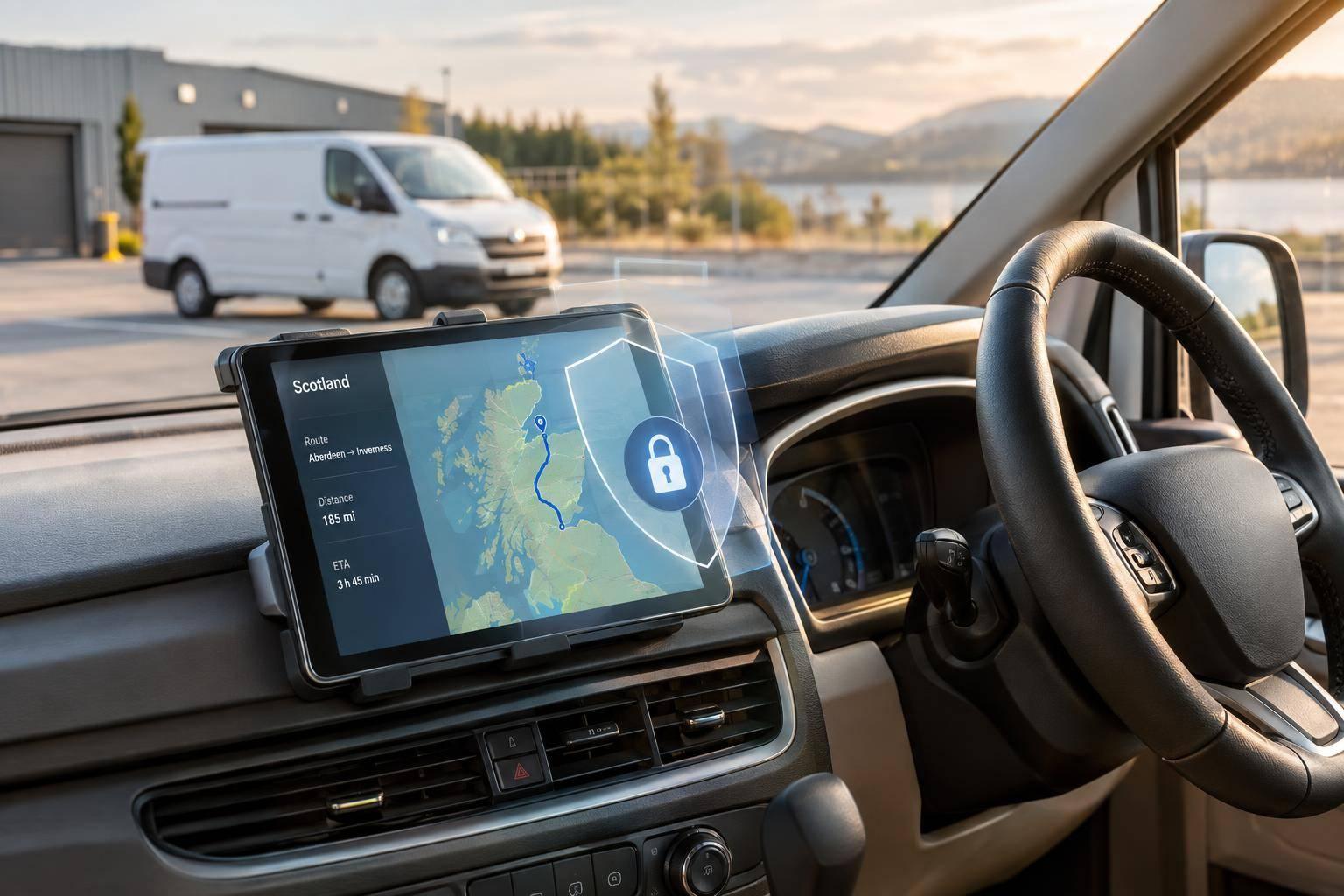
Fleet Tracking Regulations Explained: A Guide for Maintenance Providers in Scotland
Scottish maintenance providers must treat fleet tracking as personal data: ensure lawful basis, DPIA, privacy limits and tachograph care.
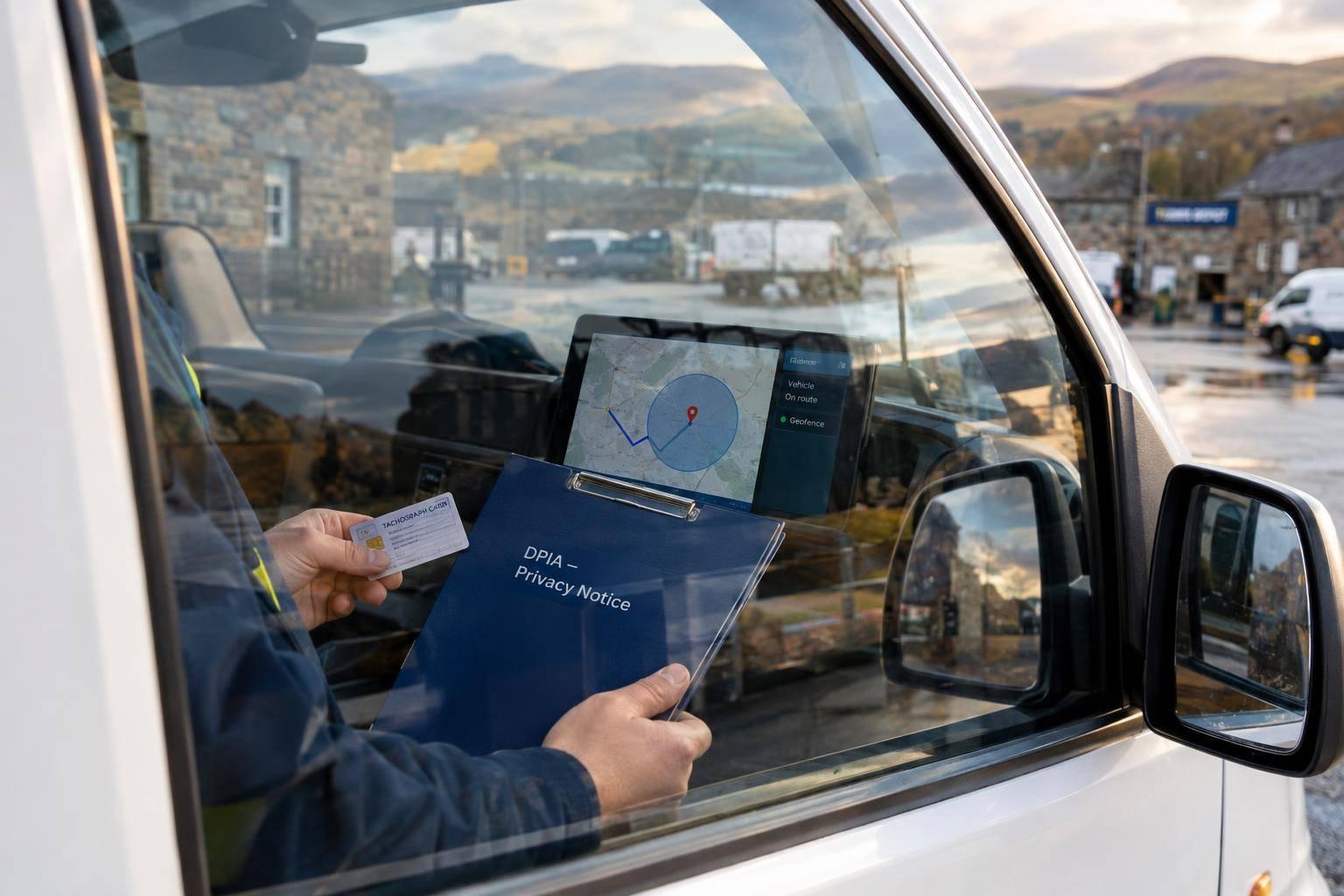
Jurisdiction Scope
Scotland, under UK-wide data-protection law (UK GDPR and Data Protection Act 2018); no separate Scotland-only fleet-tracking consent regime is identified.
Overview of Fleet Tracking Laws
Applicable Business Type
Maintenance providers (service and repair businesses operating fleet vehicles and mobile workers)
Country or Region
United Kingdom
A Scotland-focused guide for maintenance providers explaining how to deploy vehicle GPS/telematics lawfully when tracking company vehicles and mobile maintenance staff. It covers UK GDPR transparency, lawful basis, proportionality, private-use safeguards, DPIAs for higher-risk monitoring, data governance, and operational compliance.
Legal Requirements Summary
Maintenance providers in Scotland may use fleet tracking, but identifiable vehicle and driver-location/telematics data is subject to UK data-protection law. The business must establish a lawful, specific and proportionate purpose; notify drivers and passengers; apply suitable security, access and retention controls; and complete a DPIA for high-risk or intrusive monitoring. Consent is generally not mandatory and is usually unsuitable as the employment-lawful basis. Private-use tracking should normally be disabled or excluded. Any tachograph requirements are separate and apply only where the vehicle and operation fall within the relevant drivers’ hours rules.
Main Regulatory Topics
- UK GDPR and Data Protection Act 2018
- Lawful basis and transparency
- Driver and passenger notification
- Private-use safeguards
- Driver consent
- Data Protection Impact Assessments
- Proportionality and purpose limitation
- Data security and access controls
- Retention and deletion
- Data-subject rights
- Tachographs and drivers’ hours where applicable
- Monitoring, enforcement, and governance
Key Compliance Obligations
- Identify and document a lawful basis for processing location and telematics data; do not assume employee consent is required or suitable.
- Provide clear privacy information to drivers and passengers before monitoring, explaining purposes, data uses, recipients, and rights.
- Limit tracking to specified, necessary, and proportionate business purposes such as dispatch, safety, vehicle management, or incident investigation.
- Prevent or switch off monitoring during authorised private use where the vehicle is used personally, unless a defensible separate legal justification applies.
- Carry out and document a Data Protection Impact Assessment where monitoring is high risk, intrusive, involves driver-behaviour analytics, cameras, audio, or systematic evaluation.
- Apply appropriate access controls, security, retention limits, and procedures for data-subject rights and third-party sharing.
- Maintain a clear vehicle-monitoring policy and communicate it to staff; review the system and purposes periodically.
- Consider separate legal regimes where applicable, including tachograph obligations for vehicles and operations within scope of drivers’ hours rules.
Driver Consent Requirement
Consent Rule: Prior employee consent is not generally required and is usually not the preferred UK GDPR lawful basis in an employment relationship. The provider must instead identify and document an appropriate lawful basis, inform drivers and passengers clearly, and ensure monitoring is necessary and proportionate. If vehicles are available for private use, tracking should normally be disabled or otherwise prevented outside work unless a separate lawful justification exists.
Data Retention Period
Minimum Retention: No universal statutory minimum for ordinary fleet-tracking data; retain only as long as necessary for the stated purpose and documented legal, insurance, accounting, or employment requirements. A practical policy must therefore specify purpose-based periods rather than assume a fixed term.
Enforcement Authorities
- Traffic Commissioners for Great Britain
- Driver and Vehicle Standards Agency (DVSA)
- Information Commissioner’s Office (ICO)
- Police Scotland and other police forces where data is lawfully requested or relevant to an incident
Penalties for Non-Compliance
Non-compliance can expose the business and operator to DVSA or Traffic Commissioner investigation, prohibition or delayed use of unsafe vehicles, operator-licence curtailment, suspension or revocation, and sanctions for drivers’ hours or tachograph breaches. Poor maintenance records can undermine an operator-licence application or review. Unlawful or excessive tracking can lead to ICO regulatory action, compulsory remediation, complaints, compensation claims and data-protection penalties. Exact sanctions depend on the breach, seriousness, history and evidence; the cited guidance does not establish a single Scotland-specific fixed fine for fleet tracking.
Implementation Best Practices
For a Scottish maintenance provider, map every vehicle to its operator-licence, inspection and tachograph obligations before installation. Keep a controlled maintenance and telematics compliance file containing the operator-licence details, maintenance contract, inspection schedule, defect and repair records, MOT/statutory-test evidence, tachograph calibration certificates, download/audit logs, privacy notice, DPIA, retention schedule, access permissions and supplier contracts. Configure tracking around the stated safety, scheduling and asset-management purpose; minimise location and driver-behaviour data, disable private-use tracking, turn off audio by default, and audit permissions and retention regularly. Ensure the system can export records promptly for a Traffic Commissioner, DVSA inspection or data-subject request.
Compliance Checklist
- Determine whether each vehicle and journey falls within operator-licensing, drivers’ hours or tachograph rules.
- Maintain vehicles in a fit and serviceable condition and document maintenance arrangements, safety inspections, repairs, statutory tests and calibration.
- Keep a forward maintenance planner and make vehicles available for inspection, servicing, repair and testing.
- Where tachographs are required, use approved equipment; ensure installation, calibration and sealing are completed by an authorised manufacturer or calibration centre.
- Download digital/smart tachograph vehicle-unit data at least every 90 days and driver-card data at least every 28 days; analyse compliance.
- Identify a UK GDPR lawful basis for tracking and document necessity, proportionality and retention limits.
- Tell drivers and passengers that monitoring takes place, what data is collected, why it is used, who controls it and how data-subject rights can be exercised.
- Do not normally track private use; provide a disablement or privacy mode where private use is permitted.
- Complete a Data Protection Impact Assessment for high-risk driver-behaviour monitoring, cameras or other intrusive processing.
- Use clear in-vehicle signage and switch audio recording off by default unless exceptional, documented justification exists.
- Restrict access to telematics data, define retention periods, manage supplier/controller arrangements and review the system periodically.
Industry-Specific Guidance
Maintenance providers commonly operate service vans, recovery vehicles, trucks, trailers and occasionally plant or customer vehicles. Tracking can support dispatch, breakdown response, proof of attendance, maintenance planning, road-risk management and operator-licence compliance, but it does not replace required safety inspections, defect reporting, statutory testing or tachograph records. If staff take vans home or use them privately, continuous tracking is difficult to justify; use working-hours controls or a privacy mode and explain the arrangement to drivers and passengers. If the provider maintains vehicles for another operator, the vehicle owner/operator remains responsible for its operator-licence and drivers’ hours compliance, while the maintenance contractor should preserve accurate service, inspection and calibration evidence and clarify controller/processor roles for telematics data. Scottish operations are subject to the Great Britain operator-licensing and UK GDPR framework; cross-border work in Ireland or France may trigger additional local requirements.
Recent Legal Updates
As at 16 October 2026, the authoritative material located does not identify a new Scotland-specific fleet-tracking rule or a new fixed deadline for maintenance providers. The current position remains a combination of Great Britain operator-licensing, roadworthiness and tachograph requirements, plus UK GDPR and Data Protection Act 2018 obligations for personal telematics data. Businesses should re-check GOV.UK, the Traffic Commissioner/DVSA and ICO pages before deployment because tachograph specifications, operator-licensing guidance and ICO employment-monitoring guidance can be updated.
Authoritative Resources
- Information Commissioner’s Office (ICO): monitoring workers and vehicle tracking guidance
- GOV.UK: Goods vehicle operator licensing guide
- GOV.UK: Guide to maintaining roadworthiness
- GOV.UK: Drivers’ hours and tachographs guidance
- Traffic Commissioner / Driver and Vehicle Standards Agency (DVSA) operator-compliance materials
Related Blog Posts
- Fleet Tracking Regulations Explained: A Guide for Delivery Firms in Scotland
- Fleet Tracking Regulations Explained: A Guide for Vehicle Leasing Companies in Scotland
- Fleet Tracking Regulations Explained: A Guide for Courier Businesses in Scotland
- Fleet Tracking Regulations Explained: A Guide for Maintenance Providers in the UK