Fleet Tracking Regulations Explained: A Guide for Utilities Companies in the UK
UK guidance for utilities on lawful, proportionate fleet tracking: transparency, DPIAs, retention, private-use limits and access controls.
 By Michael Bar5 min read
Jurisdiction Scope
UK-wide data-protection and employment-monitoring context; the cited guidance is from the UK Information Commissioner’s Office.
Overview of Fleet Tracking Laws
Applicable Business Type
Utilities companies operating vehicle fleets, including employers using telematics to manage field-service and essential-service vehicles.
Country or Region
UK
A UK-focused compliance guide for utilities companies using fleet tracking or vehicle telematics. It covers lawful and proportionate monitoring of identifiable drivers, transparency to drivers and passengers, privacy safeguards, DPIAs for high-risk monitoring, access and sharing controls, and retention/deletion practices.
Legal Requirements Summary
Utilities companies may use fleet tracking, but identifiable vehicle and driver data is subject to UK data-protection law. They must establish a lawful and proportionate purpose, transparently notify workers and passengers, restrict monitoring during private use, and complete a DPIA where monitoring is high risk—particularly for behaviour analytics, cameras, audio or profiling. The UK GDPR sets no universal retention period, so the company must justify and periodically review its own retention schedule and securely delete data when no longer needed.
Main Regulatory Topics
- Data Privacy
- UK GDPR Lawful Basis
- Worker and Passenger Transparency
- Driver Consent
- Private-Use Restrictions
- Data Protection Impact Assessments
- Monitoring Proportionality
- Record-Keeping and Retention
- Access and Data Sharing
- Driver-Behaviour Analytics
- Real-Time and Historic Tracking
Key Compliance Obligations
- Identify and document an appropriate UK GDPR lawful basis for vehicle tracking and ensure monitoring is necessary, proportionate and tied to specified purposes.
- Inform workers and passengers that vehicle monitoring is taking place, including the circumstances and purposes; provide adequate privacy information and, where relevant, in-vehicle signage.
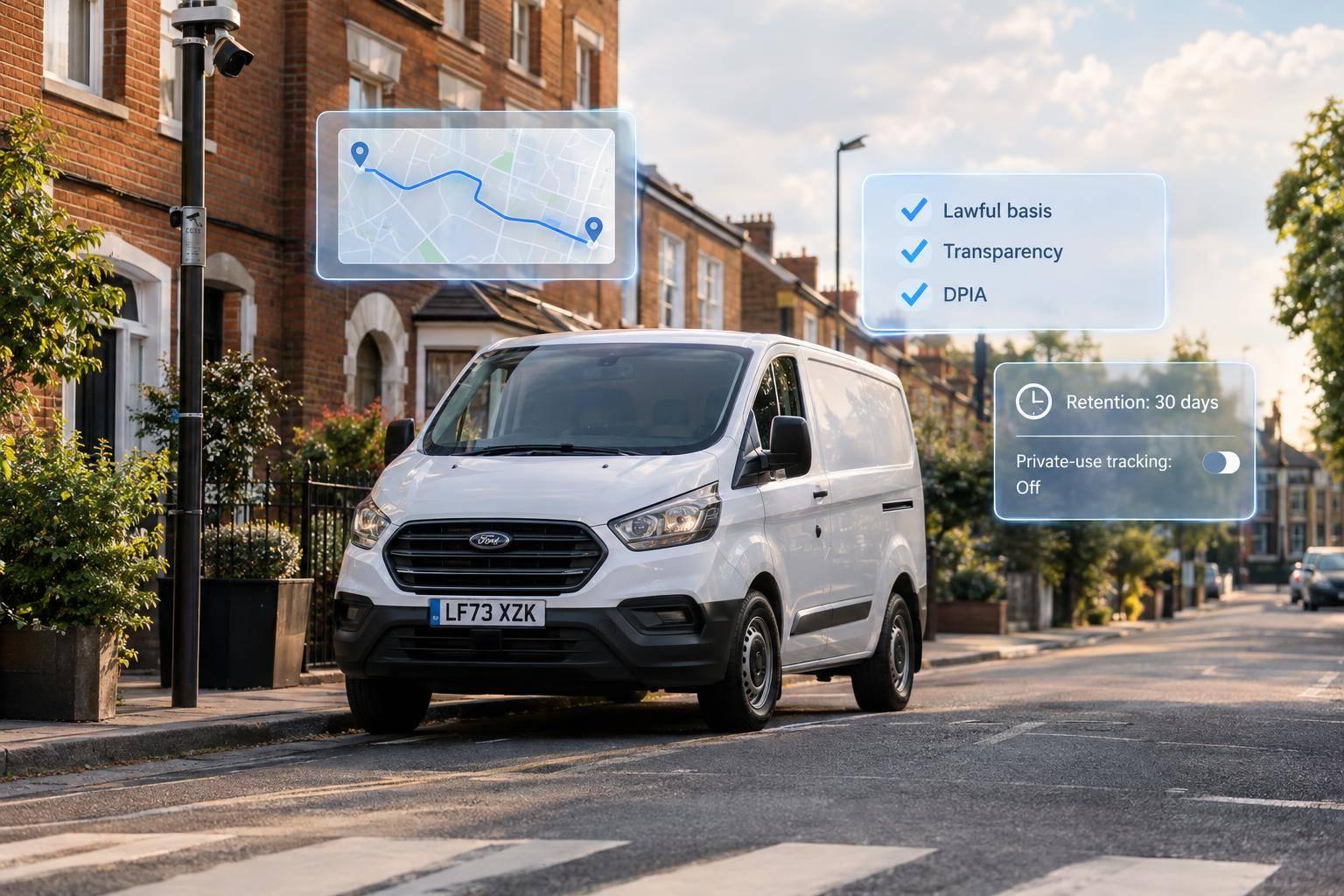
- Avoid or disable monitoring during authorised private use of company vehicles unless there is a clear justification.
- Complete a Data Protection Impact Assessment (DPIA) for high-risk monitoring such as driver-behaviour analytics, cameras, audio, profiling or other systems making inferences about drivers.
- Use less intrusive alternatives where they can achieve the same operational, safety or compliance objective.
- Limit access to authorised personnel, control disclosures to telematics suppliers, insurers and contractors, and protect driver and passenger data.
- Set, justify and regularly review a retention schedule; securely delete tracking data when it is no longer necessary.
- Apply additional safeguards where tracking data is used for disciplinary, performance, insurance or safety decisions, recognising that telematics data identifying drivers is personal information.
Driver Consent Requirement
Consent Rule: Prior informed notice is required, but employee consent is not usually the appropriate legal basis because of the employment power imbalance. Monitoring should instead have a documented lawful basis and be necessary and proportionate; genuine consent is appropriate only where workers have a real choice and can withdraw it without detriment. If vehicles are available for private use, monitoring during private use will rarely be justifiable and should normally be disabled or otherwise prevented.
Data Retention Period
Minimum Retention: No fixed statutory period under the UK GDPR; retain only for as long as necessary for the stated purpose, using and regularly reviewing a documented retention schedule.
Enforcement Authorities
- Information Commissioner’s Office (ICO) for UK GDPR and Data Protection Act 2018 compliance
- Driver and Vehicle Standards Agency (DVSA) for roadworthiness, vehicle and operator compliance
- Department for Transport / traffic commissioners for applicable operator-licensing and drivers’-hours oversight
- Health and Safety Executive (HSE) and relevant regulators where monitoring supports workplace or utility operational safety
Penalties for Non-Compliance
Non-compliance can lead to ICO investigations, enforcement notices, orders to stop or change processing, compensation claims, reputational damage and potentially significant UK GDPR fines. Road-transport failures can result in DVSA or traffic-commissioner enforcement, prohibition or prohibition of vehicles, fixed penalties, prosecution, operator-licence action and adverse compliance records. Inaccurate or missing working-time, tachograph, defect or maintenance records can therefore affect both the business and individual drivers. The exact sanction depends on the breach, seriousness, evidence, cooperation and prior history; the sources do not support a single fixed penalty for utility-fleet tracking.
Implementation Best Practices
Treat utility-fleet telematics as personal-data processing whenever vehicles or driver activity can be linked to an identifiable worker. Start with a documented purpose-and-necessity assessment and DPIA; configure geofencing, working-hours schedules, private-use suspension, data minimisation, retention limits, and role-based access before deployment. Consult workers, provide a concise privacy notice and vehicle signage, and record training and acknowledgements. Keep telematics separate from disciplinary decision-making unless the policy clearly explains that use and the evidence is reliable and proportionate. Integrate the platform with legally required tachograph, defect, maintenance and working-time processes, but do not assume that GPS data replaces statutory records. Audit supplier security, international transfers, sub-processors, accuracy, access logs and deletion routinely.
Compliance Checklist
- Define and document the lawful purpose and lawful basis for tracking; do not collect more data than necessary.
- Complete and document a Data Protection Impact Assessment (DPIA) before high-risk monitoring, particularly driver-behaviour analytics, cameras, audio, or inference-based systems.
- Give drivers and passengers clear privacy information explaining what is collected, why, how long it is retained, who receives it, and their rights.
- Restrict monitoring to working time and legitimate operational purposes; provide a method to disable or suspend tracking during authorised private use.
- Set role-based access controls, secure the telematics platform, maintain audit logs, and establish retention and deletion rules.
- Use tachographs where legally required and retain/download tachograph data in accordance with drivers’-hours rules.
- Monitor mobile workers’ working time, prevent working-time-limit breaches, and keep working-time records for at least two years.
- Require daily walkaround checks, record defects, repair major defects before use, and retain vehicle repair and maintenance records.
- Use telematics alerts for safety, lone-worker welfare, route/service assurance, vehicle security, maintenance, and incident investigation only where proportionate.
- Review the system, DPIA, privacy notice, supplier contracts, access permissions, and retention schedule periodically and after material changes.
Industry-Specific Guidance
Utilities companies commonly operate mixed fleets carrying staff, tools, plant and specialist equipment, often with emergency call-outs, lone workers, take-home vehicles and work near members of the public. Tracking can support dispatch, ETA and route planning, lone-worker welfare, vehicle and asset security, maintenance, fuel efficiency, incident investigation and service-delivery assurance. However, utility operations do not create a blanket right to continuous employee surveillance: private journeys and passengers must be protected, and monitoring must remain necessary and proportionate. For HGVs or other vehicles within tachograph rules, GPS telematics complements rather than replaces tachograph records. Contractors and agency drivers must receive appropriate privacy information too; ensure contracts allocate controller/processor responsibilities and incident handling.
Recent Legal Updates
As at 17 October 2026, the authoritative material located does not identify a UK utility-specific fleet-tracking mandate or a new tracker-specific deadline. The current position remains principles-based: UK GDPR and ICO worker-monitoring requirements govern identifiable driver and passenger data, while existing drivers’-hours, tachograph, working-time, roadworthiness and maintenance rules continue to apply where relevant. GOV.UK fleet guidance says mobile-worker working-time records should be retained for at least two years and requires daily walkaround checks and defect records. Recheck ICO, GOV.UK, DVSA and traffic-commissioner publications before deployment or a major system change because guidance and enforcement practice can change.
Authoritative Resources
- Information Commissioner's Office (ICO): worker-monitoring and vehicle-monitoring guidance
- GOV.UK: Running a fleet of vans
- Driver and Vehicle Standards Agency (DVSA): Guide to maintaining roadworthiness
- GOV.UK / Department for Transport road-transport guidance