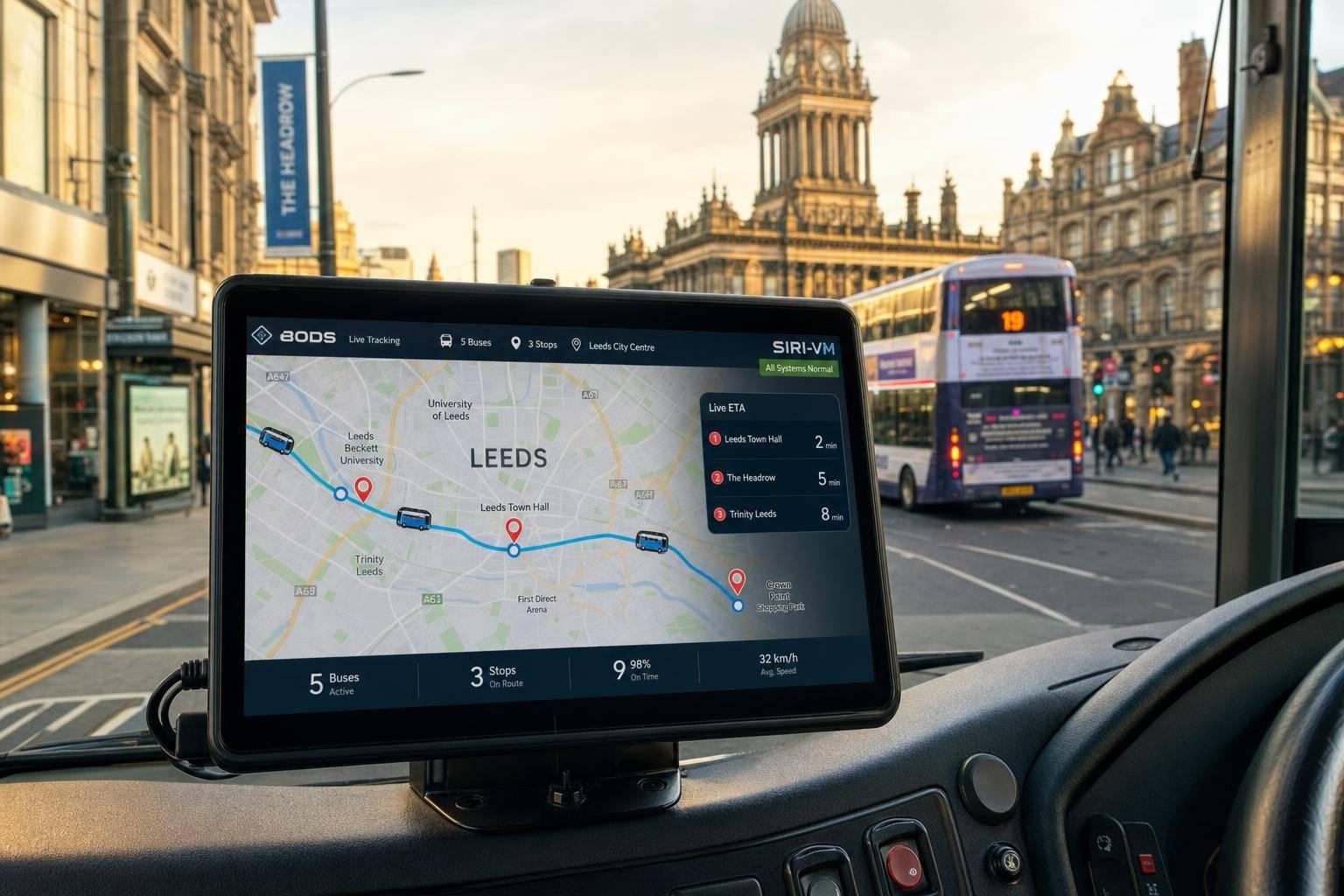
Best Fleet Tracking Devices for Buses in Coventry
Guide to GPS/telematics for Coventry buses: live AVL, SIRI‑VM/BODS compliance, CCTV, diagnostics and local installation.
 By Michael Bar7 min read
Overview
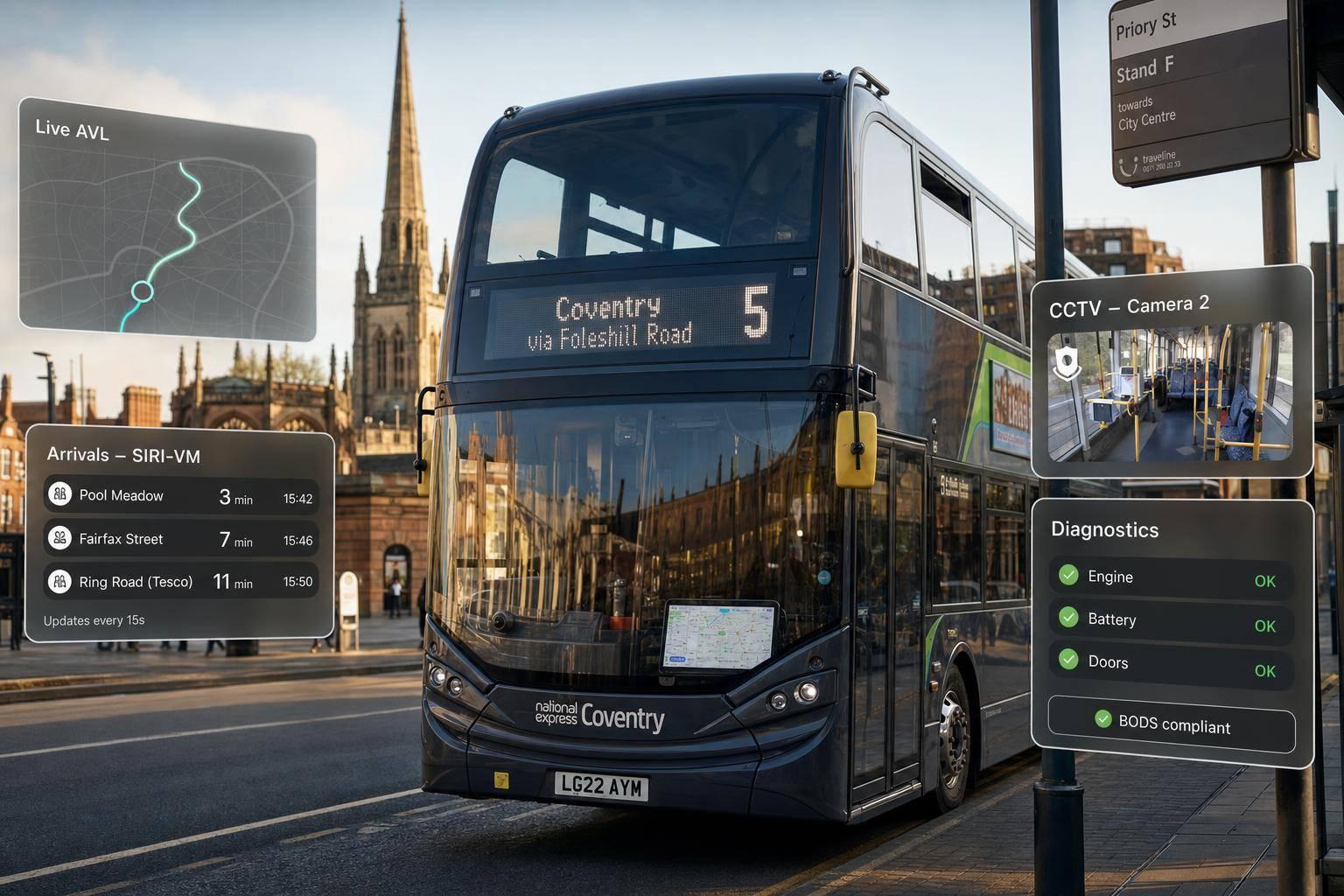
A practical en-GB guide to selecting GPS/AVL and wider telematics for buses operating in Coventry. Coventry’s established AVL/real-time passenger-information environment makes open standards and integration at least as important as the tracker hardware itself.
Key Features for Buses (scheduled local-service, contract and coach fleets) Tracking in Coventry, West Midlands, England
- Live GPS/AVL location with frequent updates
- SIRI-VM 2.0 or 2.0Q-compatible bus-location data export for England’s Bus Open Data Service
- Real-time passenger information and arrival prediction integration
- Geofencing, route adherence and early/late-running alerts
- Driver-behaviour monitoring and safety-event reporting
- CANbus/vehicle diagnostics and preventive-maintenance data
- CCTV, emergency response and onboard-system integration
- Passenger counting and, where required, EMV/ticketing integration
- 4G connectivity, with 5G where supported and justified
- Web dashboards, mobile/driver applications and operational reports
- Out-of-hours installation to avoid taking buses out of service
- UK GDPR-conscious access control, retention and audit policies
Technical Specifications
Recommended minimum specification for a Coventry bus deployment:
- Connectivity: 4G LTE as the baseline; 5G is useful for high-bandwidth CCTV/telematics integrations where coverage and cost justify it.
- Positioning and reporting: GNSS/GPS AVL with configurable reporting, route and stop association, geofences and loss-of-signal buffering. For England’s BODS feed, location data must use SIRI-VM version 2.0 or 2.0Q; regulations require automatic location updates no less frequently than every 30 seconds and no more frequently than every 10 seconds.
- Power and installation: hard-wired commercial-vehicle installation with tamper-resistant mounting and backup handling is preferable to a consumer OBD tracker. Confirm the vehicle’s electrical compatibility, antenna placement, data SIM and installer certification before purchase.
- System integration: require APIs/export for BODS, SIRI-VM, RTPI, timetable, ticketing, CCTV, APC and control-room systems as applicable.
- Environmental/safety requirements: ask vendors for the exact device IP rating, operating-temperature range, EMC approval, vibration testing and UKCA/CE status for the selected hardware; these model-specific values were not consistently published in the accessible sources and should not be assumed.
Typical Pricing
Basic vehicle telematics may be lower or higher depending on hardware and contract, while integrated CCTV, passenger counting, CANbus/tachograph integration, professional fitting and public-transport back-office work are usually additional.
Industry and Region-Specific Recommendations
For a scheduled Coventry local-service fleet, make SIRI-VM/BODS compatibility, route adherence, stop-level arrival data and dependable control-room alerts non-negotiable. England’s rules require relevant local-service operators to provide automatic vehicle-location data, with updates between 10 and 30 seconds; procure a platform that can generate and validate the required feed rather than relying on a consumer tracker. Coventry has precedent for AVL linked to real-time displays and timetable performance monitoring, so integration with existing operator/city systems should be tested in a pilot. For safety-led operations, pair live tracking with driver-behaviour alerts, CCTV/emergency workflows and role-based access. For Coventry installation and aftercare, obtain written confirmation of engineer coverage, installation lead time, out-of-hours fitting, SIM/network resilience, replacement-device SLA and on-site support.
Compliance Tips for Buses (scheduled local-service, contract and coach fleets) Fleets in Coventry, West Midlands, England
For local bus services in England outside London, choose a system that can publish accurate timetable, fares and automatic vehicle-location data to the Department for Transport’s Bus Open Data Service (BODS). BODS location data uses SIRI-VM; the regulations require AVL updates no less frequently than every 30 seconds and no more frequently than every 10 seconds. Confirm the supplier supports the required SIRI-VM fields, data quality monitoring and API integration. For driver monitoring or onboard CCTV, establish a UK GDPR lawful basis, provide clear driver/passenger privacy information and signage, restrict access and retention, and disable continuous audio by default unless strongly justified. Check any TfWM/National Express Coventry integration requirements before procurement.
Local Service and Support in Coventry, West Midlands, England
Coventry-specific deployments should also test interoperability with West Midlands real-time information and BODS feeds, which are already used for NX West Midlands & Coventry data.
Installation Options in Coventry, West Midlands, England
- Self-install using supplied hardware and instructions
- Planned professional installation by supplier technicians