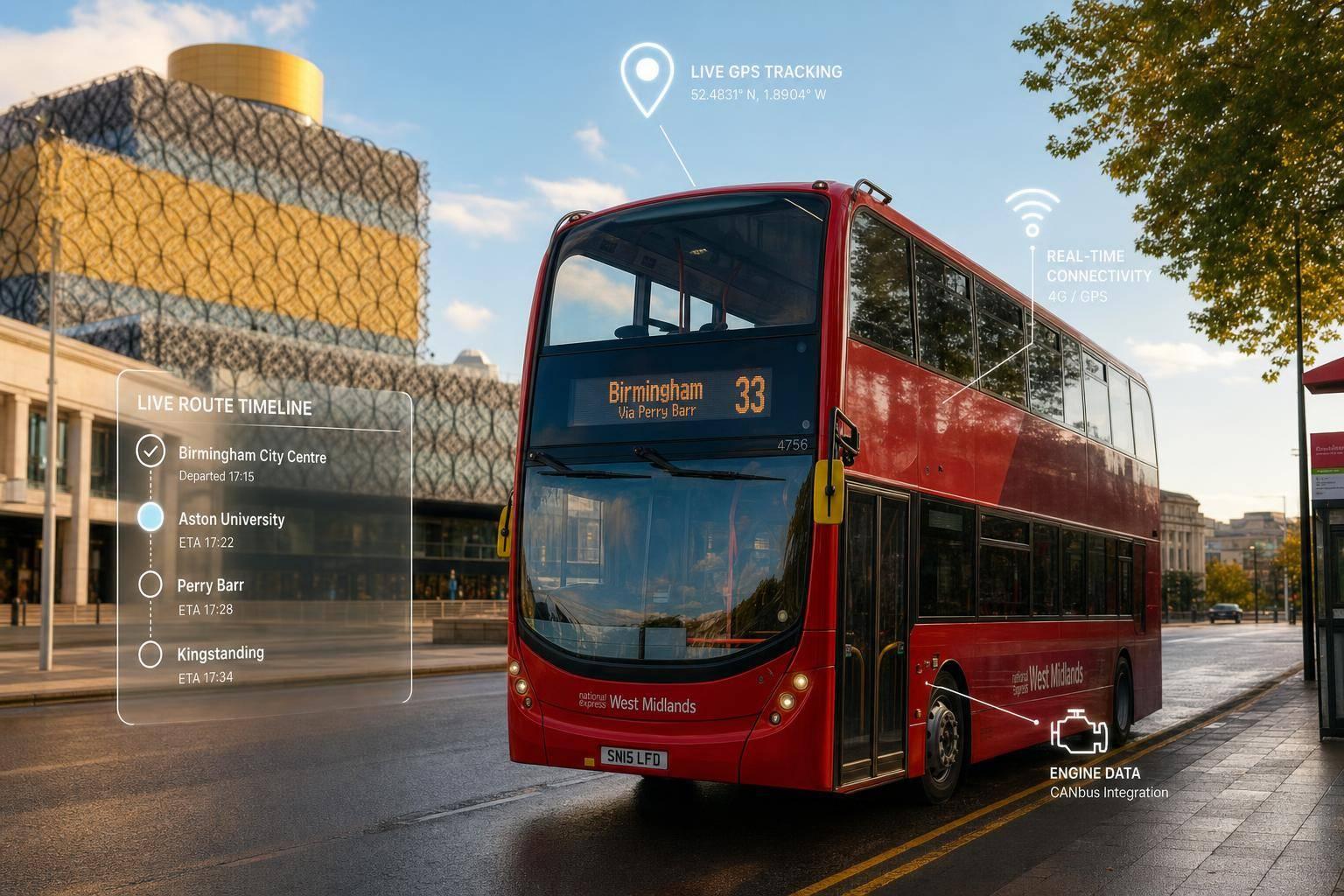
Best Fleet Tracking Devices for Buses in Leeds
Compare AVL and telematics options for Leeds bus fleets—BODS/SIRI-VM compliance, pricing, installation and local support for operators.
 By Michael Bar9 min read
Overview
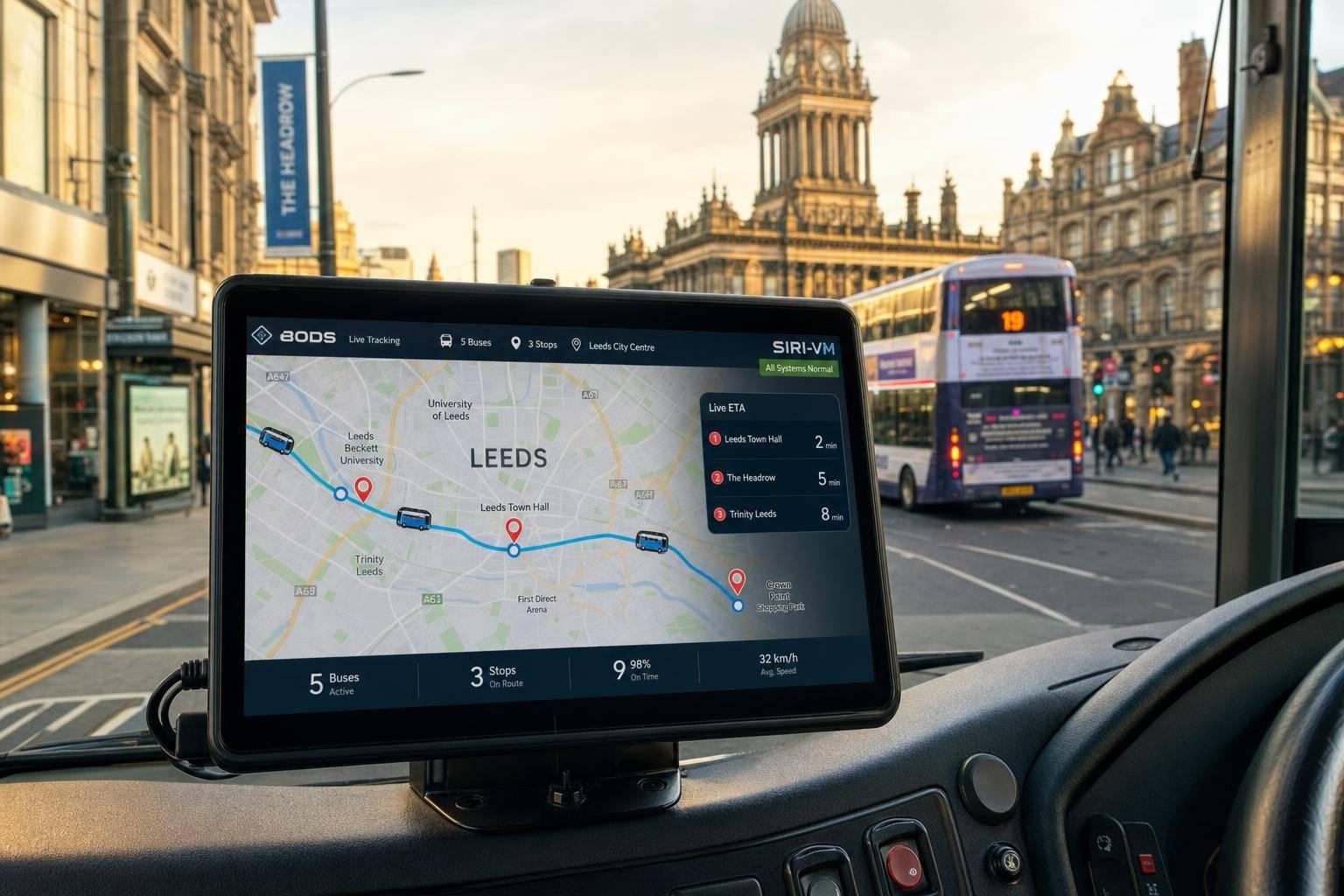
This guide compares bus-tracking and fleet-management solutions appropriate for operators in Leeds and the wider West Yorkshire area. For buses, the purchasing decision is broader than a basic vehicle tracker: the system may need automatic vehicle location (AVL), real-time passenger information (RTPI), timetable and journey association, driver communications, safety/CCTV, maintenance telemetry and Bus Open Data Service (BODS) integration. England’s open-data regime covers timetable, fares, real-time vehicle location and historic punctuality data, and AVL supplied to BODS uses the SIRI-VM schema. The Leeds/Yorkshire context is particularly relevant because local transport planning has included network-wide RTPI delivery and First Yorkshire has previously used AVL and live fleet-management technology.
Key Features for Buses (scheduled, school, private-hire and coach/public-transport fleets) Tracking in Leeds and West Yorkshire, England
- Live GPS/AVL location with frequent updates
- BODS compliance and SIRI-VM vehicle-location output
- Timetable and journey association
- RTPI and passenger-information integration
- Driver behaviour, speed and harsh-event monitoring
- CANbus and maintenance telemetry
- CCTV, incident evidence and remote video access
- Driver-to-control-room voice or messaging
- Geofencing, alerts and operational reporting
- Passenger counting and EMV payments where required
- 4G/5G connectivity and API integration with SIRI/GTFS systems
- Out-of-hours or depot-based installation to minimise service disruption
Technical Specifications
Exact modem generation, input voltage, IP rating and update interval should be confirmed for the selected hardware. Confirm input voltage, antenna arrangement, storage, camera specification, IP rating and retention period in the quote. Confirm whether dedicated onboard hardware, vehicle power wiring, cellular SIM, GNSS update rate and payment certification are included. Confirm the supported onboard AVL hardware, cellular technology, GNSS accuracy, power requirements and data-retention/service-level terms. For legal compliance, England’s regulations require AVL data for relevant local services and specify updates no more frequently than every 10 seconds and no less frequently than every 30 seconds; confirm that the chosen system and journey-association workflow can meet the applicable BODS operating requirement.
Typical Pricing
A plug-and-play FMB003 is listed from £120 ex VAT, with service packages shown separately; larger integrated bus telematics, CCTV and passenger-counting deployments generally require a quotation. Treat these as indicative prices, since installation, SIM/connectivity, APIs, CCTV, APC hardware and support can materially change the total.
Industry and Region-Specific Recommendations
- For a large scheduled operator, prioritise a platform that links AVL to timetable and journey data, supports SIRI-VM/BODS, and feeds RTPI.
- Require battery, charging, state-of-health and maintenance reporting in the specification rather than accepting location-only tracking.
- Define retention, GDPR access controls and incident-export procedures before installation.
- Leeds procurement should explicitly test coverage at depots, termini, tunnels and built-up routes; require installation that avoids taking buses out of service, preferably depot or out-of-hours fitting; and obtain local aftercare contacts, replacement-device times and engineer response SLAs.
- Make BODS/SIRI-VM compliance a technical acceptance test: check the operator identity, vehicle registration, journey association, update frequency, interruption handling and API monitoring. The legal range is no less frequently than every 30 seconds and no more frequently than every 10 seconds for the relevant AVL submission.
- Ask every supplier for a total-cost-of-ownership quote covering hardware, SIM/data, installation, platform licences, API/BODS fees, CCTV storage, software support, warranty, removal and vehicle replacement. Public prices are not directly comparable because some are per tracker, some per service/unit, and others are fully quote-based.
Compliance Tips for Buses (scheduled, school, private-hire and coach/public-transport fleets) Fleets in Leeds and West Yorkshire, England
For buses operating in Leeds, select a system that can provide accurate vehicle-location data for the Bus Open Data Service (BODS), including SIRI-VM-compatible vehicle monitoring where applicable; England’s PSV open-data rules define the real-time vehicle-location interface. Keep GPS, driver-behaviour and passenger data access-controlled, documented and retained only as long as necessary. If CCTV, audio or passenger-counting systems are fitted, complete a UK GDPR/Data Protection Impact Assessment, display clear in-vehicle privacy notices, identify the data controller and keep audio disabled by default unless exceptional justification exists. Maintain records that support DVSA operator-compliance and punctuality monitoring, and check PSVAR and other PSV obligations separately.
Local Service and Support in Leeds and West Yorkshire, England
Leeds operators can source UK-wide installation and support rather than relying only on a Leeds retail outlet. For a full-size bus fleet, prioritise suppliers that offer depot/mobile engineering, out-of-hours fitting, device commissioning, platform onboarding, API/BODS integration and post-installation technical support.
Installation Options in Leeds and West Yorkshire, England
- Hard-wired professional installation during depot or out-of-service hours—best for permanent bus fleets and integration with vehicle power/CANbus, CCTV or passenger-counting equipment.
- Plug-and-play installation for compatible vehicles using an OBD tracker such as the FMB003, subject to confirming that the bus has a suitable accessible connector and that the device is appropriate for the vehicle.
- Specialist in-vehicle installation of 4G/5G telematics and automated passenger-counting hardware, with commissioning and integration into the operator’s platform or passenger-information service.