
Best Fleet Tracking Devices for Buses in Liverpool
Compare top AVL and telematics options for Liverpool bus fleets, covering integration with LCRCA, RTI, pricing and local support.
 By Michael Bar7 min read
Overview
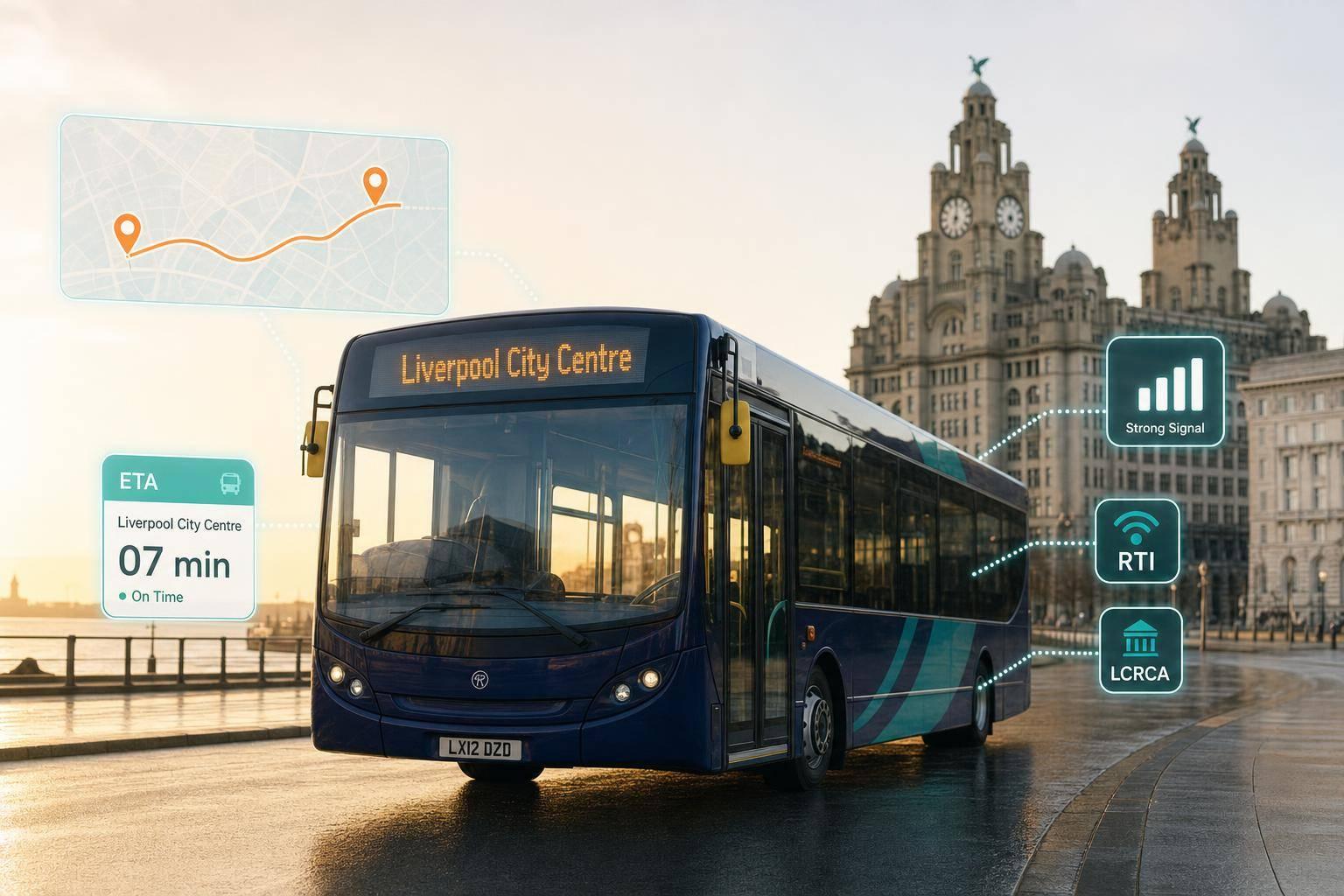
This guide identifies suitable fleet-tracking and automatic vehicle-location solutions for buses operating in Liverpool and the wider Liverpool City Region. Liverpool is a particularly data-integration-sensitive market: the Combined Authority is preparing bus franchising from September 2026, with the full network expected to be franchised by the end of 2027. Its planned central AVL system is intended to provide an authoritative source for vehicle location, punctuality and network performance, with open APIs and live monitoring of speed, headway, dwell time and journey times. Existing Liverpool experience also demonstrates the need to combine data from multiple operators and provide real-time passenger information.
Key Features for Buses (scheduled-service, independent, community and coach fleets) Tracking in Liverpool and the wider Liverpool City Region, UK
- Live automatic vehicle location with configurable refresh rates and accurate GPS
- Real-time passenger information, including live departures and estimated arrivals
- Open APIs and SIRI/ETM/static-AVL data integration for journey planners and operator systems
- Punctuality, headway, dwell-time, speed and journey-time monitoring
- Driver behaviour and eco-driving analysis, including harsh braking, acceleration and cornering
- Driver-to-control-room communications and incident escalation
- Geofencing, route adherence and depot/terminus monitoring
- Fuel, idling, maintenance and MOT reporting
- Installation, aftercare and compatibility with existing bus electrical/telematics equipment
Industry and Region-Specific Recommendations
Liverpool's planned architecture requires consistent GPS accuracy and refresh rates, live operational metrics, open APIs and a single authoritative view across operators. Before signing, require: documented API/SIRI/ETM compatibility; an agreed GPS update interval; route, headway and punctuality reporting; depot and route geofences; driver-privacy and GDPR controls; installation without compromising vehicle safety systems; backup during power loss; export of historic data; and named UK aftercare. Also confirm how the solution will coexist with Liverpool's franchising and RTPI arrangements, since the region already uses live departures, digital displays and QR-linked stop information.
Compliance Tips for Buses (scheduled-service, independent, community and coach fleets) Fleets in Liverpool and the wider Liverpool City Region, UK
For Liverpool bus operators, prioritise an AVL platform that can exchange reliable vehicle-location data with the Liverpool City Region’s emerging central AVL, franchising and real-time passenger-information environment. If cameras or in-vehicle surveillance are added, complete a DPIA, define the lawful basis and controller, provide clear passenger/driver signage, minimise retention, and keep audio disabled by default except in exceptional, justified circumstances. Confirm BODS/AVL data fields, API compatibility, accessibility and any LCRCA contract requirements before purchase.
Local Service and Support in Liverpool and the wider Liverpool City Region, UK
Liverpool has established local and regional capability for bus AVL, RTI, telematics and CCTV support. Verify response times, out-of-hours fault cover, SIM/network resilience, spare-unit policy, on-site call-out charges and compatibility with the operator’s ticketing/RTI contract in the statement of work.
Installation Options in Liverpool and the wider Liverpool City Region, UK
- Professional fixed installation by a fleet-telematics engineer, suitable for permanently powered bus AVL, driver-behaviour sensors and CCTV/telematics integrations.
- Local/scheduled installation and system setup through a Merseyside fleet-tracking provider; obtain confirmation of vehicle-by-vehicle fitting coverage and certification before ordering.
- Self-install is potentially available for portable/plug-in units, but it is less suitable where a bus requires tamper-resistant wiring, external antennas, CCTV or integration with ticketing/RTI systems.