Best Fleet Tracking Devices for Buses in Nottingham
Compare Nottingham bus telematics and AVL options—features, pricing guidance, compliance and local support for operators.
 By Michael Bar8 min read

Overview
A practical guide to choosing fleet tracking and bus telematics for operators running buses in Nottingham and the surrounding Nottinghamshire area. Nottingham’s requirements extend beyond simple GPS: the city already uses integrated AVL, ticketing and operational systems, while local and county real-time information services consume vehicle-location data to predict arrivals and publish live information. Nottingham City Transport’s public fleet map also demonstrates the value of accurate live location and vehicle metadata.
Quick Comparison of Leading Fleet Tracking Devices
| Solution | Best for Nottingham bus use | Relevant features | Published pricing | Local/UK support position |
|---|---|---|---|---|
| Teltonika FTC965 | Rugged standalone tracking across 12V/24V buses or mixed commercial fleets | 4G LTE Cat 1, 2G fallback, high-accuracy GNSS, Bluetooth 5.4 and IP69K protection | Hardware/platform pricing not published in the source; obtain installer quotation | UK distributor route identified; use a Nottingham commercial-vehicle installer for fitting and support |
Top Recommended Fleet Tracking Devices
- Teltonika FTC965
Key Features for Buses and coaches, including urban scheduled-service buses Tracking in Nottingham and Nottinghamshire, UK
- Live AVL/GPS tracking and accurate location feeds
- Real-time passenger information and arrival prediction
- Driver behaviour monitoring and safety alerts
- Operations control, dispatch, scheduling and rostering integration
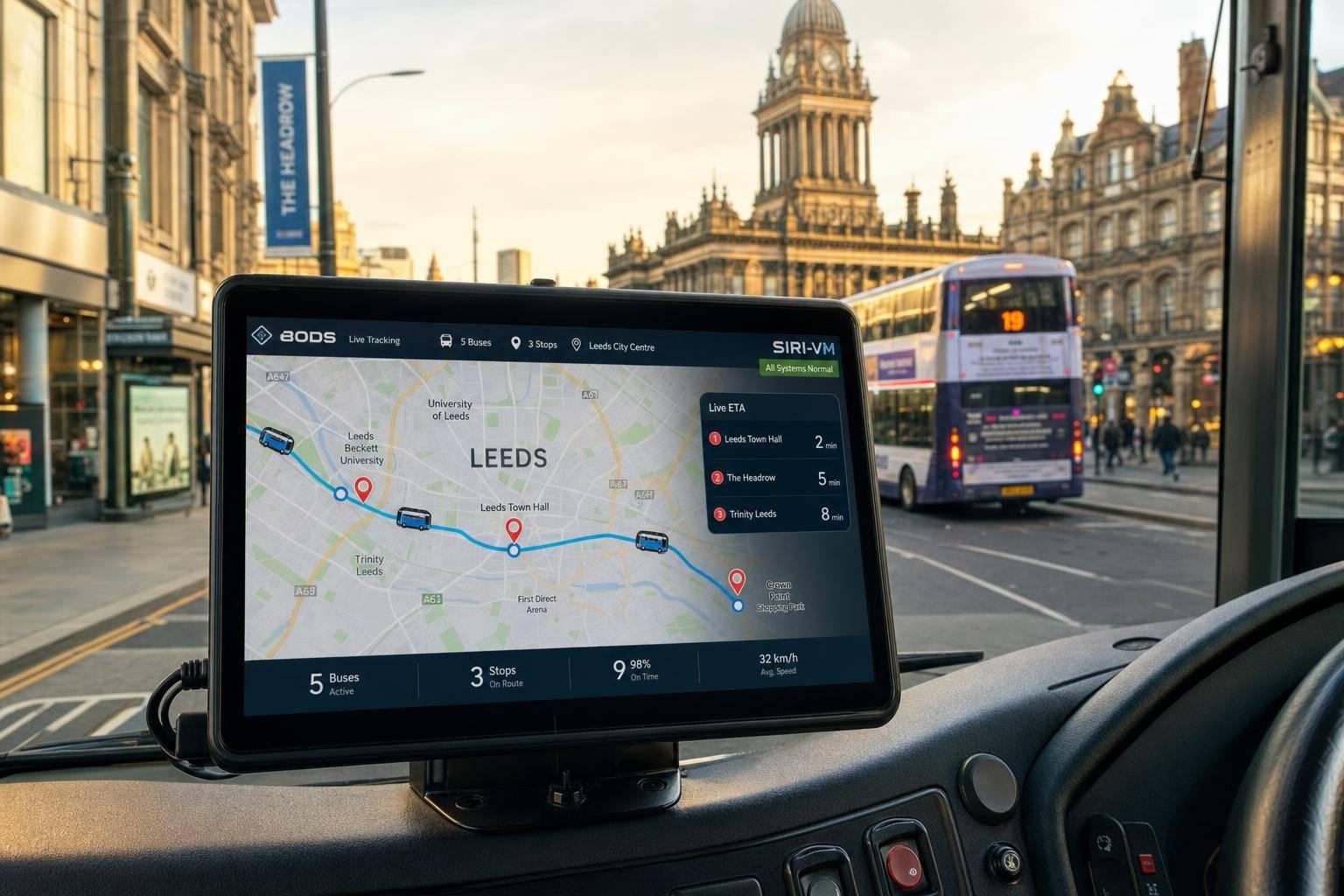
- BODS, SIRI-VM, SIRI and GTFS data/API connectivity
- Passenger counting and EMV/contactless-payment integration
- CANbus/FMS and vehicle-health data
- Tachograph integration
- Geofencing, exception alerts and fleet reporting
- 4G/5G connectivity with 2G fallback where appropriate
- Rugged 12V/24V hardware suitable for bus electrical systems
- CCTV and onboard-system integration
Technical Specifications
Teltonika FTC965: 4G LTE Cat 1 cellular with 2G GSM fallback; GPS/GLONASS/Galileo/BeiDou GNSS with up to 41 visible satellites and stated accuracy under 1.5m CEP; Bluetooth 5.4; 10–100V power input, covering typical 12V/24V bus systems; IP69K protection. Nottingham data interoperability: Nottinghamshire’s AVL feed is published in SIRI-VM 1.3, and Transport Nottingham describes a city-wide data broker and prediction engine that uses vehicle locations, historical journey times and traffic conditions. Buyers should require standards-based export and API compatibility.
Device Pros, Cons, and Pricing
Teltonika FTC965: Pros – Rugged IP69K enclosure, 4G with 2G fallback, 12V/24V commercial-vehicle suitability and Bluetooth accessory connectivity suit buses operating in demanding depot conditions. Cons – It is primarily tracking hardware; passenger-information, dispatch and ticketing functions require a separate platform, and the source gives no subscription or installed price. Price – Quotation required.
Typical Pricing
Expect roughly £100–£500+ per bus for basic GPS installation and about £10–£50+ per vehicle per month for software, with integrated bus systems involving CCTV, CANbus, tachograph, APC, dispatch or passenger information normally priced by quotation. Treat these as indicative only: a Nottingham scheduled-bus CAD/AVL deployment will usually cost more than a basic tracker.
Industry and Region-Specific Recommendations
- Mixed 12V/24V fleet, rural routes or harsh depot conditions: pair a rugged tracker such as FTC965 with a compatible UK fleet platform. Its 10–100V input, IP69K rating and 4G/2G connectivity are useful for buses and mixed commercial vehicles, but it will not by itself provide passenger-information or dispatch workflows.
- Safety-led operation: choose driver-behaviour monitoring, harsh-event alerts, CANbus data, tachograph integration and optional CCTV rather than location-only tracking.
- Nottingham RTPI and data compliance: require SIRI-VM/SIRI, GTFS and BODS-compatible exports or APIs. This matters because Nottingham’s prediction engine uses AVL data to calculate arrivals and its public systems distribute live journey information to passengers and partners.
- Procurement and aftercare: request a Nottingham installation plan, depot survey, immobilisation/safety policy, SIM/network arrangements, response-time SLA, firmware management, data-retention terms and training. A provider’s national listing does not by itself prove local engineer coverage; obtain that commitment in writing.
- Passenger-facing accuracy: test location update frequency and stop-level prediction on congested Nottingham corridors, as the council explains that satellite-tracked bus signals feed the real-time system used to estimate arrival times.
Compliance Tips for Buses and coaches, including urban scheduled-service buses Fleets in Nottingham and Nottinghamshire, UK
If cameras or driver/passenger data are combined with tracking, provide clear notices, restrict access, document purposes and retention, and complete a DPIA where appropriate. NCT publishes CCTV signage, access and retention rules, while Nottingham City Council states that vehicle CCTV should have clear signage, no audio recording and a DPIA. For demand-responsive or council-supported services, ensure CCTV handling aligns with UK GDPR, the Data Protection Act 2018 and the ICO CCTV Code of Practice. Check the operator’s Bus Open Data Service obligations and require the supplier to support compliant AVL/timetable matching and SIRI-VM feeds where applicable.
Local Service and Support in Nottingham and Nottinghamshire, UK
Require a service-level agreement covering SIM connectivity, hardware replacement, depot visits, firmware, data exports, passenger-information uptime and incident response.
Installation Options in Nottingham and Nottinghamshire, UK
- Professional on-site installation for fixed bus telematics, CANbus, tachograph, CCTV and passenger-information integrations
- Mobile or scheduled fleet fitting by a UK installer/reseller; confirm Nottingham coverage and out-of-hours availability in the quotation
- Self-install or OBD/battery-powered tracking for simpler vehicles or school/minibus applications, where permitted by the supplier
- Remote platform/API onboarding for AVL and passenger-information software; hardware fitting and commissioning should still be confirmed