Best EV Data Tools for Fleet AI
Compare top EV telematics, charging and battery tools for UK fleets to pick the right data-driven platform for range, charging and AI.
 By Michael Bar22 min read
If I were shortlisting EV fleet data tools today, I’d split them into three groups first: vehicle telematics, charging analytics, and battery data tools. That’s the fastest way to avoid paying for data you won’t use.
A connected EV can produce up to 25 GB of data per hour, but most fleets do not need every signal. What matters is whether the tool helps you track SoC, charging events, route energy use, driver behaviour, battery condition, and reporting in a way that fits your fleet. In this review, I’d put GRS near the front for smaller UK van fleets on price and security, Geotab near the front for deep EV analysis and EV changeover planning, and ChargePoint near the front if charging cost and session data matter more than live vehicle tracking.
If you want the short version, here it is:
- Best for smaller UK van fleets: GRS Fleet Telematics - from £7.99 per vehicle per month
- Best for deep EV data and AI-led analysis: Geotab MyGeotab
- Best for safety and driver coaching: Samsara
- Best for mixed-fleet changeover planning: Teletrac Navman
- Best for live battery and range alerts: Verizon Connect
- Best for charging session data: ChargePoint
- Best for fuel + EV spend in one view: Shell Fleet Hub
- Best for battery state-of-health tracking: Volterra EVCare
- Best for high-detail EV analytics: Electra EVE Ai 360
- Best for large EV data sets and modelling: Navixy
What I’d look at first:
- Data depth: Does it pull vehicle data or just GPS?
- Charging visibility: Can I see session time, kWh, and location?
- Battery view: Can I track SoH and degradation?
- AI use: Does it help with routing, faults, coaching, or charging cost?
- UK fit: Can it support CO₂, ESG, VAT, and mixed-fleet reporting?
Quick Comparison
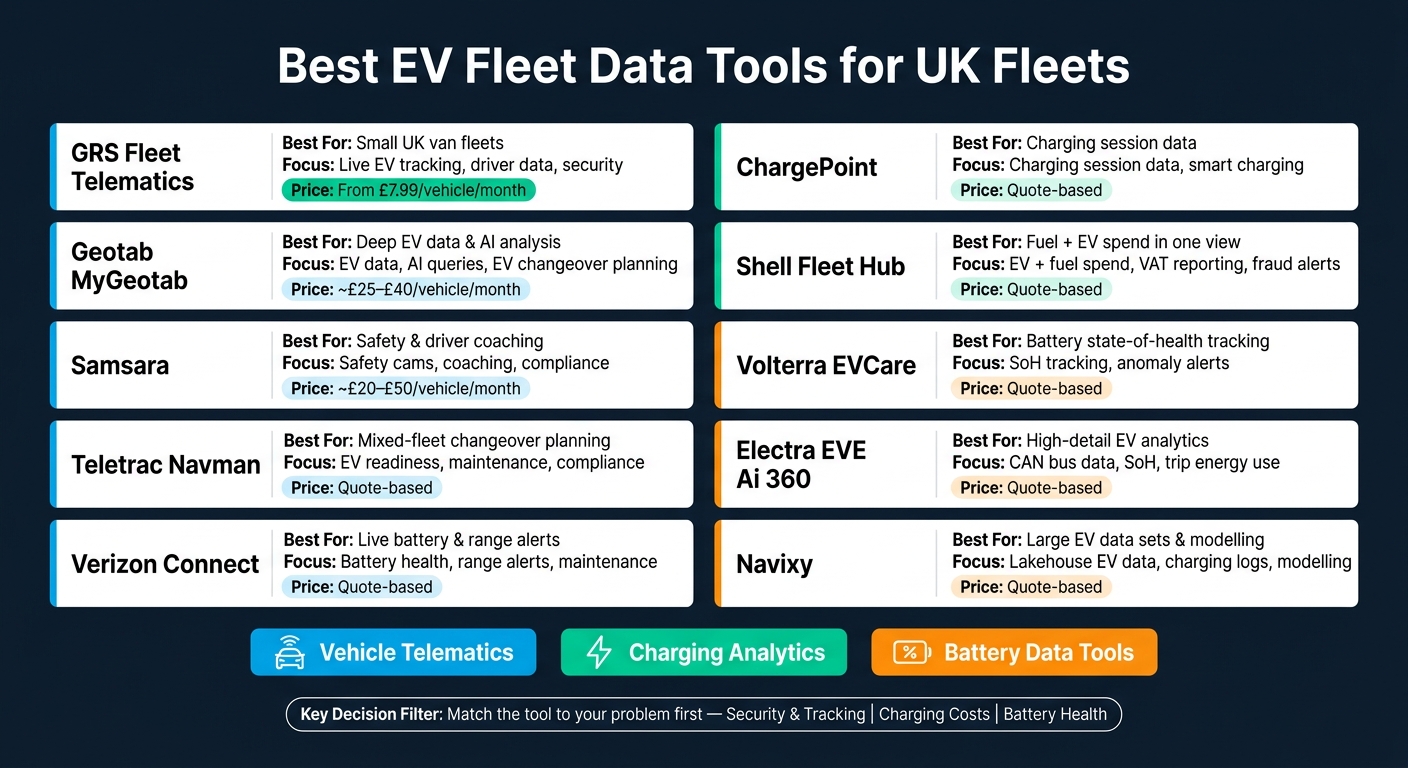
Best EV Fleet Data Tools Compared: Features, Pricing & Use Cases
| Tool | Best fit | Main focus | Starting price / pricing style |
|---|---|---|---|
| GRS Fleet Telematics | Small UK van fleets | Live EV tracking, driver data, security | From £7.99/vehicle/month |
| Geotab MyGeotab | Data-led fleets | EV data, AI queries, EV changeover planning | About £25–£40/vehicle/month |
| Samsara | Mid-to-large fleets | Safety cams, coaching, compliance | About £20–£50/vehicle/month |
| Teletrac Navman | Mixed fleets | EV readiness, maintenance, compliance | Quote-based |
| Verizon Connect | Large fleets | Battery health, range alerts, maintenance | Quote-based |
| ChargePoint | Depot/public charging fleets | Charging session data, smart charging | Quote-based |
| Shell Fleet Hub | Fleets tracking energy spend | EV + fuel spend, VAT reporting, fraud alerts | Quote-based |
| Volterra EVCare | Fleets focused on battery condition | SoH tracking, anomaly alerts | Quote-based |
| Electra EVE Ai 360 | Fleets wanting deep EV analytics | CAN bus data, SoH, trip energy use | Quote-based |
| Navixy | Fleets with heavy data loads | Lakehouse EV data, charging logs, modelling | Quote-based |
My main takeaway: pick the tool that matches the problem first. If you need security and live van tracking, start with telematics. If you need charging cost control, start with charging data. If you need battery life tracking, start with SoH tools. That simple filter makes the shortlist much easier to build.
1. GRS Fleet Telematics
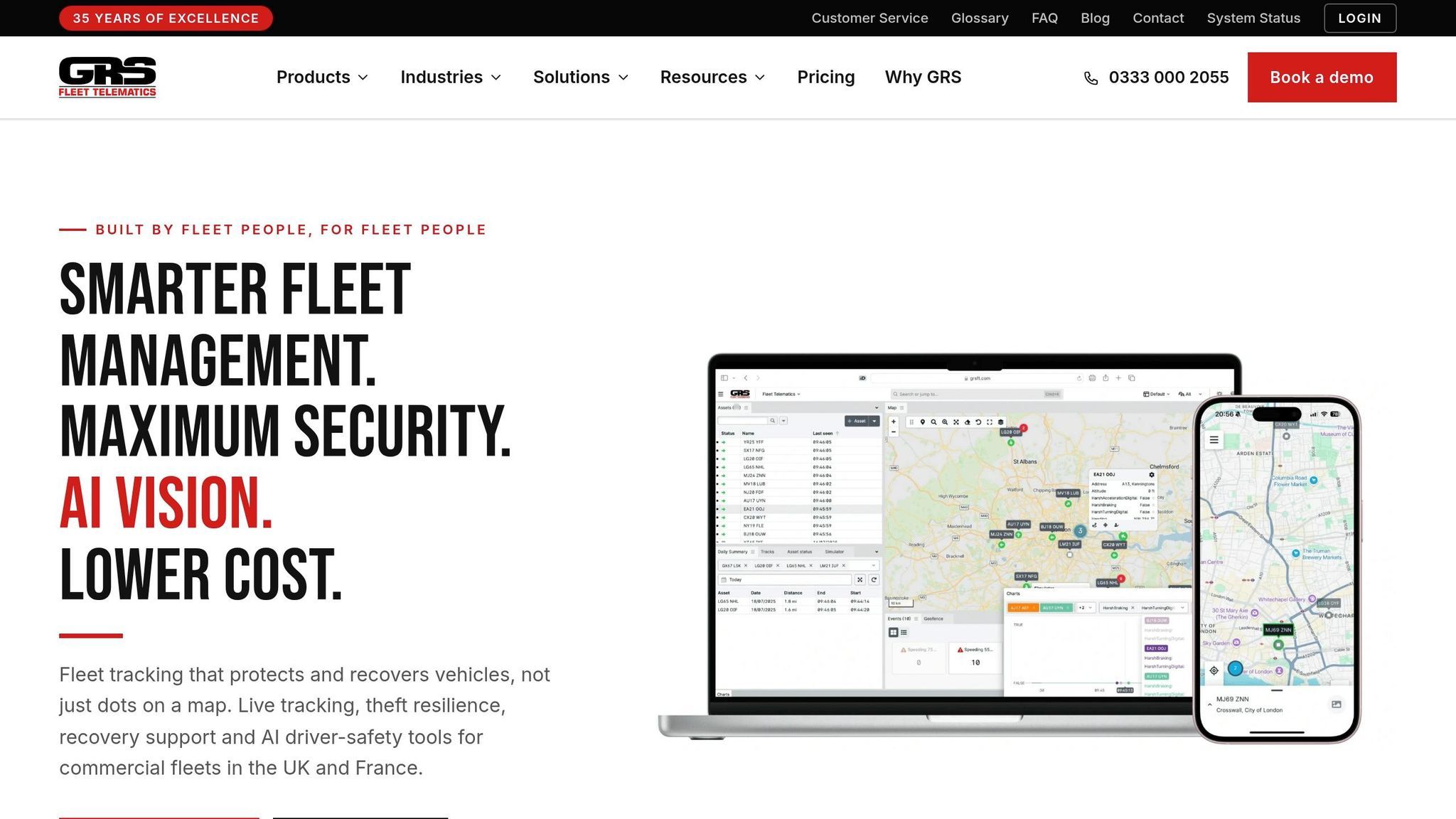
For fleets that want live EV data, security tools and reporting in one place, GRS Fleet Telematics pulls the main signals into a single dashboard. It’s a UK van tracking platform that combines live EV telemetry, driver monitoring and vehicle security from £7.99 per vehicle per month.
EV Data Depth
The platform shows state of charge (SoC), voltage levels and temperature in real time, so fleet managers can keep an eye on battery health as vehicles are out on the road. Charging reports make it easier to review charging habits and spot misuse, while maintenance can be timed around predicted battery wear.
It also includes driver behaviour and eco-driving data. That helps managers spot wasteful driving and support better coaching, with clearer input for maintenance, charging and day-to-day vehicle use.
Charging and Route Intelligence
Route planning and geofencing tools sit alongside the EV data, which makes journey tracking much simpler. Managers can also set geofence alerts to keep a closer watch on vehicle movement.
Fleet Integration and Reporting
The dashboard includes CO₂ and ESG reports, which can help with sustainability targets and customer reporting needs. GRS also offers dual-tracker hardware. Hardware starts from £35 for a wired tracker.
| Feature | GRS Fleet Telematics Capability |
|---|---|
| Real-time Monitoring | 24/7 tracking of voltage, temperature and SoC |
| Charging Reports | Logs that monitor charging behaviour and flag misuse |
| Security | Dual-tracker technology |
| Compliance | CO₂ and ESG reports for sustainability goals |
2. Geotab MyGeotab EV Fleet Management
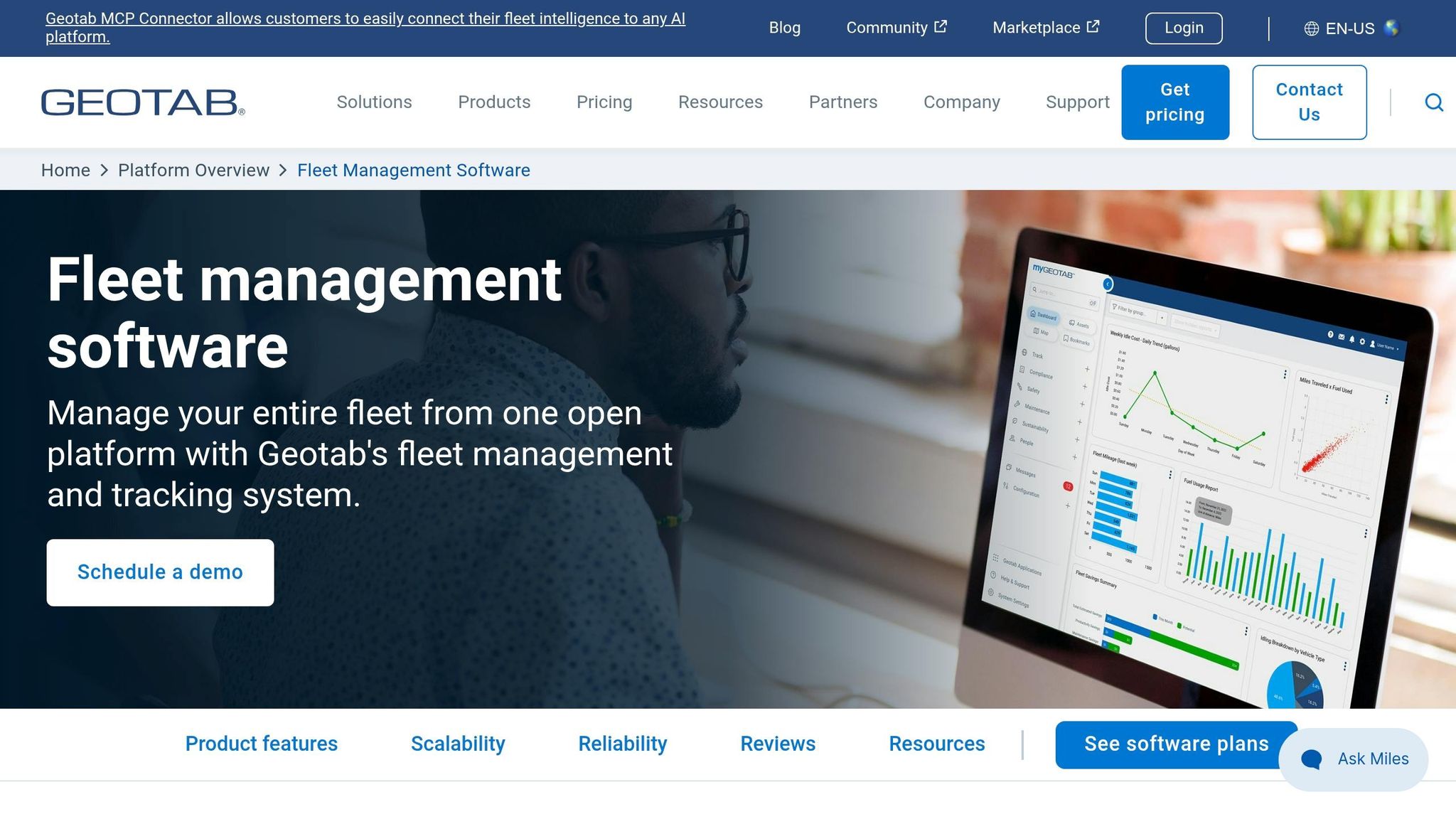
Live tracking tells you what's happening on the road. Geotab goes a step further and turns EV data into planning, reporting and automation. Geotab MyGeotab supports 300+ EV makes and models and uses an open architecture to connect charging, ERP and dash cam data. Pricing usually falls around £25–£40 per vehicle per month, based on the reseller and hardware bundle.
EV Data Depth
The platform pulls in real-time SoC, battery health, voltage and charging status through GO9 hardware, which connects through OBD-II or CAN bus. It also includes a Live Electric Vehicle Charging State diagnostic that shows when a vehicle starts and stops charging, along with energy delivered and time-of-use data.
That means managers don't just see that a van charged. They can see when it charged, how much energy it took on, and how that lines up with tariff periods. The Fuel and EV Energy Usage Report adds another layer by showing efficiency trends over time, including how temperature can affect battery performance.
AI Analytics
Geotab Ace allows managers to query fleet data in natural language. Instead of digging through reports, they can ask direct questions and get answers from the system. For busy fleet teams, that's a big shift.
On the driver side, the GO Focus Plus AI dash cam flags risky behaviour. Pilot results reported 90% less tailgating and 95% less phone use. That AI side becomes far more useful when it's tied back to route planning and charging decisions, rather than sitting in a silo.
Charging and Route Intelligence
The Electric Vehicle Suitability Assessment (EVSA) helps fleets work out which assets are a good fit for EV replacement. It uses real-world ICE vehicle data at VIN level to assess range needs, ROI and CO₂ impact.
This is where the platform starts to earn its keep. Rather than making a rough guess, fleet teams can use actual vehicle usage data to decide which vans or cars should move first. SoC data also supports range estimates, route assignment and missed-charge alerts. Geotab says that charging around electricity price fluctuations can cut costs by up to 62%.
Fleet Integration and Reporting
The open API links with charging networks, V2G systems and the Geotab Marketplace. Predictive maintenance uses diagnostic trouble codes (DTCs) benchmarked against data from millions of connected vehicles.
There is a trade-off, though. Setup usually needs reseller support, and pricing is less clear than with simpler tools. So this is better suited to fleets that want analysis and integration in one place, not just a map with live dots moving around.
| Feature | Geotab MyGeotab EV Capability |
|---|---|
| EV Model Support | 300+ makes and models |
| Key EV Metrics | SoC, charging status, battery health, energy consumption |
| AI Tools | Geotab Ace (GenAI assistant), GO Focus Plus AI dash cam |
| Transition Tools | EV Suitability Assessment (EVSA) for ICE-to-EV planning |
| Integration | Open API, Geotab Marketplace, V2G and charging infrastructure |
3. Samsara EV Fleet Management

Samsara puts less weight on raw EV numbers and more on live safety coaching and compliance. In practice, it brings EV telemetry, safety tools and compliance features into one AI-led platform. Pricing usually sits around £20–£50 per vehicle per month on a 36-month term.
EV Data Depth
Samsara shows state of charge, energy use and vehicle fault data. Those live EV metrics help fleet managers spot charging gaps, fault trends and vehicles that aren’t being used enough.
AI Analytics
Its AI dash cams use on-device processing to flag fatigue, phone use and tailgating in real time. Automated Coaching then turns that performance data into driver feedback without much admin work.
Charging and Route Intelligence
Route optimisation uses live traffic, weather and vehicle capacity. Smart Compliance connects with EU tachographs and warns drivers before they go over driving-time limits. So the EV data doesn’t just sit in a dashboard. It feeds into action when fleets want the system to do more than report back.
Fleet Integration and Reporting
Samsara is best suited to fleets with 20+ vehicles that want EV data linked with safety, coaching and compliance.
| Feature | Samsara Capability |
|---|---|
| AI Dash Cams | On-device processing for real-time detection of fatigue, phone use and tailgating |
| Route Intelligence | AI optimisation based on traffic, weather and vehicle capacity |
| Driver Coaching | Automated coaching workflows with low admin overhead |
| Compliance | Smart Compliance with EU tachograph integration |
4. Teletrac Navman EV Monitoring
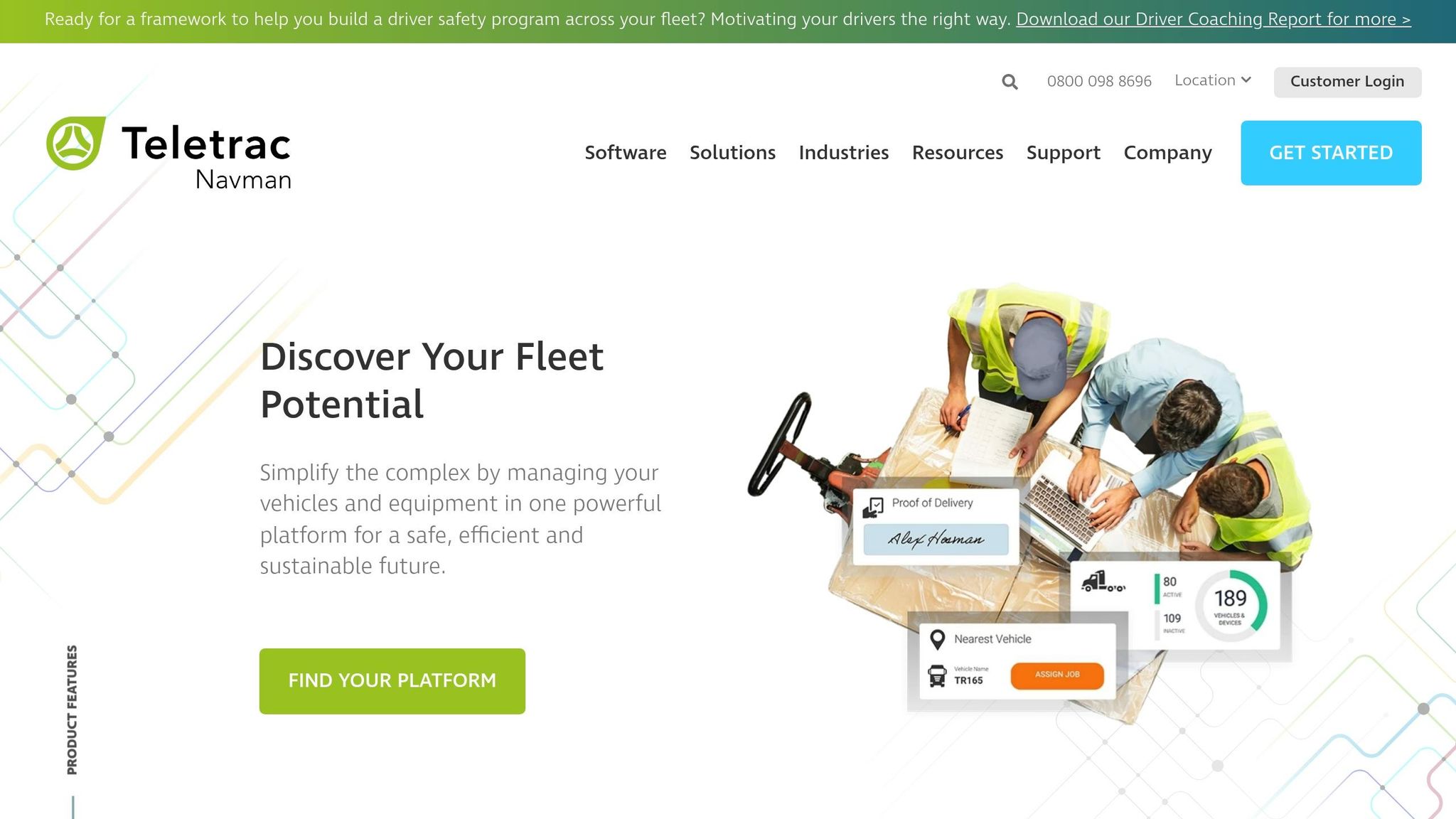
Teletrac Navman's TN360 gives fleets one dashboard for both ICE and EV vehicles. That makes it a strong choice for operators moving past basic EV tracking and into full transition planning and compliance control. Pricing is quote-based and depends on fleet size, hardware, and the feature set, though advanced telematics in the UK often lands between £20 and £35+ per vehicle, per month.
EV Data Depth
The platform's EV Readiness Tool looks at existing ICE fleet data to help fleets decide which vehicles and routes make the most sense to electrify first. It also covers charger demand and emissions impact.
That matters because raw EV data on its own only gets you so far. The value comes when those signals shape forecasts and route choices.
AI Analytics
Teletrac Navman uses machine learning to pick up early patterns in routes and maintenance. Its predictive maintenance tools use sensor data from vehicles in use to forecast repairs before a breakdown happens, which helps fleets move away from fixed servicing schedules.
Charging and Route Intelligence
Route optimisation uses live data to cut mileage and map charging stops more effectively. The platform also supports driver ID through pin pads or key fobs, so vehicles can be linked to the right chargers. That helps stop unauthorised use and keeps vehicles ready for planned runs.
From there, the same stream of data feeds into compliance and emissions reporting.
Fleet Integration and Reporting
Its ESG reporting stands out for UK fleets. The platform automates emissions and compliance data across mixed-fleet operations, and it includes real-time tachograph integration plus digital driver hours. It's best suited to fleets with 10+ vehicles that need to manage ICE, EV, and alternative fuel vehicles in one place.
| Feature | Capability |
|---|---|
| EV Readiness Tool | AI-driven analysis to prioritise vehicles and routes for electrification |
| Predictive Maintenance | Sensor-based forecasting to reduce unplanned downtime |
| ESG Reporting | Automated emissions and fuel usage data for compliance |
| Mixed Fleet Support | ICE, EV, hydrogen, CNG and RNG in one platform |
| Compliance | Real-time tachograph integration and digital driver hours |
5. Verizon Connect EV Status Tracking

While the previous platform leaned more towards mixed-fleet planning, this one is stronger when you need live battery health and range control. Verizon Connect offers live EV monitoring for both mixed and fully electric fleets, with pricing set on a bespoke basis depending on fleet size and the features you choose.
EV Data Depth
The platform tracks battery status and battery degradation in real time. That gives fleet managers a much clearer picture of vehicle condition before assigning longer routes, and it also helps with battery triage when a vehicle starts showing signs of trouble.
AI Analytics
Verizon Connect uses live EV and vehicle data to produce predictive maintenance alerts, helping teams spot issues early. It also tracks driver behaviour in a single driver score view, making it easier to assess both efficiency and safety at a glance.
Charging and Route Intelligence
If a vehicle is getting close to its range limit or needs charging, real-time alerts give dispatchers time to step in. In practice, that means they can reassign vehicles before a route falls apart, which helps cut downtime on tightly scheduled runs.
Fleet Integration and Reporting
Verizon Connect links with charging networks and carbon-accounting tools for ESG reporting. It can export battery, charging and emissions data into carbon reports, which makes reporting less of a scramble.
| Feature | Verizon Connect EV Capability |
|---|---|
| Key EV Features | Battery health monitoring, range alerts, energy management |
| Reporting | Carbon footprint and sustainability tracking |
| Maintenance | Predictive maintenance and system health alerts |
The next platforms move away from vehicle telemetry and more towards charging-led analytics and specialist EV data layers.
6. ChargePoint Fleet Charging Analytics
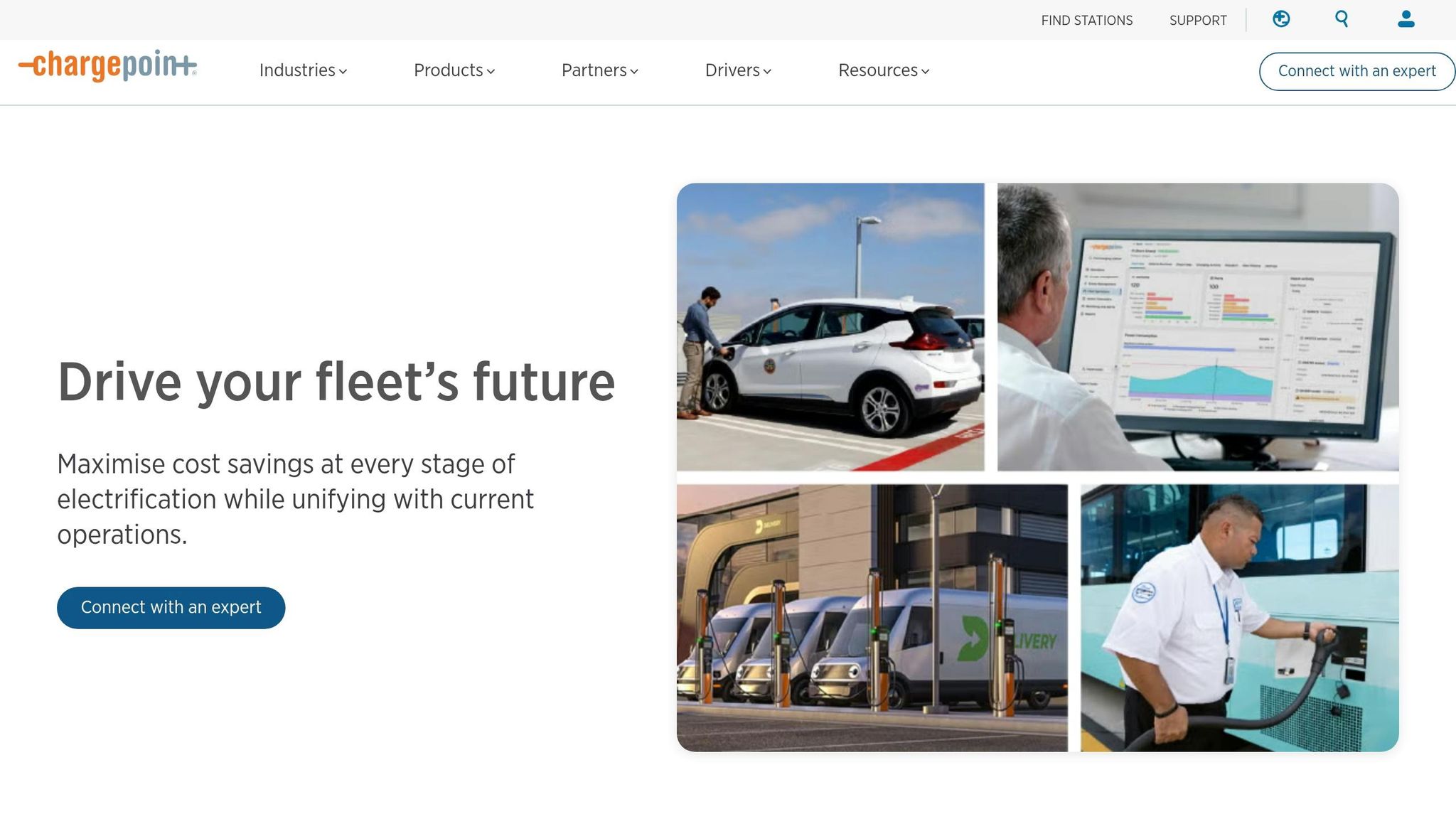
Vehicle telematics tells you what’s happening on the road. ChargePoint shows what happens when the vehicle plugs in. For fleet managers, that means detailed charging analytics with each session logged by start time, end time, location, duration, and kWh delivered.
EV Data Depth
ChargePoint tracks energy use across home, depot, and public charging, which makes cross-site cost allocation simpler. Because the data sits at session level, teams can use it for energy forecasting and automated charging schedules. Put plainly, it helps with cost control, planning, and day-to-day charging decisions.
AI Analytics
Smart charging can move charging to cheaper time periods and cut energy costs. That makes ChargePoint a good match for AI-led fleet workflows, especially when the goal is to lower energy spend without a lot of manual work.
Charging and Route Intelligence
Smart charging can also reduce charging during peak-demand periods. In the same dashboard, fleet teams can view SoC and battery health alongside session data. That gives managers a clearer picture of both charging activity and vehicle condition in one place.
Fleet Integration and Reporting
ChargePoint supports Open Charge Point Protocol (OCPP) 2.0.1, so the data can feed into third-party management dashboards instead of staying locked inside one system. It also integrates with major telematics platforms, bringing charging sessions and energy data into the same view as vehicle status. On top of that, it supports total cost of energy reporting by combining fuel card and EV charging data.
| Feature | ChargePoint Capability |
|---|---|
| Energy Tracking | Detailed kWh per session, home and depot charging |
| Charging Management | Smart charging and reduced charging during peak demand |
| Interoperability | High - OCPP 2.0.1 supported |
| Reporting | Total cost of energy, carbon footprint and ESG reporting |
7. Shell Recharge Solutions Fleet Platform
Where charging analytics focus on energy use, Shell Fleet Hub is more about bringing EV charging and fuel spend into one place. It tracks EV charging sessions alongside fuel transactions in a single dashboard, so fleet managers can see the full picture of spend without jumping between systems.
EV Data Depth
Shell Fleet Hub logs EV charging sessions next to fuel purchases, which gives managers one view of energy spend across the whole fleet. That means they can check live spend data before moving into policy controls or system links. The platform also shows spend history and vehicle activity in real time. At the moment, EV spend controls sit at the card level.
AI Analytics
Shell’s API plugs Shell Card data and services straight into existing systems, apps, and websites. On top of that, its analytics can spot unusual activity and help with spend forecasting.
Fleet Integration and Reporting
This setup works well for UK fleets that care about VAT recovery and automated reporting. It includes 24/7 live reports, VAT-compliant invoicing, and VAT recovery support. Because the platform connects by API, charging and fuel data can flow into ERP or fleet management software without manual entry.
There’s also an extra layer of spend control. Real-time fraud alerts and one-click card blocking make it easier to react fast if something looks off.
In day-to-day use, the main draw is pretty clear: cost control, reporting, and system integration.
| Feature | Shell Recharge Capability |
|---|---|
| EV Session Tracking | Charging sessions logged alongside fuel spend |
| Reporting | 24/7 live reports, VAT invoicing and VAT recovery |
| Integration | API connectivity to external business systems |
| Fraud Controls | Real-time fraud alerts, one-click card blocking |
8. Volterra EVCare
This section moves from charging-session tools to battery-condition analytics. Volterra EVCare supports data from 300+ EV models and puts the focus on battery-led fleet analysis.
EV Data Depth
EVCare provides real-time battery state-of-health (SoH) data across 300+ EV models, which helps fleets track degradation over time.
AI Analytics
EVCare uses AI to forecast charging demand, spot underused vehicles, and cut downtime. That helps with charging plans and vehicle replacement decisions.
Fleet Integration and Reporting
Alerts flag battery or charging anomalies, so teams can step in fast when something looks off.
| Feature | Volterra EVCare Capability |
|---|---|
| EV Model Coverage | Data from 300+ EV models |
| Battery Monitoring | Real-time battery state-of-health (SoH) |
| AI Forecasting | Forecast charging demand, improve utilisation, reduce downtime |
| Anomaly Alerts | Flags battery or charging anomalies |
That makes it a better fit for fleets that need battery visibility, not just live tracking.
9. Electra EVE Ai 360 Fleet Analytics

The last few tools were mainly about live tracking and battery status. Electra EVE Ai 360 sits a bit deeper in the stack. It’s framed as a fleet-wide analytics platform built on high-resolution EV data.
EV Data Depth and AI Analytics
At the core is CANbus data, along with SoH, SoC, and trip-level energy use. That gives fleet managers a closer look at battery condition and vehicle efficiency.
That extra data depth is what gives the AI layer its value. Instead of relying on manual reporting, managers can spot trends and exceptions in EV data much faster. In practice, that helps flag battery degradation, inefficiency, and outlier vehicles across the fleet.
Integration and Fit
There aren’t any product-level details here on charging or route intelligence. Integration details also aren’t specified, so it makes sense to check how well it fits with your current reporting stack before adoption.
| Feature | Electra EVE Ai 360 Capability |
|---|---|
| Data Source | High-resolution CANbus data |
| Battery Metrics | SoH, SoC and trip-level energy use |
| AI Layer | Fleet-wide trend detection and exception identification |
| Integration | Not specified - verify compatibility before adoption |
10. Navixy EV Telematics Lakehouse
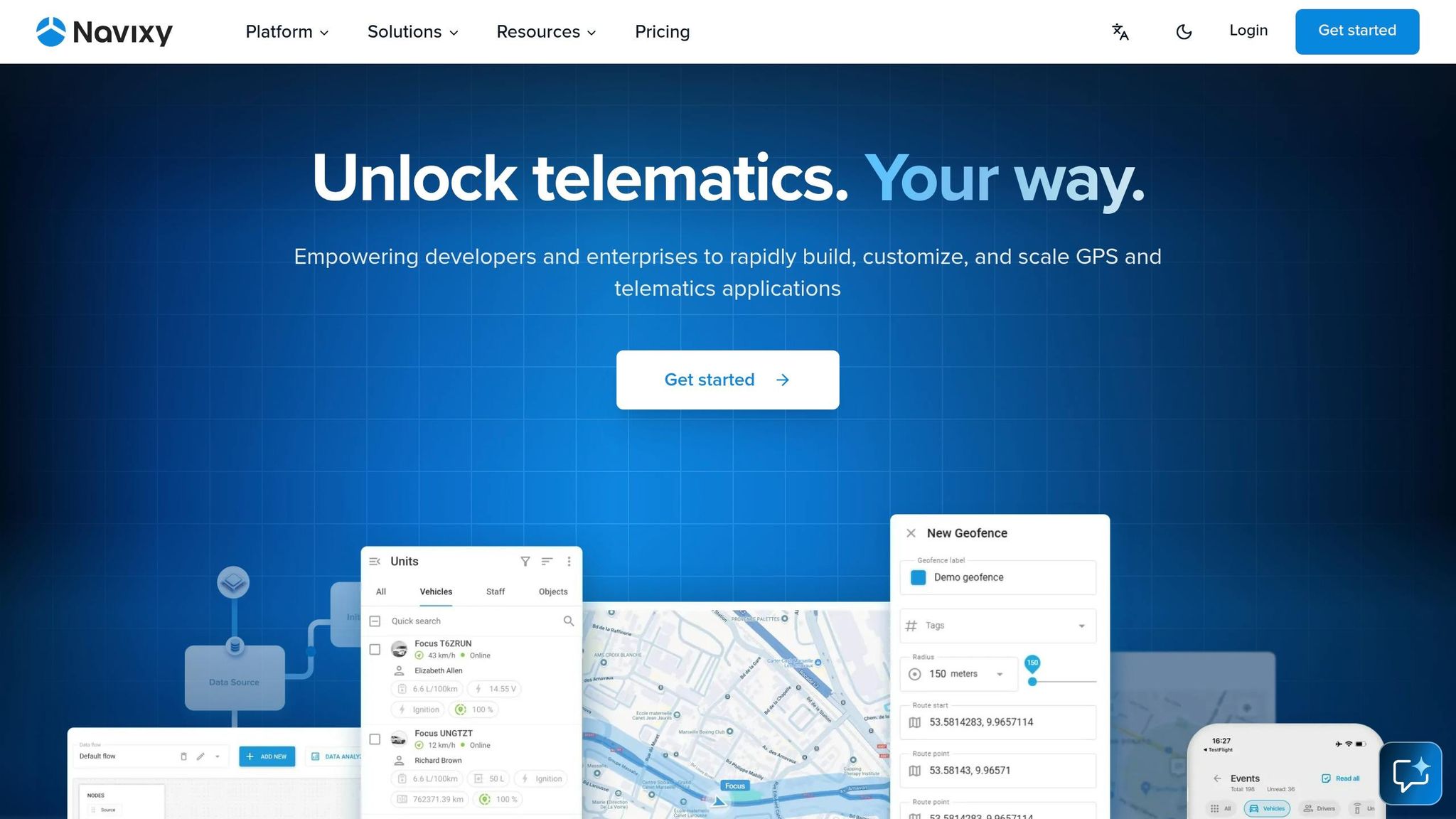
While some analytics platforms put EV trends front and centre, Navixy leans into the layer underneath: the data itself. It uses a Lakehouse model to bring together high-volume telematics data for AI analysis.
EV Data Depth
Navixy ingests CAN bus data, including real-time SoC, SoH and kWh consumption. That gives fleet teams a close look at battery status and energy use, not just a top-level dashboard view.
Charging and Route Intelligence
The platform logs charging sessions by start and end time, location, energy delivered and charge rate. In practice, that makes it more useful for modelling and reporting than for simple live tracking.
Fleet Integration and Reporting
Its Lakehouse architecture is built to handle high data volumes, which suits fleets with heavy data loads and AI modelling needs. The main test is whether that reporting output can plug into compliance and sustainability workflows in a way that’s actually useful day to day.
| Feature | Navixy Capability |
|---|---|
| Data Architecture | Lakehouse model for unified telematics data ingestion |
| Battery Metrics | Real-time SoC, SoH and kWh consumption |
| Charging Analytics | Session start/end, location, energy delivered and charge rate |
| Best Suited For | Fleets needing high-volume EV data for AI modelling and reporting |
How the Top EV Data Tools Compare
The individual profiles show what each platform does. This section shows where each one stands out. The comparison looks at four areas: data depth, AI analysis, charging and route intelligence, and integration.
Data Depth
The biggest split is simple: some platforms read data straight from the vehicle, while basic GPS tracking does not. That matters because GPS-only tools miss battery monitoring, charging optimisation and EV routing.
The stand-out tools for EV data depth are:
| Tool | Key strength |
|---|---|
| GRS Fleet Telematics | Live EV telemetry for mixed electric and hybrid vans |
| Geotab MyGeotab | Broad EV model support and deep battery data |
| Navixy | CAN bus data with custom battery dashboards |
Data depth shapes how far the AI layer can go. If the platform only knows where the vehicle is, its analysis will stay pretty limited. If it can see battery status, charging patterns and vehicle behaviour, the output becomes much more useful.
AI Analytics
The best AI tools combine live battery data with past usage to improve range forecasts. That matters in day-to-day fleet work, because EV range can shift a lot with driving style, route conditions and charging habits. EV-specific coaching and anomaly alerts also matter, since driver behaviour affects EV range more than diesel consumption.
Geotab also includes an EV suitability assessment, which helps fleets spot the best vehicles to replace first.
| Tool | Key strength |
|---|---|
| GRS Fleet Telematics | Eco-driving and route-efficiency support |
| Geotab MyGeotab | EV suitability assessment and range forecasting |
| Navixy | Predictive analytics, custom alerts and dashboards |
Once AI can read the right signals, the next step is simple: can it help fleet teams make better charging and route decisions?
Charging and Route Data
Charging and route intelligence matter most when fleets need to juggle charger availability, route feasibility and depot energy use. This is where the gap between vehicle tools and charging-platform tools becomes clear.
Geotab supports load management as well as charging-cost analysis. Navixy uses geofencing to detect when vehicles enter or leave charging stations. Charging platform tools sit more at the infrastructure layer, so they tend to be better for charger use and energy tracking than for vehicle battery diagnostics.
| Tool | Key strength |
|---|---|
| GRS Fleet Telematics | Route planning and fuel-efficiency tracking |
| Geotab MyGeotab | Charging-cost analysis and load management |
| Navixy | Geofenced charging-station detection and range analytics |
In plain terms, some tools help you understand the vehicle, while others help you manage the charging setup around it. Fleet managers often need both.
Fleet Integration and Reporting
For UK fleets, the main issue is whether the platform can support mixed-fleet reporting, SECR data and API-based exports that feed forecasting, compliance and utilisation models. A tool might have strong dashboards on screen, but if the data cannot move into the rest of the reporting stack, it creates extra work.
Navixy's custom API dashboards show how EV data can feed broader reporting processes. GRS Fleet Telematics is also a strong match for UK fleets that need mixed electric and hybrid van visibility, along with route planning and fuel-efficiency tracking.
| Tool | Key strength |
|---|---|
| GRS Fleet Telematics | UK-focused mixed electric and hybrid van visibility, plus route planning and fuel-efficiency tracking |
| Geotab MyGeotab | Data coverage across more than 300 EV models |
| Navixy | Custom API dashboards for battery management |
From here, the focus shifts from strengths to trade-offs.
Pros and Cons of Each Tool
These tools make different trade-offs around data depth, AI, charging visibility and ease of use. The table below cuts each platform back to its main strengths and weak spots.
| Product | Pros | Cons | Best for |
|---|---|---|---|
| GRS Fleet Telematics | From £7.99 per vehicle per month; dual-tracker security | Primarily designed for van fleets | UK SME van fleets |
| Geotab MyGeotab | Deep EV data and EV suitability assessment | Complex to configure for smaller operators | Data-driven fleets needing battery and charging analytics |
| Samsara | AI safety coaching and driver monitoring | Starts at approximately £21 per vehicle per month; requires hardware purchase; typically 3-year contracts | Mid-to-large fleets focused on driver safety |
| ChargePoint | Charging session analytics and cost control | Limited telematics depth | Fleets with heavy depot or on-route charging needs |
| Verizon Connect | Live EV monitoring and range alerts | Starts at approximately £18 per vehicle per month; requires hardware purchase | Large-scale fleets needing broad UK-wide coverage |
A simple way to think about it: telematics tools track the vehicle, while charging tools track energy use and infrastructure.
That distinction matters more than it might seem at first. If you need to know where vehicles are, how they’re driven and how much range is left, telematics platforms do the heavy lifting. If you care more about charging sessions, electricity costs and charger usage, charging platforms give you a clearer view.
Use these trade-offs to cut down your shortlist based on fleet size, data depth and reporting needs.
How to Pick the Right EV Data Tool for a UK Fleet
Start with the gap you need to fix.
Is it security? Charging data? Battery health? Routing?
That first choice matters more than the software brand on the box. It shapes the AI-led work the tool can support, from forecasting and driver coaching to anomaly detection. Once that is clear, fleet size and charging pattern help narrow the field.
Fleet size and vehicle mix will rule out some options straight away. Small van fleets often want three things: reliable tracking, driver monitoring, and pricing that does not get out of hand as vehicles are added. GRS Fleet Telematics is aimed at that kind of setup. From £7.99 per vehicle per month, it brings together live tracking, eco-driving analytics, geofencing, and dual-tracker security. If you run a mixed fleet with EVs and diesel vans, it makes sense to pick one platform that can handle both in the same interface. Otherwise, you end up with split systems and messy data.
Then look at charging.
Depot-based fleets should focus on tools that can watch overnight charging sessions and flag problems, such as missed charging or a battery that is still low before the next shift. If your drivers rely on public charging, you need charge-event tracking that logs the start and end time, location, session length, and energy delivered. Without that, cost allocation across depot and public networks gets messy fast.
CANbus integration should sit high on the list. It gives you more accurate state of charge (SoC) data and battery-health trends, which helps with dispatch, charging windows, and vehicle allocation. It also helps with residual value and end-of-life planning, since battery condition has a direct effect on disposal decisions.
Route complexity is the next test. For fleets with high-variability routes, tools need to do more than draw lines on a map. Look for route optimisation that takes payload, weather, and driving behaviour into account. Driver scoring also works better when it tracks EV-specific habits, like regenerative braking efficiency and harsh acceleration. Those behaviours can affect EV range far more than similar driving habits affect diesel fuel use.
Cost needs a wider view too. Do not stop at the monthly subscription. Check hardware costs, contract length, and how much work the rollout will take. GRS Fleet Telematics offers hardware from £35 and software from £7.99 per vehicle per month, with no upfront recovery fees. That kind of detail helps cut the shortlist down to the tools that suit your routes, chargers, and reporting needs.
Conclusion
The main difference between the tools above is simple: how much depth their data gives you, and how well they turn that data into something you can act on. There isn’t one EV data tool that fits every UK fleet. The right choice depends on the problem you need to solve, whether that’s live telematics, battery health, or charging costs.
AI-ready data feeds are only as good as the data behind them. If the data is weak, the output will be too. Better data also supports ESG and emissions reporting, which matters more as UK ZEV rules get tighter.
To cut down your shortlist, use three checks:
- Is the data reliable?
- Does the AI change decisions?
- Does it fit your existing systems?
For UK van fleets, that often comes down to security, live visibility, and simple reporting. For smaller UK van fleets, GRS Fleet Telematics is a practical fit, with dual-tracker security and pricing from £7.99 per vehicle per month.
FAQs
Which EV data matters most for my fleet?
Prioritise data that shows whether vehicles are ready to go and how well they use energy. The two key metrics are State of Charge (SoC), which shows dispatch readiness, and State of Health (SoH), which helps track battery degradation.
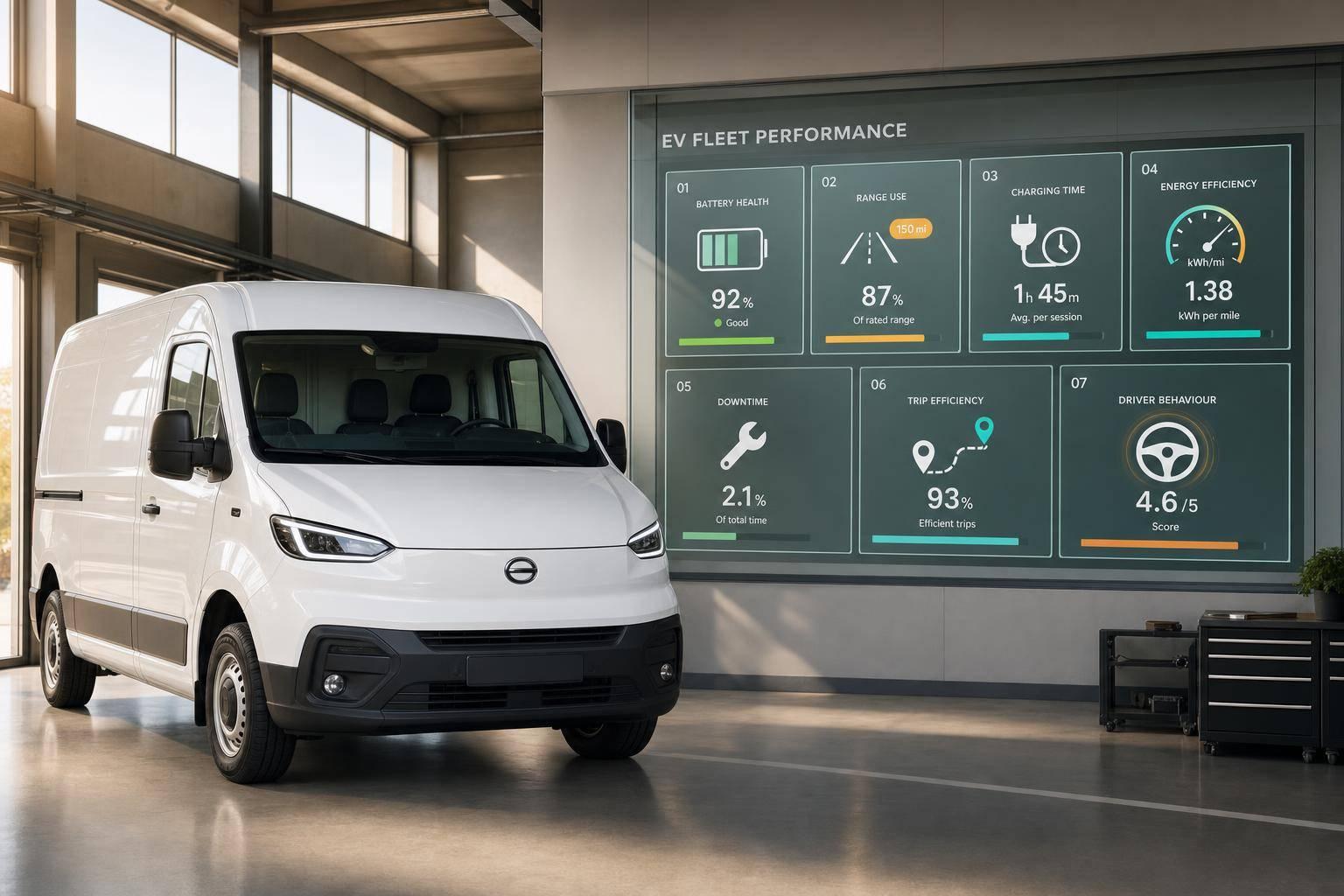
It also helps to monitor energy consumption in kWh per mile, charge event logs including time, location and cost, vehicle uptime, and route efficiency. Together, these figures support charging schedules and day-to-day operating capacity.
Do I need telematics, charging data, or battery reporting?
Yes. These tools matter for running an electric fleet, because EVs need closer attention to battery health and energy use than standard vehicle tracking can offer.
Telematics lets fleets monitor SoC and SoH in real time. Charging data shows how energy is being used, helps teams optimise off-peak charging, and tracks charger use. That can cut downtime and support better maintenance decisions.
How can EV fleet data improve AI-led decisions?
EV fleet data gives AI what it needs to move fleet operations from reactive to predictive. Instead of waiting for a problem to show up, managers can use live data like state of charge, battery health, and charging behaviour to make better day-to-day calls.
That can mean:
- matching vehicles to routes based on the range they have left
- scheduling charging outside peak electricity tariffs
- spotting battery degradation early, before it leads to downtime
It’s a simple shift, but an important one. With the right data coming in at the right time, fleet teams can act earlier and plan with more confidence.